
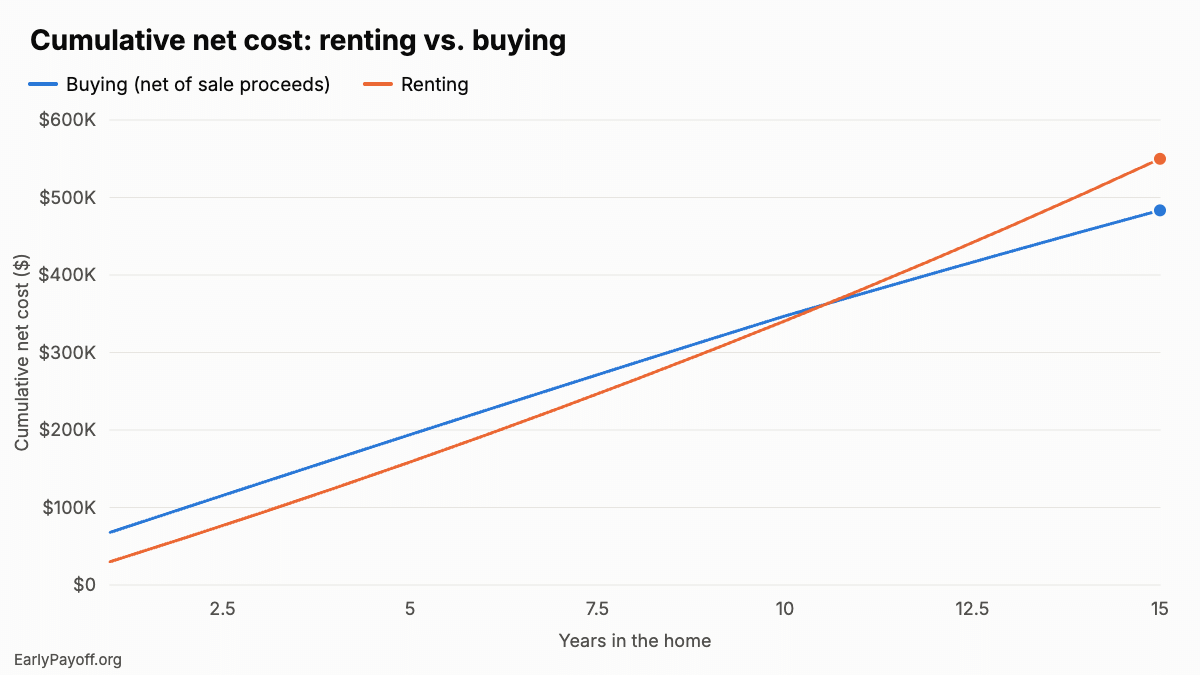
Buying beats renting only if you stay long enough for home-price growth and loan paydown to cover the large one-time costs of buying and selling, plus the earnings you give up on your down payment. With mortgage rates averaging 7.40% in mid-October 2026, that break-even point is often a decade or more away. In our example market, buying a $400,000 home instead of renting a similar one for $2,500 a month breaks even in year 11 at 3% annual appreciation, in year 7 at 4%, and not until year 15 at 2%.
Your numbers will differ, so this guide walks through every cost on both sides, shows the calculation, and tells you which inputs move the answer most.
Key takeaways
- How long you stay matters most. Buying and selling costs plus forgone earnings make buying expensive in the first years almost everywhere.
- In the example, owning costs about $3,675.90 in the first month versus $2,500 in rent, before any equity is counted.
- Appreciation is the swing factor: at 0% a year the buyer is still behind after 10 years by $119,184; at 4% the buyer is ahead by $38,741.
- Rents rose 2.8% in the 12 months ending September 2026, according to the BLS consumer price index, so renting costs climb too.
- Many buyers won’t get a tax benefit from mortgage interest because the 2026 standard deduction is large.
The full cost of buying
A fair comparison counts everything that leaves your pocket as an owner, then credits you with the equity you walk away with when you sell. The pieces:
- Down payment and its opportunity cost. The down payment is not spent, but it is tied up. Money that could earn interest elsewhere earns nothing while it sits in the house, so the forgone earnings are a real cost. The example uses the 3-month Treasury bill yield of 4.26% on October 16, 2026, from the Federal Reserve’s H.15 release, as a conservative stand-in.
- Closing costs. Lender fees, title insurance, appraisal, recording and prepaid items, often a few percent of the price. The example assumes 3%. See how to estimate and lower closing costs.
- Mortgage interest. In the early years most of each payment is interest. The principal part isn’t a cost, since it builds equity you get back when you sell.
- Private mortgage insurance. With less than 20% down on a conventional loan you will usually pay PMI until the balance falls to 78% of the original value, when federal law generally requires it to end. The example assumes 0.50% a year.
- Property tax. Rates vary widely by state and county, from well under 1% to more than 2% of value. The example assumes 1% of the home’s current value.
- Homeowners insurance. Premiums depend heavily on location and weather risk. The example assumes $2,400 a year, rising 3% a year.
- Maintenance and repairs. A common rule of thumb is to budget 1% to 4% of the home’s value each year, more for older homes. It is a planning shortcut, not a measured average. The example uses 1.5%. See how to budget for home maintenance.
- Selling costs. Agent commissions, transfer taxes and seller concessions. Commissions are negotiable. The example assumes 6% of the sale price.
On the plus side, the owner gets the sale price minus selling costs minus the remaining loan balance. Appreciation raises that number. The example’s base case assumes 3% a year, which is an assumption, not a forecast.
The full cost of renting
Renting is simpler: rent, renters insurance and occasional moving costs. The main question is how fast rent rises. The Bureau of Labor Statistics reported that the consumer price index for rent of primary residence rose 2.8% in the 12 months ending September 2026, and the broader shelter index rose 3.2%. The example uses 2.8% a year for rent growth. Your local market can run well above or below the national figure.
Renting also keeps your cash flexible. You aren’t on the hook for a new roof, and moving for a job costs a security deposit rather than a 6% selling cost.
Worked example: a $400,000 home vs. $2,500 rent
Inputs: a $400,000 home bought with 10% down ($40,000) and 3% closing costs ($12,000), for $52,000 of upfront cash. The $360,000 loan is a 30-year fixed at 7.40%, the Freddie Mac PMMS average for the week of October 15, 2026, with a principal-and-interest payment of $2,492.57. A comparable rental costs $2,500 a month. Every other input is an assumption listed above.
In the first month, the owner pays about $3,675.90: $2,492.57 principal and interest, $150 PMI, $333.33 property tax, $500 set aside for maintenance and $200 insurance. That is $1,175.90 more than the renter, though $272.57 of the mortgage payment is principal that builds equity.
The net cost of buying through any year equals the upfront cash, plus all owner costs, plus forgone earnings on the upfront cash, minus what you would net from selling at the end of that year. The net cost of renting is the rent paid.
| Year sold | Home value | Loan balance | Net from sale | Net cost of buying | Total rent paid | Buying minus renting |
|---|---|---|---|---|---|---|
| 1 | $412,000 | $356,616 | $30,664 | $67,867 | $30,000 | $37,867 |
| 3 | $437,091 | $349,051 | $61,815 | $131,221 | $92,544 | $38,677 |
| 5 | $463,710 | $340,283 | $95,605 | $193,962 | $158,639 | $35,323 |
| 7 | $491,950 | $330,120 | $132,312 | $255,947 | $228,487 | $27,460 |
| 10 | $537,567 | $311,769 | $193,543 | $347,130 | $340,765 | $6,365 |
Buying starts $37,867 behind after one year, mostly because of closing costs and the selling costs you would pay to get out. The gap barely moves for three years, then closes as rent rises, the loan balance shrinks faster and the home’s value compounds. In this base case buying finally pulls ahead in year 11.
The model is, if anything, generous to buying. It doesn’t assume the renter invests the roughly $1,176 a month they save in the early years; crediting the renter with those earnings would push break-even later. It also ignores income taxes on investment earnings.
Sensitivity: appreciation and how long you stay
Appreciation and time in the home move the answer more than anything else. The table holds every other input constant.
| Annual appreciation | Stay 3 years | Stay 5 years | Stay 10 years | Break-even year |
|---|---|---|---|---|
| 0% | Renting cheaper by $72,133 | Renting cheaper by $91,259 | Renting cheaper by $119,184 | Year 23 |
| 2% | Renting cheaper by $50,053 | Renting cheaper by $54,727 | Renting cheaper by $47,522 | Year 15 |
| 4% | Renting cheaper by $27,072 | Renting cheaper by $15,128 | Buying cheaper by $38,741 | Year 7 |
Rent level matters too. Holding appreciation at 3%, break-even moves to year 8 if the comparable rent is $2,800 a month, and to year 15 if it is $2,200. A simple first check is the price-to-rent ratio: divide the home price by a year of rent for a similar home. Here it is $400,000 divided by $30,000, or about 13. The higher that ratio, the longer buying takes to pay off.
What about the tax break?
Mortgage interest and property taxes are deductible only if you itemize. For 2026, the IRS standard deduction is $32,200 for married couples filing jointly and $16,100 for single filers. In the example, first-year mortgage interest is $26,526.75 and property tax is about $4,064.71, a total of $30,591.46. A married couple with no other large deductions would take the standard deduction and get no tax benefit from owning. A single filer, or a couple with a larger loan or other deductions, might. Run your own numbers before counting on a tax benefit.
How to run your own comparison
- Find two or three homes you would buy and two or three rentals you would accept that are truly comparable in size, location and condition.
- Get real figures for property tax (from the county assessor), insurance (quotes), HOA dues and a mortgage rate from a Loan Estimate.
- Estimate how long you will realistically stay. Job changes, family plans and school districts matter more than intentions.
- Use a conservative appreciation rate. Check how your local market has done over a full cycle, not just the past few years.
- Calculate net cost for each year you might sell, including selling costs. Compare it with total rent over the same period.
- Include what your upfront cash would earn if it stayed invested, and what you would do with any monthly savings from renting.
When buying is a bad idea
- You may move within five years. In the example, renting is cheaper at every appreciation rate tested for a five-year stay.
- The purchase would empty your savings. New owners face surprise repairs. Keep an emergency fund after closing.
- The payment only works with everything going right. If losing overtime or a raise falling through would strain the budget, wait.
- Local price-to-rent ratios are very high. When homes cost many years of rent, renting and investing the difference often wins.
- Your job or relationship situation is unsettled. Selling under pressure is when transaction costs hurt most.
Buying tends to make sense when you plan to stay a long time, rents near you are high relative to prices, and you have the down payment, closing costs and a cash cushion. Paying the loan down over time also brings housing costs down sharply later in life, a theme covered in should you pay off your mortgage early.
Frequently asked questions
Isn’t rent just throwing money away?
No more than mortgage interest, property tax, insurance and maintenance are. Both renters and owners pay for housing. The real question is which costs less over the time you will stay, after counting everything.
What appreciation rate should I assume?
Use a conservative figure and test a range, as the sensitivity table does. Home values can be flat or fall for years in some markets, so don’t plan on the strongest recent years repeating.
Does a lower mortgage rate change the answer?
Yes. A lower rate cuts interest, the largest owner cost in the early years, and brings break-even closer. If rates fall, rerun the numbers, and keep in mind that lower rates can also push prices up.
How much should I budget for maintenance?
A common rule of thumb is 1% to 4% of the home’s value a year, with older homes and harsher climates at the high end. Some years cost little and some bring a big repair, so set money aside every month.
Is it better to buy a cheaper home than to keep renting?
Sometimes. A smaller purchase lowers the costs that don’t build equity, but selling costs and forgone earnings still apply. Run the same comparison for the cheaper home and the rental you would actually choose.
Sources
- Freddie Mac, Primary Mortgage Market Survey (30-year fixed average, week of Oct 15, 2026), accessed Oct 2026
- Federal Reserve, H.15 Selected Interest Rates (3-month Treasury bill, Oct 16, 2026), accessed Oct 2026
- BLS, Consumer Price Index Summary, September 2026 (shelter 12-month change), accessed Oct 2026
- BLS, CPI Table 2, September 2026 (rent of primary residence 12-month change), accessed Oct 2026
- IRS, Tax inflation adjustments for tax year 2026 (standard deduction), accessed Oct 2026
- IRS, Publication 936, Home Mortgage Interest Deduction (itemizing requirement), accessed Oct 2026
- CFPB, When can I remove private mortgage insurance (PMI) from my loan?, accessed Oct 2026
Figures are as of October 2026. This article is general education, not individualized financial, tax or legal advice.