
Compare personal loans by APR, not by interest rate, and only for the same amount of cash in hand and the same term. An origination fee is usually taken out of your loan before you receive the money, so a loan with a fee and a lower rate can cost more or less than a no-fee loan at a higher rate. Which one wins depends mostly on how long you’ll keep the loan. The longer you keep it, the more the lower rate makes up for the upfront fee.
Key takeaways
- Under the Truth in Lending Act, loan fees count as part of the finance charge, so the APR includes them and the interest rate doesn’t (12 CFR 1026.4).
- To end up with $10,000 after a 5% fee, you need to borrow $10,526.32, not $10,000.
- In the example below, a 5%-fee loan at 10.99% costs $137.75 more than a no-fee loan at 14.99% over 24 months, but $541.89 less over 60 months.
- The fee is spent on day one. If you pay the loan off early, the fee loan loses its edge. In the 36-month example it costs less only if you keep the loan through month 25.
How origination fees work
An origination fee is a one-time charge for making the loan. It is usually a percentage of the loan amount. Most personal lenders that charge one deduct it from the proceeds: you are approved for $10,000, the fee comes off the top, and a smaller amount reaches your bank account. You still repay the full $10,000 plus interest. Some lenders instead add the fee to the balance, which has the same effect on cost.
Fee levels vary widely by lender and by your credit profile, and some lenders charge none. Some states cap the fees that licensed consumer lenders can charge, so the same lender’s terms may differ across state lines. Ask whether there is a fee, how it is calculated, and whether it comes out of the proceeds or is added to the balance.
APR vs. interest rate
The interest rate sets your payment. The APR measures the full cost of the credit as a yearly rate. Regulation Z, which implements the Truth in Lending Act, defines the finance charge to include interest and also “points, loan fees” and similar charges (12 CFR 1026.4(b)). Because the APR is built from the finance charge and the amount financed, an origination fee pushes the APR above the interest rate. The CFPB’s advice is to compare APR to APR, never one loan’s APR to another’s interest rate (CFPB, as of Oct 2026).
Before you sign a fixed-term personal loan, the lender must give you a Truth in Lending disclosure showing the amount financed, finance charge, APR, payment schedule and total of payments. It must also say whether you would owe a penalty for paying early (12 CFR 1026.18). Those boxes are what you compare. One caution: a disclosed APR assumes you keep the loan for the full term. If you pay off early, your real cost rate on a fee loan is higher than the APR shown.
Step 1: Gross up the loan so you net what you need
If you need exactly $10,000 to pay a contractor or clear a set of card balances, a $10,000 loan with a 5% deducted fee leaves you $500 short. To fix that, divide the cash you need by one minus the fee rate:
Loan amount = cash needed ÷ (1 − fee rate) = $10,000 ÷ 0.95 = $10,526.32
The fee is then $526.32, and $10,000 reaches your account. Note that the fee is charged on the larger amount, so it is more than 5% of the cash you actually get. This step is what makes a fair comparison possible: a no-fee loan of $10,000 and a fee loan of $10,526.32 both put the same cash in your hands, so their costs can be compared directly.
Step 2: Compare total cost across terms
Take two offers for $10,000 in hand. Loan A has no fee and a 14.99% rate. Loan B has a 5% fee and a 10.99% rate. Both rates are illustrative and sit on either side of the Federal Reserve’s 2026 Q2 average for 24-month personal loans at commercial banks, 11.86% (G.19, as of Oct 2026). “Total cost” is everything you pay beyond the $10,000 you received, meaning interest plus the fee.
| Term | Loan A payment (no fee, 14.99%) | Loan A APR | Loan A total cost | Loan B payment (5% fee, 10.99%) | Loan B APR | Loan B total cost | Cheaper |
|---|---|---|---|---|---|---|---|
| 24 months | $484.82 | 14.99% | $1,635.66 | $490.56 | 16.19% | $1,773.41 | A by $137.75 |
| 36 months | $346.60 | 14.99% | $2,477.78 | $344.57 | 14.57% | $2,404.48 | B by $73.30 |
| 60 months | $237.85 | 14.99% | $4,270.73 | $228.82 | 13.25% | $3,728.84 | B by $541.89 |
Notice how Loan B’s APR falls as the term lengthens: 16.19% at 24 months, 14.57% at 36 and 13.25% at 60. The fee is fixed, so spreading it over more years shrinks its yearly weight. Loan A has no fee, so its APR equals its rate at every term. The APR ranking flips at the same point the dollar ranking does, which is why APR is the right yardstick when the term and the cash in hand are the same.
The monthly payments barely differ, by $5.74 at 24 months and $9.03 at 60 months. Choosing by payment alone would tell you almost nothing about which loan is cheaper.
Step 3: Ask how long you’ll really keep the loan
Many borrowers pay personal loans off early, especially when they’re using one to consolidate debt and attacking it aggressively. The origination fee is never refunded when you prepay, so early payoff favors the no-fee loan. The chart tracks how much each 36-month loan has cost you by each month, counting interest paid plus, for Loan B, the fee.
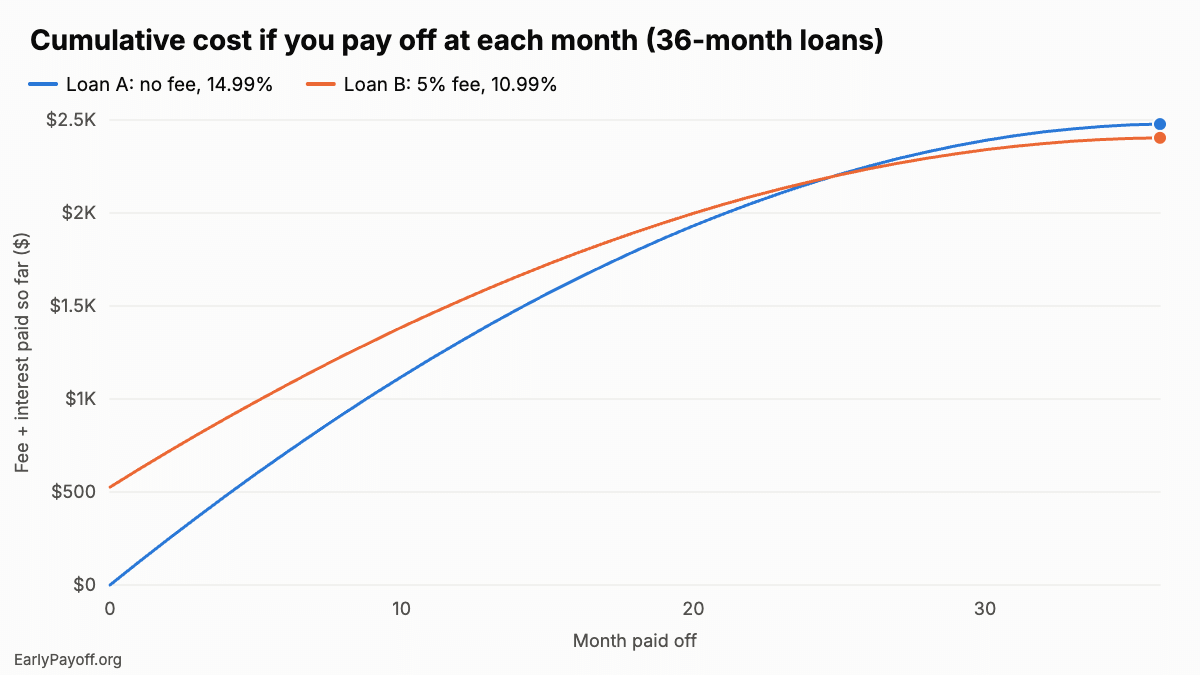
Loan B starts $526 behind because of the fee and closes the gap slowly through its lower rate. Paid off at month 12, Loan A has cost $1,308.39 and Loan B $1,528.49. At month 24 they are nearly even, $2,158.86 vs. $2,168.50. Loan B pulls ahead only if you keep it through month 25 or later. So if you expect to clear the debt in about two years, the no-fee loan is the safer pick even though its APR is higher on paper.
A checklist for comparing real offers
Prequalification quotes often show a rate range and a fee range rather than firm numbers. Once you have firm offers, line them up the same way:
- Match the cash in hand. Gross up each fee loan to the same net amount. If a lender caps the loan amount, check that the grossed-up figure fits under the cap.
- Match the term. A 60-month quote and a 36-month quote aren’t comparable on APR alone. Ask each lender for the same term.
- Confirm how the fee is collected. Deducted from proceeds and added to the balance both raise your cost, but only the first leaves you short of cash.
- Compare at your realistic payoff date. If you expect to finish early, add up the fee plus the interest through that month for each offer, as in the chart, instead of relying on the full-term APR.
Skipping the gross-up doesn’t change the APR, which is still 14.57% for the 36-month Loan B. But you’d receive only $9,500, and covering the gap with a credit card would add interest that never shows up on the loan disclosure. If your credit limits you to high-fee offers, see how to get a personal loan with bad credit for lower-cost alternatives such as credit union loans.
When a fee loan is a bad idea
- You plan to pay it off early. A bonus, tax refund or home sale on the horizon makes the fee a poor bet.
- The rate gap is small. A fee of several percent needs a sizable rate discount and a long holding period to pay off. Run the numbers for your actual offers.
- You would stretch the term just to make the fee “worth it.” In the example, the 60-month fee loan still costs $1,324.36 more than the 36-month fee loan. A longer term only spreads the fee thinner. It doesn’t make the borrowing cheaper.
- You didn’t gross up. Coming up short on cash can push you onto a credit card for the gap, which wipes out the savings.
Watch for prepayment penalties too. The required disclosure says whether one applies. And if a “lender” asks you to pay a fee before the loan is funded instead of deducting it, stop. That is a hallmark of an advance-fee loan scam.
FAQ
Is an origination fee included in the APR?
Yes. Regulation Z counts loan fees as part of the finance charge, and the APR is calculated from the finance charge. That is why a loan with a fee shows an APR higher than its interest rate.
Can I negotiate the origination fee?
Sometimes. Lenders that price by credit tier may have little room, but credit unions and banks where you already have accounts may waive or reduce it. Asking costs nothing, and a competing no-fee offer gives you leverage.
Do I get any of the fee back if I pay the loan off early?
Generally no. The fee is earned when the loan is made. Your loan disclosure states whether you’d be entitled to any rebate or owe any penalty on early payoff, so check it before you sign.
Is a lower APR always the better loan?
Only for the same amount in hand and the same term, held to the end. A longer loan can show a lower APR yet cost far more in total dollars. A fee loan’s APR also understates its cost if you pay it off early.
Sources
- eCFR, 12 CFR 1026.4, Finance charge (Regulation Z), accessed Oct 2026
- eCFR, 12 CFR 1026.18, Content of disclosures (closed-end credit), accessed Oct 2026
- CFPB, Regulation Z Appendix J to Part 1026, Annual Percentage Rate Computations for Closed-End Credit Transactions, accessed Oct 2026
- CFPB, What is APR?, accessed Oct 2026
- Federal Reserve, Consumer Credit – G.19 (Oct 7, 2026), accessed Oct 2026
This article is general education, not individualized financial, tax or legal advice.