

To apply for income-driven repayment, submit the free online application at studentaid.gov, choose a plan and consent to have your tax information pulled from the IRS. Your servicer then sets a payment based on your income, and you recertify every year. As of October 2026, the plans open to most borrowers are the new Repayment Assistance Plan (RAP) and Income-Based Repayment (IBR). SAVE is gone, and PAYE and ICR are closing by July 1, 2028.
Key takeaways
- RAP charges 1% to 10% of your adjusted gross income, minus $50 a month per dependent, with a $10 minimum. Forgiveness comes after 30 years.
- IBR charges 10% or 15% of income above 150% of the poverty guideline, is capped at the 10-year standard payment, and forgives after 20 or 25 years. It’s open only to loans made before July 1, 2026.
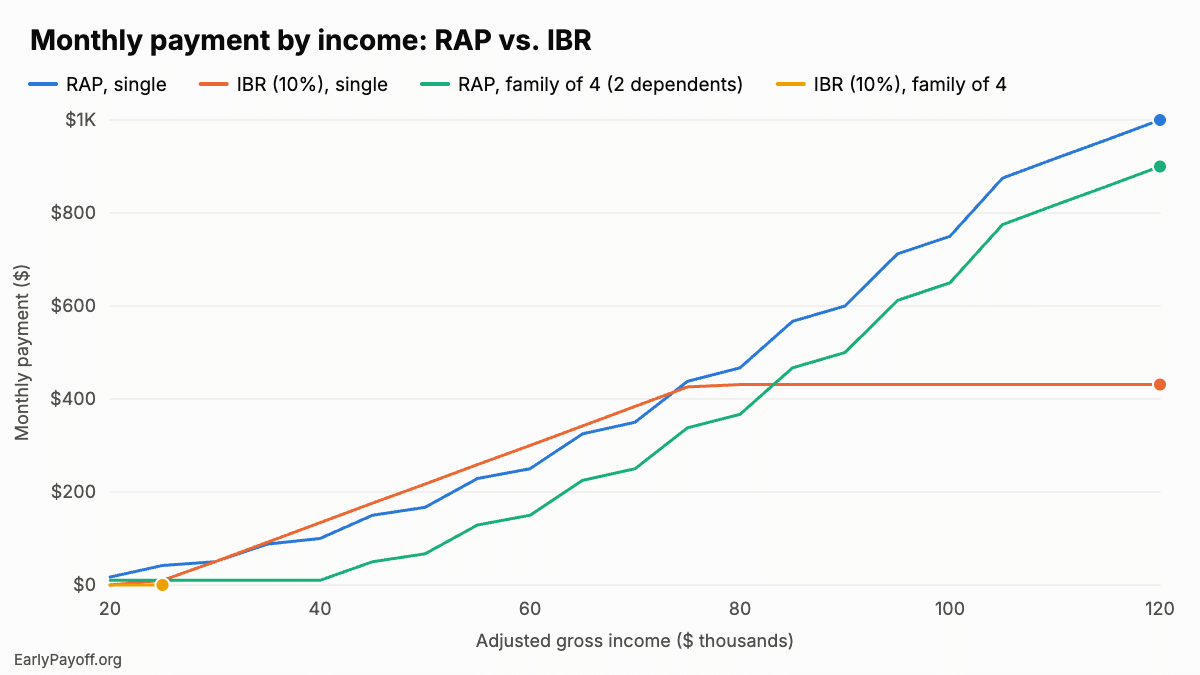
- For a single borrower earning $55,000, RAP comes to $229.17 a month and IBR to $258.83. For a married couple with two children earning $80,000, RAP is $112.50 a month higher than IBR.
- Any new Direct Loan disbursed on or after July 1, 2026, including a consolidation loan, limits all your loans to RAP or the Tiered Standard plan.
- Balances forgiven under income-driven plans on or after January 1, 2026, are generally taxable federal income again. PSLF discharges are not.
Which plans are available as of October 2026
The 2025 budget reconciliation law (Public Law 119-21, often called the One Big Beautiful Bill Act) rebuilt federal repayment. The Education Department’s final rule took effect July 1, 2026. Which plans you can use depends on when your loans were disbursed.
| Plan | Who can use it | Monthly payment | Payment cap | Forgiveness after |
|---|---|---|---|---|
| Repayment Assistance Plan (RAP) | Any Direct Loan borrower, except for parent PLUS loans and consolidation loans that include them | 1%–10% of AGI ÷ 12, minus $50 per dependent; $10 minimum | None | 30 years (360 qualifying payments) |
| Income-Based Repayment (IBR) | Loans made before July 1, 2026, if you have no Direct Loan disbursed on or after that date | 10% of discretionary income (first borrowed on or after July 1, 2014) or 15% (earlier borrowers) | 10-year standard payment | 20 or 25 years |
| Pay As You Earn (PAYE) | Limited to eligible borrowers with only pre-July 2026 loans; ends no later than July 1, 2028 | 10% of discretionary income | 10-year standard payment | 20 years |
| Income-Contingent Repayment (ICR) | Pre-July 2026 loans, including consolidated parent PLUS loans disbursed before that date; ends no later than July 1, 2028 | 20% of income above 100% of the poverty guideline, or a 12-year formula, whichever is less | None | 25 years |
| SAVE | Closed. A court order on March 10, 2026, barred the Department from carrying out the plan | — | — | — |
If you were in SAVE: Borrowers whose loans sit in forbearance because they enrolled in or applied for SAVE must pick a new plan. If you don’t, your servicer will move you to one. The Department said servicers would start sending notices on July 1, 2026, with a 90-day deadline that each servicer sets (U.S. Department of Education, as of October 2026). Apply now rather than waiting for the default plan.
If you’re in PAYE or ICR: You must choose another plan before July 1, 2028. Under the final rule, borrowers who don’t choose are moved to RAP, or to IBR for loans that can’t go into RAP.
If you borrow again: A new Direct Loan disbursed on or after July 1, 2026, including a consolidation loan, means all your loans must be repaid under RAP or the Tiered Standard plan once the new loan enters repayment. You lose IBR, PAYE and ICR even for older loans (Federal Student Aid, as of October 2026).
How the payment formulas work
RAP applies a single percentage to your entire adjusted gross income (AGI). The percentage is 1% if AGI is over $10,000 and up to $20,000, 2% if it’s over $20,000 and up to $30,000, and one point more for each additional $10,000 band, reaching 10% above $100,000. AGI of $10,000 or less means $120 a year. Divide by 12, then subtract $50 for each dependent you claim on your tax return. The payment never drops below $10. Married borrowers filing separately are judged on their own income.
RAP also limits balance growth. If you pay on time and your payment doesn’t cover the month’s interest, the unpaid interest is waived. If your payment reduces principal by less than $50, the Department adds a match of up to $50 (U.S. Department of Education, as of October 2026).
IBR starts with discretionary income: AGI minus 150% of the federal poverty guideline for your family size. For 2026, the guideline for the 48 contiguous states and DC is $15,960 for one person and $33,000 for a family of four (HHS, as of October 2026). Your payment is 10% of discretionary income, divided by 12, if you first borrowed on or after July 1, 2014, or 15% if you borrowed earlier. IBR never charges more than the 10-year standard payment. Since December 22, 2025, you no longer need a partial financial hardship to enroll.
Worked example: payments for one borrower
Take a borrower who owes $38,000 in Direct Loans at a 6.50% average rate. All the loans were disbursed after July 1, 2014, and before July 1, 2026, so both RAP and IBR (at 10%) are open. The 10-year standard payment would be $431.48. A borrower whose loans were all made after July 1, 2026, would instead get the Tiered Standard plan: 15 years at $331.02 for this balance.
| Household | RAP rate | RAP payment | IBR (10%) | IBR (15%, pre-2014 borrower) | 10-year standard |
|---|---|---|---|---|---|
| Single, AGI $35,000 | 3% | $87.50 | $92.17 | $138.25 | $431.48 |
| Single, AGI $55,000 | 5% | $229.17 | $258.83 | $388.25 | $431.48 |
| Married filing jointly, 2 children, AGI $80,000 | 7% | $366.67 | $254.17 | $381.25 | $431.48 |
| Single, AGI $110,000 | 10% | $916.67 | $431.48 | $431.48 | $431.48 |
For the single borrower at $55,000, RAP costs $2,750.04 a year and IBR costs $3,105.96, a difference of $355.92. In the first month, the RAP payment covers the $205.83 of interest and puts $23.34 toward principal. The Department’s match adds $26.66, so the balance falls by $50.00.
At $35,000, the $87.50 RAP payment doesn’t cover the interest. The $118.33 shortfall is waived, and the $50.00 match still reduces the balance. Under IBR, unpaid interest on unsubsidized loans keeps building.
The family row shows why you should run both formulas. IBR’s poverty-line deduction grows with family size, while RAP gives only $50 a month per dependent. That leaves RAP $112.50 a month higher for this family. At high incomes, RAP has no cap, so the $110,000 earner would pay $916.67 under RAP but only $431.48 under IBR.
How to apply, step by step
- Find your loans and servicer. Sign in at studentaid.gov to see each loan’s type and disbursement date. Those details decide which plans you can use.
- Estimate payments. Use the Repayment Calculator on studentaid.gov, or work through the formulas above.
- Complete the online IDR application. Most people finish in about 10 minutes. Consent to let the Department get your federal tax information from the IRS. That skips document uploads and turns on automatic recertification. If your income has dropped since your last tax return, you can submit alternative documentation, such as pay stubs.
- Handle older loan types. FFEL borrowers must upload income documents and can’t use automatic recertification. Consolidating into a Direct Consolidation Loan opens RAP but, if done now, also ends access to IBR, PAYE and ICR.
- Keep paying until the new amount starts. Your servicer may put loans in a processing forbearance. Check whether that time counts toward forgiveness for your plan.
- Set up autopay. RAP counts only on-time, full payments toward forgiveness and PSLF. Through June 30, 2028, borrowers with Direct Loans first disbursed after July 1, 2012, get a 1% autopay rate reduction instead of 0.25% if they’re enrolled by December 31, 2026 (U.S. Department of Education, as of October 2026).
Recertify every year
You must update your income and family size each year, even if nothing changed. If you gave IRS consent, the Department does this automatically and notifies you. Miss the deadline on RAP, and your payment becomes the 10-year standard amount based on what you owed when the loan entered repayment. Miss it on IBR, and unpaid interest is added to your balance and your payment jumps to the standard amount. You can recertify early whenever your income falls.
Forgiveness timelines and taxes
Remaining balances are forgiven after 20 years on IBR for borrowers who first borrowed on or after July 1, 2014, or 25 years for earlier borrowers. PAYE forgives after 20 years, ICR after 25 and RAP after 30. Progress made while on RAP doesn’t count toward IBR, ICR or PAYE forgiveness if you switch back, but it does count toward PSLF.
The tax break for forgiven student debt expired. The American Rescue Plan Act excluded discharges from 2021 through 2025. For income-driven forgiveness on or after January 1, 2026, the forgiven amount is generally taxable federal income, and some states tax it too. Federal Student Aid says borrowers who reached their forgiveness milestone before January 1, 2026, aren’t taxed even if the discharge was processed later. PSLF, Teacher Loan Forgiveness and discharges for death or total and permanent disability remain tax-free. If you’re insolvent when the debt is forgiven, you may be able to exclude some or all of it on IRS Form 982 (Taxpayer Advocate Service, March 2026).
When income-driven repayment is not the best choice
- Your income is high compared with your debt. RAP has no cap, and both plans can stretch repayment for decades. If you can afford the standard payment, you’ll usually pay less interest overall.
- You’d be relying on forgiveness decades away. A large forgiven balance could bring a large tax bill unless the law changes. Set money aside if forgiveness is your plan.
- You’re married with a working spouse. Filing jointly adds your spouse’s income. Filing separately can lower the payment but may cost more in taxes, so compare both.
- You’re about to take a new loan. A new disbursement can lock you out of IBR. Run the numbers first.
A lower payment frees cash for other goals. To decide where that cash goes, see how to budget while paying student loans. If you’re applying for a mortgage, lenders count your student loan payment. See how to buy a home with student debt.
Frequently asked questions
Can I switch between RAP and IBR?
If all your loans were made before July 1, 2026, you can generally switch between the plans you’re eligible for at any time. Time spent on RAP won’t count toward IBR forgiveness if you move back, though it still counts for PSLF.
Can my payment really be $0?
Under IBR, yes: if your income is at or below 150% of the poverty guideline for your family size, your payment is $0. Under RAP, the minimum is $10 a month.
Do parent PLUS loans qualify?
Not for RAP. Parent PLUS loans consolidated into a Direct Consolidation Loan disbursed before July 1, 2026, can use ICR, and then IBR after one ICR payment. Newer parent PLUS loans are limited to the Tiered Standard plan. See parent PLUS loans.
Should I refinance instead?
Refinancing federal loans with a private lender permanently ends access to RAP, IBR and PSLF. It can make sense only for borrowers with high, stable income who will repay in full. See how to refinance student loans.
Sources
- Federal Student Aid, Income-Driven Repayment Plans, accessed Oct 2026
- Federal Student Aid, IDR Plan Court Actions: Impact on Borrowers (updated Sept. 29, 2026), accessed Oct 2026
- Federal Student Aid, One Big Beautiful Bill Act Updates (updated Aug. 24, 2026), accessed Oct 2026
- U.S. Department of Education, Federal Student Loan Program Final Regulations, 91 FR 23768 (May 1, 2026), accessed Oct 2026
- U.S. Department of Education, Fact Sheet: Simplifying Student Loan Repayment, accessed Oct 2026
- U.S. Department of Education, Next Steps for Borrowers Enrolled in the SAVE Plan (March 2026), accessed Oct 2026
- U.S. Department of Education, Extends Enrollment Period for Student Loan Interest Rate Reduction (Sept. 29, 2026), accessed Oct 2026
- HHS ASPE, Poverty Guidelines (2026), accessed Oct 2026
- Taxpayer Advocate Service (IRS), What to Know About Student Loan Forgiveness and Your Taxes (March 2026), accessed Oct 2026
This article is general education, not individualized financial, tax or legal advice.