

To refinance student loans, you take out a new private loan at a lower rate and use it to pay off your existing loans, then repay the new lender. It can save real money on private loans you already have. Refinancing federal loans is different: the new loan is private, so you permanently give up income-driven repayment, Public Service Loan Forgiveness, federal deferment and forbearance, and federal discharge protections.
Key takeaways
- Refinancing private loans is mostly a math question. In the example below, cutting $42,000 of private debt from 10.50% to 7.50% over the same eight years saves $6,274.34.
- Refinancing federal loans is a one-way trade. A private lender pays off the federal loan, and the federal protections end with it.
- A lower rate with an origination fee only wins if you keep the loan long enough. In the example, an $840 fee took 67 months to earn back against a no-fee offer.
- A longer term lowers the payment but can cost more than the loan you started with. Stretching the same refinance to 15 years cost $7,827.23 more than keeping the old loan.
- A variable rate looks cheapest on day one. If rates rise, it can end up costing more than a fixed offer.
Federal or private: sort your loans first
Before you get a single quote, list every loan you owe and mark it federal or private. Your federal loans appear in your account at studentaid.gov. Anything that isn’t listed there, such as a loan from a bank or credit union, is private. The two groups call for different decisions.
Private loans. These already lack federal protections, so refinancing them changes the price and the lender’s policies, not your legal status. The question is simply whether the new rate, fees and terms beat what you have.
Federal loans. Federal rates are fixed for the life of each loan and set by law each year. For loans first disbursed from July 1, 2026, through June 30, 2027, the rates are 6.52% for undergraduates, 8.07% for graduate and professional unsubsidized loans, and 9.07% for PLUS loans (Federal Student Aid, as of October 2026). A private offer a point or two lower can look tempting. What you give up is in the table below.
If you only want to combine federal loans into one payment, a federal Direct Consolidation Loan does that and keeps the loans federal. It doesn’t lower your rate: the new rate is the weighted average of the old rates, rounded up to the nearest one-eighth of a percent (Federal Student Aid, as of October 2026). Consolidating now also has a catch. Any new Direct Loan made on or after July 1, 2026, including a consolidation loan, limits you to the Repayment Assistance Plan (RAP) and the Tiered Standard plan. For a consolidation loan that repays a parent PLUS loan, the only option is Tiered Standard.
What you give up when federal loans become private
The 2025 budget reconciliation law (Public Law 119-21, often called the One Big Beautiful Bill Act) reshaped federal repayment starting July 1, 2026, but the core protections remain. A private refinance loan has none of them by law. Some lenders offer their own versions, and the loan contract sets the terms.
| Feature | Federal Direct Loans (as of October 2026) | Private refinance loan |
|---|---|---|
| Income-driven payments | RAP: 1% to 10% of adjusted gross income, minus $50 a month per dependent. Income-Based Repayment (IBR) for loans made before July 1, 2026 | None. The payment is fixed by the contract |
| Forgiveness after long repayment | After 20 or 25 years (IBR) or 30 years (RAP) | None |
| Public Service Loan Forgiveness | Available after 120 qualifying payments on a qualifying plan (RAP counts; Tiered Standard does not) | Not eligible |
| Unpaid interest relief | RAP waives unpaid monthly interest after an on-time payment and adds a principal match of up to $50 | Interest accrues as the contract says |
| Unemployment and economic hardship deferment | Up to three years each for loans disbursed before July 1, 2027; not available on loans disbursed after that date | Lender policy, if offered at all |
| Forbearance | Up to one year at a time; capped at nine months in any 24 months for loans disbursed on or after July 1, 2027 | Lender policy; terms vary |
| Death and disability discharge | Discharged, and the discharge is not federally taxable | Varies by lender. For loans made since November 20, 2018, a cosigner must be released if the student borrower dies |
| Autopay discount | Temporarily 1% (instead of 0.25%) through June 30, 2028, on Direct Loans first disbursed after July 1, 2012, if you enroll by Dec. 31, 2026 | Lender policy; some lenders offer a small discount |
The trade is permanent. A private lender can’t turn a loan back into a federal one, and only federal loans can go into a Direct Consolidation Loan. If you lose your job, take a lower-paid public-service role or become seriously ill five years from now, the federal options won’t be there.
Worked example: refinancing $42,000 of private loans
Say you owe $42,000 in private student loans at 10.50% fixed with eight years (96 payments) left. Your payment is $648.48, and if you change nothing you’ll pay $20,254.19 more in interest. You get four quotes. All lender rates and fees here are illustrative, since no federal agency publishes average private refinance rates.
- Offer A: 7.50% fixed, no fee, 8 years.
- Offer B: 6.90% fixed with a 2% origination fee ($840), 8 years.
- Offer C: variable, starting at 6.40%, 8 years. To test it, the rate is assumed to rise 0.75 point at the start of each of years two through five, ending at 9.40%.
- Offer A stretched: the same 7.50% rate over 15 years.
| Option | Monthly payment | Total interest (and fee) | Total paid | Compared with keeping the current loan |
|---|---|---|---|---|
| Keep current loan (10.50%, 8 yrs) | $648.48 | $20,254.19 | $62,254.19 | — |
| Offer A (7.50% fixed, no fee) | $583.12 | $13,979.85 | $55,979.85 | Saves $6,274.34 |
| Offer B, fee added to balance | $581.94 | $13,026.11 + $840 fee | $55,866.11 | Saves $6,388.08 |
| Offer B, fee paid in cash | $570.53 | includes $840 fee | $55,610.68 | Saves $6,643.51 |
| Offer C (variable, rising) | $560.16 rising to $605.19 | $14,851.63 | $56,851.63 | Saves $5,402.56 |
| Offer A stretched to 15 years | $389.35 | $28,081.42 | $70,081.42 | Costs $7,827.23 more |
The fee break-even
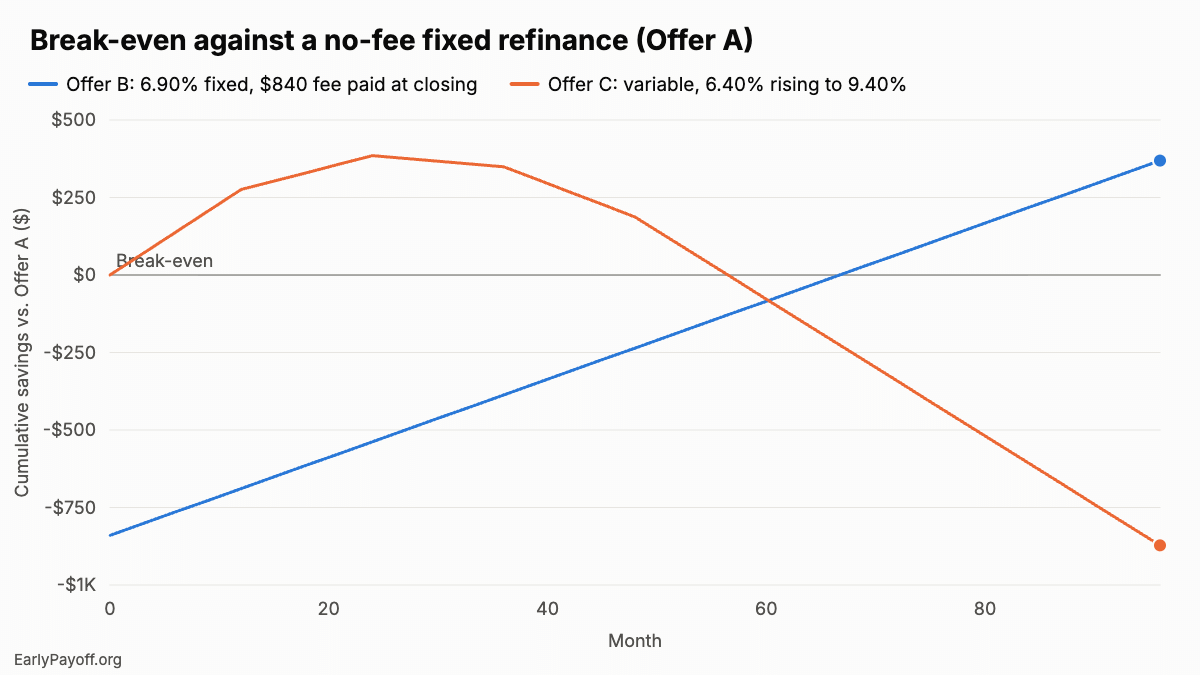
Offer B has the lowest rate, but it charges $840 up front. If you pay the fee in cash, its payment is $12.59 a month lower than Offer A’s. It takes 67 months of those smaller payments to earn back the $840. If you keep the loan all eight years, Offer B comes out $369.17 ahead. If you plan to pay the loan off in five years, or you might refinance again, Offer A is the better deal. Rolling the fee into the balance shrinks Offer B’s edge over Offer A to $113.74, because you pay interest on the fee too.
Against the loan you have now, the fee pays for itself fast. Offer B with the fee paid in cash recovers the $840 in month 11, because it cuts the payment by much more than Offer A does.
Variable vs. fixed
Offer C starts with the smallest payment, $560.16. Under the rising-rate path, its lead over Offer A peaks at $385.32. That lead is gone by month 57, and over the full term Offer C costs $871.78 more than Offer A. If rates instead stayed flat or fell, the variable loan would win. You are betting on the direction of rates for up to eight years. Read the contract for the index the rate follows, how often it can change, and whether there is a cap. Federal rules require private lenders to disclose whether the rate is fixed or variable and any limits on increases (CFPB, Regulation Z, as of October 2026).
The term trap
Stretching Offer A to 15 years cuts the payment by $259.13 a month. You pay $28,081.42 in interest, $14,101.57 more than the same rate over eight years, and $7,827.23 more than keeping your 10.50% loan. A longer term is reasonable when you need the cash flow, but it’s a payment fix, not a savings move. If you take one, check that the loan has no prepayment penalty and make extra payments whenever you can.
How to refinance, step by step
- Pull your payoff details. For each loan, note the balance, rate, remaining term and whether it’s federal or private.
- Check your credit first. Refinance pricing depends heavily on credit and income. You can get free reports and fix errors before you apply. A cosigner can help you qualify, but the cosigner is fully responsible for the debt.
- Prequalify with several lenders. Many show estimated rates after a soft credit check, which doesn’t affect your score. Compare the APR, which includes fees, not just the interest rate.
- Compare equal terms. Line up offers with the same number of years, as in the example. Then decide separately whether you want a longer term.
- Read the protections. Ask about forbearance length, death and disability discharge, cosigner release and prepayment penalties.
- Keep paying until the old loan shows paid in full. Payoff can take a few weeks. A missed payment on the old loan in the meantime still counts against you.
Interest on a refinanced loan can still qualify for the student loan interest deduction, up to $2,500 a year, if the new loan was used only to refinance qualified student loans. If you borrow more than the old balance and use the extra for anything other than education costs, none of the interest is deductible (IRS Publication 970, as of October 2026).
When refinancing is a bad idea
- You work, or might work, in public service. PSLF can discharge the remaining balance after 120 qualifying payments, and the discharge is tax-free. A private loan is never eligible.
- Your income is uncertain or low compared with your debt. Under RAP, a payment can be as low as $10 a month. A private lender expects the full contract payment. See how income-driven repayment works before you decide.
- The rate cut is small. Moving a 6.52% federal undergraduate loan to a 6% private loan saves little and gives up all the protections above.
- You are counting on forgiveness. If you are years into IBR or RAP, refinancing throws away that progress.
- Your budget is already tight. Fix the cash-flow problem first. A refinance that only works with a longer term usually costs more in total.
Refinancing makes the most sense for private loans at high rates, or for federal loans held by a borrower with a high, stable income who is sure to repay in full and won’t need the federal safety net. Even then, many people refinance only their highest-rate loans and keep the rest federal. For help deciding which balance to attack first, see which debt to pay off first.
Frequently asked questions
Can I refinance only some of my loans?
Yes. You choose which loans the new lender pays off. A common approach is to refinance high-rate private loans and keep federal loans federal so you keep income-driven repayment and forgiveness options.
Does refinancing hurt my credit?
A full application usually triggers a hard inquiry, which can lower a score slightly for a while. Prequalification with a soft check doesn’t. Opening the new loan and closing the old ones also changes the age and mix of your accounts. On-time payments matter far more over time.
Can I refinance again later?
Yes, a private loan can usually be refinanced again if you qualify for a better rate. That’s one reason to weigh origination fees carefully: a fee only pays off if you keep the loan long enough.
Should I refinance parent PLUS loans?
Parent PLUS loans first disbursed from July 2026 carry a 9.07% fixed rate and, as of October 2026, can be repaid only under the Tiered Standard plan. Because those loans already have few income-based options, a lower private rate may be worth more to a parent with strong credit. Compare offers carefully, and see how parent PLUS loans work.
What happens to my cosigner when I refinance?
If you qualify alone, the refinance pays off the old loan and the cosigner is no longer on it. That can be a faster way to free a parent from a loan than waiting for cosigner release. The CFPB found that most borrowers who applied for cosigner release were turned down.
Sources
- Federal Student Aid, Interest Rates for Federal Direct Loans First Disbursed Between July 1, 2026, and June 30, 2027 (GENERAL-26-33), accessed Oct 2026
- Federal Student Aid, One Big Beautiful Bill Act Updates, accessed Oct 2026
- Federal Student Aid, Student Loan Consolidation, accessed Oct 2026
- Federal Student Aid, Income-Driven Repayment Plans, accessed Oct 2026
- U.S. Department of Education, Reimagining and Improving Student Education: Federal Student Loan Program Final Regulations, 91 FR 23768 (May 1, 2026), accessed Oct 2026
- U.S. Department of Education, Fact Sheet: Simplifying Student Loan Repayment, accessed Oct 2026
- U.S. Department of Education, Extends Enrollment Period for Student Loan Interest Rate Reduction (Sept. 29, 2026), accessed Oct 2026
- CFPB, Should I refinance my student loan?, accessed Oct 2026
- CFPB, Finds 90 Percent of Private Student Loan Borrowers Who Applied for Co-Signer Release Were Rejected (2015), accessed Oct 2026
- CFPB, Regulation Z § 1026.47, Content of disclosures (private education loans), accessed Oct 2026
- 15 U.S.C. 1650(g), Private education loan cosigner protections, accessed Oct 2026
- Taxpayer Advocate Service (IRS), What to Know About Student Loan Forgiveness and Your Taxes (March 2026), accessed Oct 2026
- IRS, Publication 970, Tax Benefits for Education, accessed Oct 2026
This article is general education, not individualized financial, tax or legal advice.