

To read a life insurance policy, start with the schedule (declarations) page to confirm who is insured, who owns the policy, the death benefit, the premium and any riders. Then read the insuring agreement, the definitions, the beneficiary section and the exclusions, and finish with the rules that can end your coverage: the grace period, lapse and reinstatement. If the policy builds cash value, read the nonforfeiture options and compare the guaranteed columns of the illustration with the non-guaranteed ones, because only the guaranteed figures are promises.
Key takeaways
- Check the schedule page first. A misspelled name, wrong birth date or missing rider is easiest to fix during the free-look period, which is at least 10 days in many states.
- Most states let an insurer contest a policy for misstatements during the first two years, and allow a suicide exclusion for up to two years. Some states set shorter limits.
- Missing a premium does not end coverage immediately. Policies carry a grace period, commonly 31 days, and many allow reinstatement for several years after a lapse.
- Illustrations must label guaranteed and non-guaranteed values separately. In our hypothetical example, the guaranteed column runs out of money at age 67 while the illustrated column is still growing.
- Re-read the beneficiary designation after marriage, divorce, a birth or a death. The designation, not your will, usually decides who gets paid.
Before you start: gather the right documents
A life insurance policy is a contract, and the contract is usually more than one document. You should have the policy itself, a copy of your signed application (often attached to the policy and legally part of it), any riders or endorsements, and, for cash value policies, the illustration you signed when you bought it. If you cannot find the application, ask the insurer for a copy; it is what the insurer checks if it ever reviews a claim.
The NAIC’s Life Insurance Buyer’s Guide, which many states require insurers to give buyers, tells you to read the policy carefully and ask about anything that is not clear. If you are still deciding between policy types, our guide on how to choose a life insurance company and policy covers that step.
The policy, section by section
Schedule or declarations page
This one or two-page summary sits near the front. It lists the insured, the owner (who may be a different person), the policy number, issue date, face amount, premium and how often it is due, the premium class you were approved at, and any riders with their own costs. For term insurance it also shows the term length and when the level premium ends. Compare every line with what you applied for. If you applied for a 20-year term and the schedule shows 15, or you were placed in a higher-cost risk class than quoted, raise it right away.
Insuring agreement
This is the insurer’s core promise: to pay the death benefit to the beneficiary when it receives proof that the insured died while the policy was in force, subject to the policy’s terms.
Definitions
Terms such as “in force,” “policy anniversary,” “attained age,” “cash surrender value” and “net amount at risk” have precise meanings in the contract. A rider for chronic or terminal illness, for example, pays only if your condition meets the policy’s definition, which may be narrower than a doctor’s everyday description. When a later section uses a defined term, flip back and read the definition.
Owner and beneficiary provisions
The owner controls the policy: they can change beneficiaries, borrow against cash value, surrender it or assign it. The beneficiary section names primary beneficiaries (paid first) and contingent beneficiaries (paid if no primary beneficiary survives). Check that names are complete, shares add up to 100%, and that a contingent beneficiary is listed. Naming a minor child directly can cause problems because minors generally cannot receive the money themselves; many families name a trust or a custodian under their state’s transfers-to-minors law instead. Ask an estate attorney which approach fits your state.
Contestability and the suicide exclusion
State law limits how long an insurer can challenge a policy based on misstatements in the application. New York’s insurance law, for example, makes a policy incontestable after it has been in force for two years during the insured’s lifetime, and North Carolina’s insurance department describes the same two-year window. If the insured dies within that period, the insurer can investigate the application and may deny the claim or adjust it if it finds a material misstatement. Accurate answers matter more than a slightly lower premium.
Many policies also exclude death by suicide during the first two years and refund premiums instead. New York permits an exclusion of up to two years from issue. Some states set a shorter limit: Colorado law says suicide after the first policy year cannot be used as a defense against payment. Your policy’s own clause, read with your state’s law, controls.
Other exclusions and the misstatement-of-age clause
Some policies exclude specific activities disclosed during underwriting, such as private aviation, so read the list rather than assuming. Separately, a misstatement-of-age clause lets the insurer adjust the death benefit to what your premium would have bought at the correct age. It does not void the policy.
Grace period, lapse and reinstatement
If you miss a premium, the policy stays in force during the grace period. North Carolina describes a minimum 31-day grace period, and New York’s standard provisions use 31 days (or one month for later premiums). If the insured dies during the grace period, the insurer typically pays the claim minus the unpaid premium. After the grace period ends without payment, the policy lapses.
A lapse is not always final. New York requires reinstatement within three years of default if you apply, show evidence of insurability that satisfies the insurer, and pay overdue premiums with interest capped at 6% a year. Reinstating an old policy can be cheaper than buying new coverage at an older age, but it can also restart the contestability period for statements on the reinstatement application, so read that clause too.
Riders
Riders add or change benefits, often for an extra charge listed on the schedule page. Common ones include waiver of premium (premiums are waived if you become disabled as the rider defines it), accelerated death benefits (part of the death benefit paid early for terminal or chronic illness), a term conversion option (lets you switch term coverage to permanent coverage without new medical underwriting, usually only until a stated age or year), and child or spouse term riders. Note each rider’s cost, trigger and expiry date. IRS Publication 525 explains when accelerated death benefits are excluded from income for terminally or chronically ill insureds.
Nonforfeiture options (cash value policies)
Whole life and similar policies build cash value, and state nonforfeiture laws keep you from losing all of it when you stop paying. The NAIC Standard Nonforfeiture Law model requires a cash surrender value option and a paid-up insurance option, and says the policy must name which paid-up benefit applies automatically if you do not choose within 60 days of a missed premium. In practice the paid-up choice is usually either reduced paid-up insurance (a smaller permanent policy with no further premiums) or extended term insurance (the full face amount for a limited time). The same model lets the insurer defer paying a cash surrender value for up to six months. Find the table of guaranteed values in your policy, since it shows what each option is worth year by year.
| Policy section | What to check | Red flag |
|---|---|---|
| Schedule / declarations | Names, birth dates, face amount, premium, term length, risk class, riders | Any mismatch with your application or quote |
| Application (attached) | Health, tobacco, occupation and hobby answers | Answers you did not give or that are incomplete |
| Insuring agreement | What the insurer promises to pay and when | Conditions you did not expect |
| Definitions | Meaning of terms used in riders and exclusions | Narrow definitions of illness or disability |
| Owner and beneficiary | Primary and contingent names, shares, owner | No contingent beneficiary; minor named directly; ex-spouse still listed |
| Contestability and suicide | Length of each period (often two years; varies by state) | Periods that restart on reinstatement or conversion |
| Grace period and reinstatement | Grace length (commonly 31 days); reinstatement window and conditions | Premiums on a payment method that might fail unnoticed |
| Riders | Cost, trigger definition, expiry age | Paying for a rider you no longer need |
| Nonforfeiture options | Default option; guaranteed cash value table | Not knowing which option applies automatically |
| Illustration (cash value) | Guaranteed vs non-guaranteed columns; lapse year at guaranteed values | Coverage that survives only at non-guaranteed assumptions |
How to read an illustration: guaranteed vs non-guaranteed
Cash value policies are often sold with an illustration, a year-by-year projection of premiums, cash values and death benefits. The NAIC Life Insurance Illustrations Model Regulation, which many states have adopted in some form, requires guaranteed values to be clearly labeled as guaranteed and shown before the corresponding non-guaranteed values. It forbids insurers and agents from implying that non-guaranteed elements are guaranteed. The summary page must show results on three bases: the policy guarantees, the insurer’s current illustrated scale, and a reduced “midpoint” scale that averages the guaranteed and illustrated interest rates and charges. You sign a statement acknowledging that the non-guaranteed values can change, and the insurer must send an annual report on the policy’s status.
Worked example: a hypothetical flexible-premium policy
The figures below are hypothetical, not any insurer’s rates. A 40-year-old pays $3,000 a year into a universal-life-style policy. Under the guaranteed scale, the insurer may keep up to 8% of each premium, charge $900 in year one rising 8% a year, and credit 2.00% interest. Under the illustrated (current) scale, it keeps 5%, charges $600 rising 7% a year, and credits 5.50%. The midpoint scale averages them: a 6.5% load, a 3.75% credit, and charges halfway between the two. By year 20, guaranteed charges reach $3,884 a year versus $2,170 on the current scale.
| Policy year (age) | Premiums paid | Guaranteed value | Midpoint value | Illustrated value |
|---|---|---|---|---|
| 5 (44) | $15,000 | $9,062 | $10,829 | $12,747 |
| 10 (49) | $30,000 | $16,445 | $21,695 | $27,783 |
| 20 (59) | $60,000 | $19,824 | $39,121 | $64,669 |
| 25 (64) | $75,000 | $10,491 | $41,600 | $85,691 |
| 30 (69) | $90,000 | Lapsed (year 28) | $35,169 | $106,881 |
| 40 (79) | $120,000 | Lapsed | Lapsed (year 37) | $138,078 |
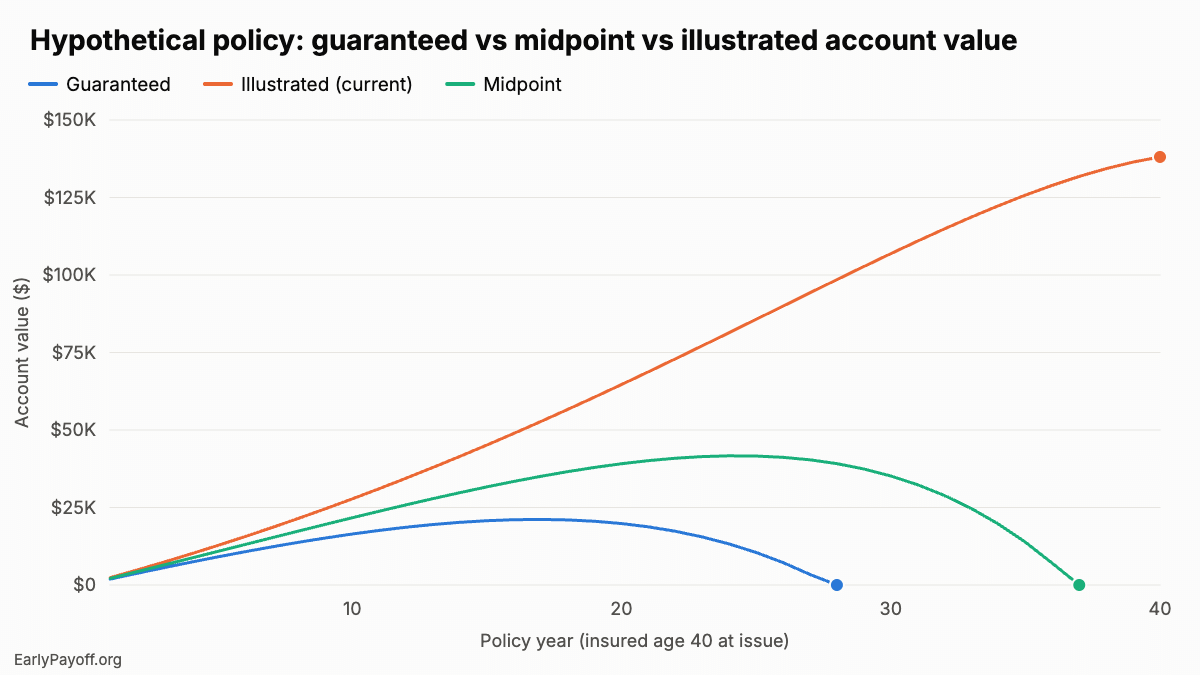
At year 20 the illustrated value is $44,845 higher than the guaranteed value; the guaranteed figure is only 31% of the illustrated one. More important, at guaranteed assumptions the account peaks at $21,151 in year 17 and cannot cover its charges in year 28, at age 67. The policy would lapse unless the owner pays much more. At midpoint assumptions it lasts until year 37 (age 76). Only at the fully illustrated assumptions does it stay in force past age 80.
The illustrated column is not wrong; insurers can and often do credit more than the minimum. But it is a projection, and the gap between columns shows how much of the outcome depends on things the insurer does not promise. When you review an illustration, find the year each column lapses, ask what premium would keep the policy in force to age 95 or 100 at guaranteed values, and request an updated “in-force” illustration every few years after you buy.
When a policy review can backfire, and what not to do
Reading your policy is always worthwhile, but acting on what you find can go wrong. Do not cancel an existing policy before a replacement is issued and its free-look period has passed. A new policy restarts the contestability and suicide periods, and your premium will reflect your current age and health. A new diagnosis can make old coverage irreplaceable.
Be careful with surrendering cash value policies in the early years, when surrender charges are often highest, and with policy loans that grow unpaid. A loan balance reduces the death benefit and, if it grows large enough to exhaust the cash value, can cause a lapse. A lapse of a policy with an outstanding loan can also create taxable income for the amount above what you paid in premiums. If an agent recommends replacing a policy, ask for the replacement comparison forms most states require and read them before signing.
A policy review is also the right moment to check whether the face amount still fits your household. Debts paid down, children grown or a new mortgage can all change the number. Our guide on how much life insurance you need walks through that calculation, and if your coverage is term, see how to choose a term life policy for conversion and renewal features to look for.
A 20-minute review routine
- Confirm the schedule page matches your application and quote.
- Read your application answers and report any error to the insurer in writing.
- Verify the owner and both primary and contingent beneficiaries.
- Note the dates when contestability, the suicide exclusion, level premiums and any conversion option end.
- Set premiums on automatic payment and confirm the insurer has a current address and email for lapse notices.
- For cash value policies, request an in-force illustration and find the lapse year at guaranteed values.
- Store the policy where your beneficiaries can find it.
Income protection is the other half of the picture for working households. If you depend on a paycheck, read about how to choose disability insurance, which covers the years when you are alive but unable to work.
Frequently asked questions
Can I return a life insurance policy after I read it?
Yes, during the free-look period that starts when the policy is delivered. North Carolina, for example, requires at least 10 days for new policies and a longer period for replacement policies. Your state’s rule and the exact number of days appear on the policy’s cover page or first pages. Returning the policy in this window generally gets you a refund of premiums paid.
What happens if the insured dies during the contestability period?
The insurer is allowed to review the application against medical and other records before paying. If everything was answered accurately, the claim is paid as usual, though it may take longer. If the insurer finds a material misstatement, it may deny the claim and refund premiums or adjust the benefit, depending on the policy and state law.
Does a will override the beneficiary on a policy?
Generally no. Life insurance passes by the beneficiary designation on file with the insurer, which is why an outdated designation can send money to an ex-spouse. Some states have laws that automatically revoke an ex-spouse’s designation after divorce, but they do not apply in every situation. The safest step is to update the designation directly with the insurer.
Are the numbers in an illustration part of the contract?
Only the guaranteed values are promises. The non-guaranteed columns show what would happen if the insurer’s current interest rates, dividends and charges continued unchanged, which the illustration itself must state. Treat them as one scenario, and judge the policy by whether you could live with the guaranteed column.
How do I find a policy a relative may have owned?
The NAIC runs a free Life Insurance Policy Locator, linked from many state insurance department websites, that lets participating insurers check their records for policies on a deceased person. If a match is found and you are the beneficiary, the insurer contacts you. Check the deceased person’s papers and bank statements for premium payments, too. State unclaimed-property programs may also hold benefits that were never collected.
Sources
- Life Insurance Illustrations Model Regulation (#582), NAIC, accessed Oct 2026
- Standard Nonforfeiture Law for Life Insurance (#808), NAIC, accessed Oct 2026
- NAIC Life Insurance Buyer’s Guide (as adopted, Ill. Admin. Code tit. 50, pt. 930, Exh. B), accessed Oct 2026
- New York Insurance Law §3203, Individual life insurance policies; standard provisions, New York State Senate, accessed Oct 2026
- FAQs About Life Insurance, North Carolina Department of Insurance, accessed Oct 2026
- Colorado Revised Statutes, Title 10, §10-7-109 (Colorado General Assembly), accessed Oct 2026
- Publication 525 (2025), Taxable and Nontaxable Income, IRS, accessed Oct 2026
- Life Insurance Policy Locator (NAIC tool), Arkansas Insurance Department, accessed Oct 2026
This article is general education, not individualized financial, tax or legal advice.