

Originally published on EarlyPayoff in October 2021. Fully rewritten and updated in October 2026.
You need enough life insurance to pay off the debts your family could not carry, replace the income they would lose for as many years as they depend on it, and fund goals like your children’s education, minus what you already have: savings, existing coverage and Social Security survivor benefits. For the example family below, a 38-year-old earning $95,000 with two young children, that comes to $959,784, or $1 million once rounded to a policy size. Rules of thumb can land close to that number or miss it by more than $1 million, so it is worth doing the math.
Key takeaways
- A needs-based calculation is the most accurate method. It adds debts, income replacement, education and final expenses, then subtracts savings, existing coverage and Social Security survivor benefits.
- For the example family, the needs-based figure is $959,784. Ten times income gives $950,000; the DIME method gives $2,239,428 because it ignores offsets and the time value of money.
- Social Security can be a large offset. The children’s survivor benefits in the example are worth $521,715 in today’s dollars (SSA rules, as of Oct 2026).
- Your need shrinks as the mortgage is paid down and children grow up. A ladder of 15-, 20- and 30-year term policies covers the example family’s need every year with 62% of the coverage-years of one $1 million, 30-year policy.
Three ways to estimate your coverage
Most online calculators use one of three methods. They differ mainly in what they leave out.
- Income multiple (a rule of thumb). Multiply your income by a number, often 10. It is quick, but it ignores your actual debts, how many years your family needs support, and what you already have. It is not based on any regulation or standard.
- DIME. Add Debts (plus final expenses), Income times the number of years your family needs it, your Mortgage balance and Education costs. It is more tailored but subtracts nothing and treats a dollar needed in 15 years as equal to a dollar today.
- Needs-based (capital needs) analysis. Lists each need, converts future income to a lump sum today, and subtracts existing resources. It takes 30 minutes with a spreadsheet and is the method this article recommends.
| Method | Result for the example family | What it counts | What it misses |
|---|---|---|---|
| 10 times income | $950,000 | Income only | Debts, number of years, education, savings, Social Security |
| DIME | $2,239,428 | Debts, 18 years of full income, mortgage, education | Savings, existing coverage, Social Security, investment earnings on the payout |
| Needs-based | $959,784 | All needs, discounted to today, minus existing resources | Depends on your assumptions; review them every few years |
A needs-based calculation, step by step
The example household: one spouse, age 38, earns $95,000 and is the person being insured. The other spouse earns $55,000. Their children are 7 and 4. They bought a home a year ago with a $380,000, 30-year fixed mortgage at 7.40%, roughly today’s average rate (Freddie Mac PMMS, week of Oct 15, 2026). After 12 payments of $2,631.04, they owe $376,428.
1. Debts and final expenses
Include every debt you would want paid off: the $376,428 mortgage, an $18,000 car loan and any other balances. Paying off the mortgage is a choice, not a requirement. Some families prefer to keep the payment and invest the money, but a paid-off home lowers the surviving spouse’s monthly costs and stress. Add final expenses; this family budgets $15,000. Funeral prices vary widely, and the FTC’s Funeral Rule lets you get itemized price lists to compare.
2. Income replacement
Decide how much income to replace and for how long. This family chose 75% of the insured’s pay, $71,250 a year, because the insured’s own spending would stop. They want it for 18 years, until the youngest turns 22. Over 18 years that is $1,282,500 before inflation.
But the family will not need all of it on day one. The death benefit can be invested and drawn down over time, so the lump sum needed today is smaller. The calculation assumes the need grows 3% a year with inflation and that the money earns 5.09%, the 10-year Treasury yield on Oct 16, 2026 (Federal Reserve H.15). On those assumptions, the income need today is $1,087,071. A lower assumed return raises that figure, so stay conservative.
3. Education and other goals
This family wants $60,000 per child in today’s dollars, $120,000 total. Choose your own target; costs vary widely by type of school. Add anything else you would want funded, such as a few months of child care while the surviving parent adjusts.
4. Subtract Social Security survivor benefits
Unmarried children of a worker who dies generally get 75% of the worker’s basic Social Security benefit until age 18, or 19 if still in high school. Total family benefits are capped at 150% to 180% of the worker’s benefit (SSA, Survivors Benefits, April 2026). Your estimated benefit is on your Social Security statement at ssa.gov.
The example assumes the insured’s basic benefit is $2,600 a month, so each child would get $1,950 a month, within the family maximum of $4,751.50 that SSA’s 2026 formula produces. The older child would collect for 11 years and the younger for 14. Assuming benefits rise 3% a year and are discounted at the same 5.09%, they are worth $521,715 today.
The surviving spouse could also claim 75% while caring for a child under 16, but the example leaves that out. At a $55,000 salary, the earnings test would withhold $15,260 of the $23,400 annual benefit, because SSA withholds $1 for every $2 earned above $24,480 in 2026 (SSA, as of Oct 2026). Three benefits would also exceed the family maximum, shrinking each one.
5. Subtract what you already have
Subtract savings your family could use ($40,000 here, not counting retirement accounts) and existing coverage. The insured has employer group life equal to one year’s salary, $95,000. The NAIC warns that employer coverage often ends when you leave the job (NAIC Life Insurance Buyer’s Guide, as of Oct 2026). If a job change is likely, leave it out or plan to replace it.
| Item | Amount |
|---|---|
| Income replacement (75% of $95,000 for 18 years, in today’s dollars) | $1,087,071 |
| Mortgage payoff | $376,428 |
| Car loan payoff | $18,000 |
| Education (two children) | $120,000 |
| Final expenses | $15,000 |
| Total needs | $1,616,499 |
| Less: children’s Social Security survivor benefits (today’s dollars) | −$521,715 |
| Less: savings | −$40,000 |
| Less: employer group life | −$95,000 |
| Coverage needed | $959,784 |
| Rounded to a policy size | $1,000,000 |
A stay-at-home parent needs coverage too. The calculation is the same, except that the main need is the cost of replacing child care and household work the parent provides, plus any debts.
The cost of too little or too much coverage
Too little is the bigger risk. If this family relied only on the $95,000 group policy, the survivors would be $959,784 short of the plan above. That gap usually means selling the house, drawing down retirement savings, or the surviving parent taking on more work while raising two children alone. Ten times income, $950,000, happens to land within $9,784 of the need here, but only by coincidence. With a larger mortgage or a third child, it would fall well short.
Too much costs premium dollars every year. The DIME figure is $1,239,428 above the needs-based figure. Using a hypothetical 20-year term rate of $0.70 per $1,000 of coverage a year (an assumed rate for illustration, not a quote), that extra coverage would cost $17,352 over 20 years. Money spent on unneeded coverage is money not going to the mortgage, retirement or an emergency fund. Insurers also limit total coverage to what your income justifies, so a very large application may be cut back anyway.
Laddering policies to match a declining need
Your need is not constant. Each year the mortgage balance falls, fewer years of income remain to replace, and children age out of the plan. Re-running the same calculation as if the insured died in a later year shows the need sliding from $959,784 today to $481,202 in year 15 and $87,009 in year 20. By year 25, savings and group coverage would cover what remains.
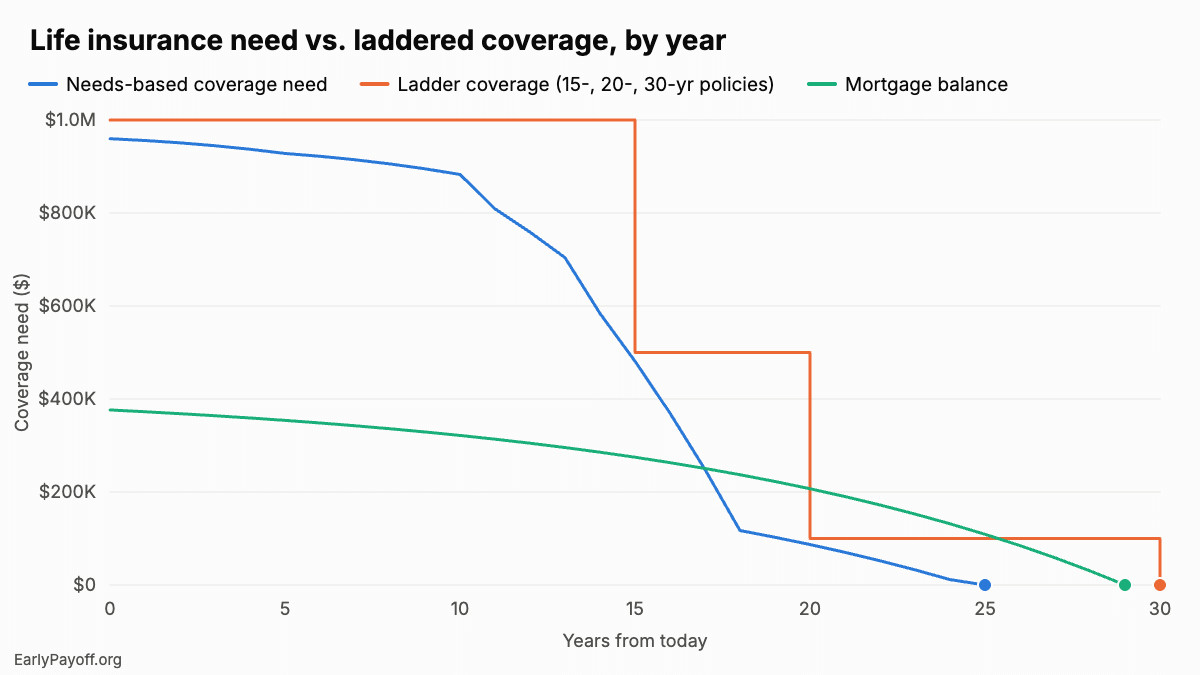
A ladder buys several term policies with different lengths so total coverage steps down with the need. Each layer is sized to the highest need in its window and rounded up to the nearest $50,000:
| Approach | Policies | Coverage, years 0–14 | Years 15–19 | Years 20–29 | Coverage-dollar-years | Premiums at hypothetical rates |
|---|---|---|---|---|---|---|
| Ladder | $500,000 15-yr + $400,000 20-yr + $100,000 30-yr | $1,000,000 | $500,000 | $100,000 | $18,500,000 | $13,325 |
| One 30-year policy | $1,000,000 30-yr | $1,000,000 | $1,000,000 | $1,000,000 | $30,000,000 | $36,000 |
| One 20-year policy | $1,000,000 20-yr | $1,000,000 | $1,000,000 | None; need of up to $87,009 uncovered | $20,000,000 | $14,000 |
The ladder covers the need in every year of the projection while buying 62% of the coverage-dollar-years of the single 30-year policy. At the hypothetical rates, it costs 37% as much. The single 20-year policy is nearly as cheap but leaves the last stretch of the mortgage exposed. Get real quotes for each layer before deciding; the savings depend on how your insurer prices different term lengths. Paying down the mortgage faster, as covered in should you pay off your mortgage early, shrinks the later layers further. For choosing each policy’s length and features, see how to choose a term life policy.
When this method does not fit
- Your assumptions are optimistic. A higher assumed return or lower inflation shrinks the number. If your survivors would keep the money in savings, use a lower return.
- Your health may change. A ladder assumes you will not need new coverage later. If you expect another child or a bigger home, a guaranteed insurability or conversion option, or a slightly larger long layer, keeps that door open.
- Someone depends on you for life. A child with a disability who will need support as an adult has a need that does not end, and term ladders built around an end date do not fit it.
- Nobody depends on your income. If you have no dependents and no co-signed debts, a large policy mostly buys peace of mind for others. Savings may cover final expenses.
- Social Security rules or your record differ. Benefits depend on your earnings record and work credits, and the earnings test and family maximum can cut payments. Check your own statement rather than assuming the example’s figures.
Revisit the number after any big change: a birth, a home purchase, a large raise, or paying off a debt. If you are expecting a child, how to plan your finances for a new baby covers the other money steps to take at the same time. Once you know the amount, how to choose a life insurance company and policy covers vetting insurers.
FAQ
Is 10 times my income enough life insurance?
Sometimes, by coincidence. It was close for the example family but would be too little for someone with a large mortgage and young children, and far too much for someone with grown children and few debts. Treat it as a starting point, not an answer.
Should I count my employer’s life insurance?
Count it only if you expect to stay in the job for the length of the need. Group coverage usually ends when you leave unless the plan has a conversion option, and converting can be expensive. Many people buy enough individual coverage to stand on its own.
Will my family owe tax on the death benefit?
Generally no. The IRS says life insurance proceeds paid because of the insured’s death are not included in gross income. Interest earned on the proceeds after they are paid, or while the insurer holds them, is taxable (IRS, as of Oct 2026).
Do both spouses need life insurance?
Usually, if the household depends on both. Run the calculation separately for each spouse. A nonworking spouse’s need is the cost of the child care and household work the family would have to pay for.
How often should I recalculate?
Every few years and after major life events, as the NAIC suggests for reviewing a policy. If your need has dropped, you may be able to reduce coverage or let a ladder layer expire; if it has grown, buy more while you are healthy.
Sources
- Social Security Administration, Survivors Benefits (Publication EN-05-10084, April 2026), accessed Oct 2026
- Social Security Administration, How much survivors receive, accessed Oct 2026
- SSA Office of the Chief Actuary, Benefit formula bend points, accessed Oct 2026
- SSA Office of the Chief Actuary, Formula for family maximum benefit, accessed Oct 2026
- SSA Office of the Chief Actuary, Exempt amounts under the earnings test, accessed Oct 2026
- Freddie Mac, Primary Mortgage Market Survey, accessed Oct 2026
- Federal Reserve, Selected Interest Rates (H.15), accessed Oct 2026
- Federal Reserve, Consumer Credit (G.19), accessed Oct 2026
- NAIC, Life Insurance Buyer’s Guide, accessed Oct 2026
- FTC, Shopping for Funeral Services, accessed Oct 2026
- IRS, Life Insurance and Disability Insurance Proceeds (FAQ), accessed Oct 2026
This article is general education, not individualized financial, tax or legal advice.