

To save for a big purchase, set a price and a date, divide the price by the number of months, and move that amount automatically into a separate insured savings account, certificate of deposit or Treasury bills. Interest lowers the monthly deposit you need, but the bigger win is not borrowing. In the example below, saving $12,000 over 24 months costs $2,020.98 less than buying now with an average-rate personal loan.
Key takeaways
- A sinking fund is a monthly deposit sized to reach a known price by a known date. For $12,000 in 24 months it is $479.89 a month at a 4.26% yield, or $500.00 with no interest.
- Where you keep the money matters. The FDIC’s national average savings rate was 0.38% in October 2026, while 3-month Treasury bills yielded 4.26%.
- Bank and credit union deposits are insured up to $250,000 per depositor, per institution, for each ownership category (FDIC and NCUA, as of Oct 2026).
- Financing the same $12,000 over 24 months costs $1,538.34 in interest with an average personal loan and $2,962.21 on an average credit card.
Step 1: Pin down the price and the date
A vague goal (“a new roof someday”) doesn’t get funded. Get a real number: two or three quotes for a home project, the out-the-door price for a car, or a realistic total for a trip including taxes and fees. Add 10% to 15% for surprises if the price isn’t fixed yet.
Then pick the month you want to buy. If the purchase can wait, a longer runway means a smaller monthly deposit. If it can’t wait, for example a failing furnace, the choice becomes how much to save first and how little to borrow. For a car, also look past the sticker: our guide to the true cost of a car covers insurance, fuel and depreciation you should budget for too.
Step 2: Do the sinking fund math
With no interest, the monthly deposit is just price divided by months. With interest, you need slightly less because the balance earns money along the way. The standard formula for a deposit made at the end of each month is:
Monthly deposit = Goal × r ÷ ((1 + r)n − 1), where r is the annual yield divided by 12 and n is the number of months.
For a $12,000 goal over 24 months at 4.26% (the 3-month Treasury bill rate in the Federal Reserve’s H.15 release for October 16, 2026), r is 0.355% and the deposit is $479.89. You put in $11,517.36 and interest supplies $482.67. At the FDIC’s national average savings rate of 0.38%, the deposit rises to $498.18 and interest adds only $43.64. Over two years, the low-yield account costs you $438.96 more out of pocket.
| Time to save $12,000 | No interest | At 0.38% (avg savings) | At 4.26% (T-bill benchmark) |
|---|---|---|---|
| 12 months | $1,000.00 | $998.26 | $980.62 |
| 24 months | $500.00 | $498.18 | $479.89 |
| 36 months | $333.33 | $331.49 | $313.08 |
Two lessons stand out. First, time does far more than yield: stretching from 12 to 24 months cuts the deposit roughly in half, while a better yield trims it by a few percent. Second, the yield gain is real money but modest, so don’t take on risk to chase it. The money has to be there on the purchase date.
Yields change. The 4.26% figure is a snapshot, and Treasury bill rates move with Federal Reserve policy. Recalculate every few months. If yields fall, raise the deposit slightly or accept a small shortfall. Interest is also taxable income, so the after-tax gain is somewhat smaller than shown.
Step 3: Choose where to keep the money
Money for a purchase within a few years belongs somewhere safe and easy to reach. That rules out stocks, stock funds and crypto: none of them are deposit-insured, and their value can drop right before you need it (NCUA, as of Oct 2026).
| Option | Protection | Access | Rate benchmark (Oct 2026) |
|---|---|---|---|
| Savings or money market deposit account (bank) | FDIC insurance up to $250,000 per depositor, per bank, per ownership category | Anytime | National averages: savings 0.38%, money market 0.63%; some accounts pay much more |
| Share savings account (credit union) | NCUA insurance up to $250,000 per member-owner, per ownership category | Anytime | Varies by credit union |
| Certificate of deposit (bank or credit union) | FDIC or NCUA insured to the same limits | Locked until maturity; early withdrawal penalty | National average 12-month CD: 1.76% |
| Treasury bills | Issued by the U.S. Treasury; not FDIC insured | Matures in 4 to 52 weeks; can be sold earlier at market price | 3-month bill: 4.26%; federal tax applies, no state or local tax |
Savings accounts are the simplest choice for monthly deposits. Rates vary widely, and the national average is low, so compare what your bank pays with what other insured banks and credit unions offer. Keep the fund in its own account, or a labeled sub-account, so it doesn’t drift into everyday spending.
CDs fit when you know the purchase date. A CD that matures just before you buy locks in a rate. The trade-off is that withdrawing early triggers a penalty set by the bank (CFPB, as of Oct 2026). A CD ladder (several CDs maturing in different months) can work for money you add over time.
Treasury bills are sold in terms from 4 to 52 weeks, in $100 increments with a $100 minimum, at a discount to face value. Interest is subject to federal income tax but exempt from state and local income tax (TreasuryDirect, as of Oct 2026). That exemption matters most in high-tax states. Bills are a good home for a lump sum. For monthly deposits, many people collect cash in savings and roll it into bills every month or two.
Save first vs. finance now
The alternative to saving is buying now and paying it off. Here is the same $12,000 purchase paid over 24 months three ways, using average rates from the Federal Reserve’s G.19 release (2026 Q2, published October 7, 2026).
| Approach | Rate | Monthly amount | Total paid | Interest |
|---|---|---|---|---|
| Save for 24 months, then buy | Earn 4.26% | $479.89 | $11,517.36 | +$482.67 earned |
| Buy now, 24-month personal loan | 11.86% | $564.10 | $13,538.34 | $1,538.34 paid |
| Buy now, credit card paid off in 24 months | 22.15% | $623.43 | $14,962.21 | $2,962.21 paid |
Saving costs $2,020.98 less than the personal loan and $3,444.85 less than the credit card. The monthly amount is also lower: $84.21 less than the loan payment and $143.54 less than the card payment. The only thing the borrower gets for that money is having the item two years sooner. Personal loans often carry an origination fee on top of the rate, which widens the gap; see how to compare origination fees.
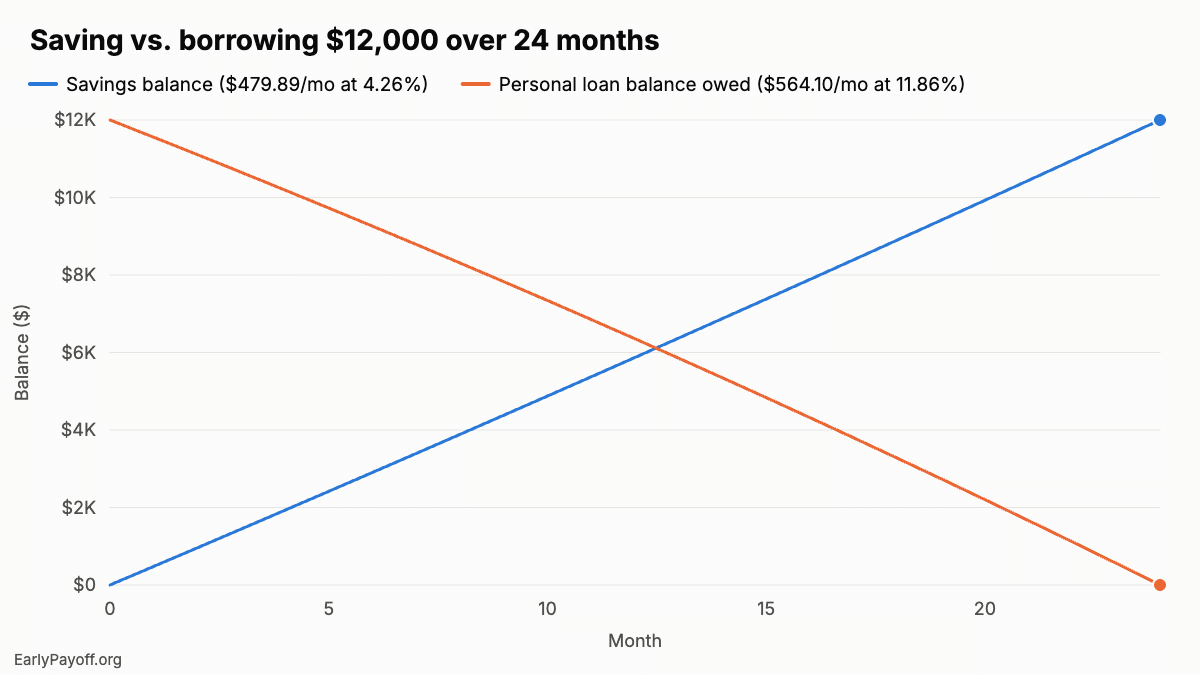
The chart shows the two paths. The saver’s balance climbs to $5,872.46 by month 12 and $12,000.03 by month 24. The borrower still owes $6,353.62 after a year of payments.
What about 0% financing offers?
A true 0% APR offer can beat saving if you pay it off within the promotional period. Be careful with “no interest if paid in full” store deals. These use deferred interest: if any balance remains when the promotion ends, interest can be charged back to the purchase date. You must also make every minimum payment on time, and the minimums usually won’t clear the balance in time (CFPB, as of Oct 2026). If you use one, divide the price by the promotional months and pay that amount, not the minimum.
When saving first is not the right call
- The purchase prevents a bigger cost. A leaking roof, a dead furnace in winter or the car you need to get to work can’t wait 24 months. Borrowing the gap, at the lowest rate available, may be cheaper than the damage or lost income.
- You would raid the emergency fund. A purchase fund is not an emergency fund. Keep them separate, and don’t drain emergency savings for a planned purchase.
- You are carrying high-rate debt. Saving at 4.26% while paying 22% on a card loses money. Pay down the card first unless the purchase is essential.
- Prices are rising faster than your savings. If the item’s price is likely to rise substantially before you buy, waiting costs more. Base this on real quotes, not general worry about inflation.
Make the plan automatic
Schedule the deposit for payday so the money moves before you can spend it, and add the line to your monthly budget as a sinking fund. Our guide to building a budget that works shows where it fits. If you are saving for several things at once, rank them and fund them in order, as described in how to set financial goals for the year. Check the balance every quarter against the target path; at 4.26%, the $12,000 fund should hold about $5,872 at the one-year mark.
Frequently asked questions
How much should I save each month for a big purchase?
Divide the price by the number of months until you buy. That is the no-interest amount and a safe upper bound. Interest lowers it slightly: for $12,000 over 24 months, the deposit is $479.89 at 4.26% instead of $500.00.
Is a high-yield savings account safe?
If the bank is FDIC insured or the credit union is NCUA insured, deposits are protected up to $250,000 per depositor, per institution, for each ownership category. Check that the institution is insured, not just the app or website you use to reach it.
Should I use a CD or Treasury bills?
Both work for money you won’t touch until a known date. In October 2026, 3-month Treasury bills yielded more than the national average CD, and their interest is free of state and local income tax. Many individual banks pay more than the average CD, so compare actual offers.
Is it ever smarter to finance and invest the cash?
Only if the loan rate is clearly below what you can safely earn. With average personal loans at 11.86% and safe yields near 4.26%, financing costs more than it earns. A genuine 0% offer paid off on time is the main exception.
Sources
- Federal Reserve, Selected Interest Rates – H.15 (Oct 16, 2026), accessed Oct 2026
- Federal Reserve, Consumer Credit – G.19 (released Oct 7, 2026), accessed Oct 2026
- FDIC, National Rates and Rate Caps (published Oct 19, 2026), accessed Oct 2026
- FDIC, Understanding Deposit Insurance, accessed Oct 2026
- NCUA, Share Insurance Coverage, accessed Oct 2026
- CFPB, What is a certificate of deposit (CD)?, accessed Oct 2026
- TreasuryDirect, Treasury Bills, accessed Oct 2026
- CFPB, How does a “no interest if paid in full” promotion work?, accessed Oct 2026
This article is general education, not individualized financial, tax or legal advice.