

To use a credit card for holiday shopping without carrying a balance, charge only what you already have the cash to cover, and pay the full statement balance by the due date. If you do, the card’s grace period means you pay no interest on those purchases. You also get federal protections for billing errors and fraud that cash and many other payment methods do not offer. The trouble starts when you pay less than the full balance, because interest then starts building at rates that averaged 22.36% in August 2026.
Key takeaways
- Card issuers must send your statement at least 21 days before the payment due date. Paying the full statement balance in that window avoids interest on purchases on cards with a grace period.
- A $1,500 holiday balance at 22.36% costs $0 in interest if paid in full, $56.24 over 3 months, $187.81 over 12 months and $1,289.39 if you pay only an assumed minimum.
- On the minimum path, the balance takes 78 months, or 6.5 years, to clear.
- You have 60 days after the statement is sent to dispute a billing error in writing, and your liability for unauthorized charges is capped at $50.
- Avoid cash advances and deferred-interest store offers unless you are sure how they work. Cash advances usually start charging interest the day you take them.
How the grace period works
A grace period is the time between the end of a billing cycle and the payment due date. If you pay the full balance by then, you usually owe no interest on purchases. Card issuers are not required to offer a grace period, but most do for purchases (CFPB, as of October 2026). Federal rules require issuers to mail or deliver your statement at least 21 days before the due date, and they cannot treat a payment received in that window as late (Regulation Z, 12 CFR 1026.5).
Here is how it plays out with holiday dates. Say you buy gifts on November 27, your statement closes on December 10 and your due date is January 4. That purchase has no interest if the full December statement balance is paid by January 4. Charges made after December 10 show up on the January statement, with a due date in early February. Look up your own closing date in your account, because it decides which statement each purchase lands on.
The grace period is fragile. If you pay less than the full statement balance, you lose it. You then owe interest on the unpaid amount, and new purchases usually start charging interest from the day you make them. Paying in full some months but not others can cost you the grace period for that month and the next (CFPB). That is why a card that already carries a balance is a poor tool for holiday spending.
Worked example: $1,500 of holiday charges
A household puts $1,500 of gifts, travel and food on one card and makes no other charges. The card’s APR is 22.36%, the Federal Reserve’s August 2026 average for credit card accounts that were charged interest (G.19, preliminary). Interest is figured monthly at one-twelfth of the APR, so the first month’s interest on the full balance is $27.95. The minimum payment uses an assumed formula of 1% of the balance plus that month’s interest, or $35, whichever is more. Issuers set their own formulas, so check your statement.
| Payment strategy | Monthly payment | Months to pay off | Total interest |
|---|---|---|---|
| Pay the statement balance in full | $1,500.00 once | 1 | $0.00 |
| Three equal payments | $518.75 | 3 | $56.24 |
| Six equal payments | $266.56 | 6 | $99.32 |
| Twelve equal payments | $140.66 | 12 | $187.81 |
| Minimum payments only (assumed formula) | Starts at $42.95, falls to $35 | 78 | $1,289.39 |
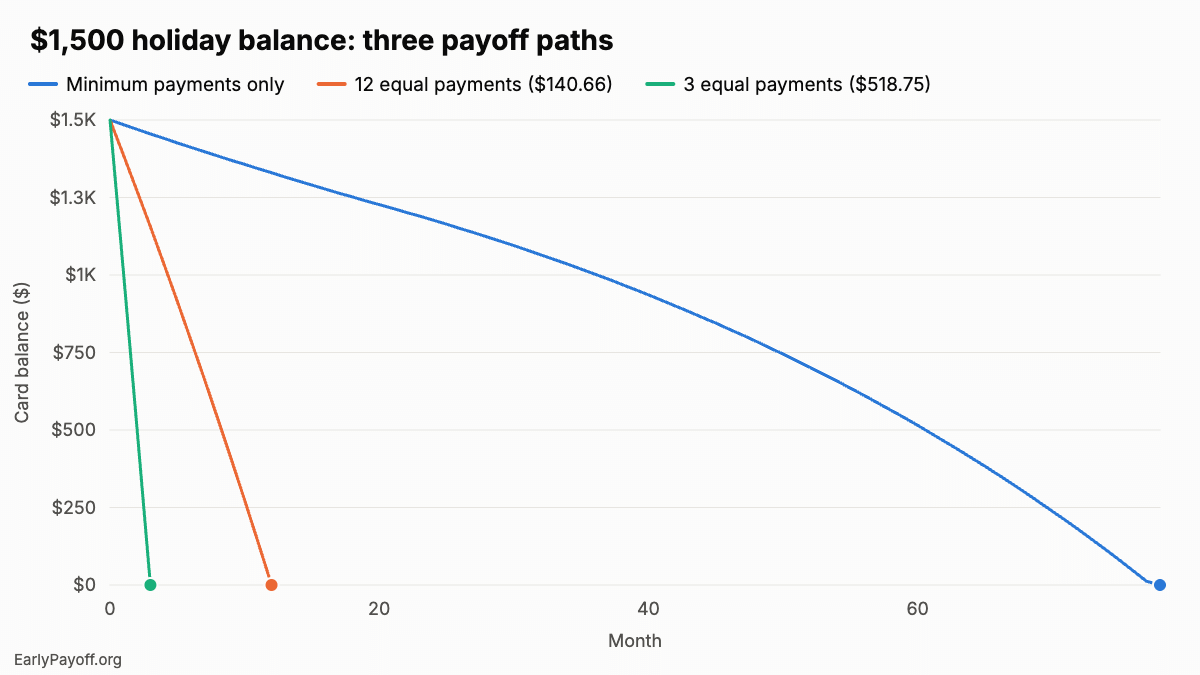
Paying only the minimum means $2,789.39 in total payments for $1,500 of holiday shopping, and the last payment lands six and a half years later. Even three months of payments costs $56.24, which is a reason to keep the total at a level you can clear in one statement. Your statement must show how long the balance would take to repay at the minimum and what it would cost (12 CFR 1026.7). Read that box before you decide what to pay.
Five rules for holiday card use
- Set the budget first. Decide the total and the per-person amounts in cash terms before you shop. Our guide to building a budget that works shows how to fit it into your monthly plan.
- Use one card. Putting all holiday spending on one card makes it easy to see the running total and pay it off in one payment.
- Move the cash as you go. Each time you charge something, move the same amount from checking to savings, or note it in a tracker. When the statement arrives, the money is waiting.
- Set up autopay for the statement balance. Choose “statement balance,” not “minimum payment.” Then check that your account can cover it on the due date.
- Watch your utilization. A large balance on the statement date can lower your credit score temporarily, even if you pay it in full. If you plan to apply for a mortgage or car loan soon, see how to improve your credit utilization; paying part of the balance before the statement closes can help.
Your protections when something goes wrong
Credit cards come with federal protections under the Fair Credit Billing Act, carried out in Regulation Z. These matter during the holidays, when packages go missing and card numbers get stolen.
- Billing errors. Billing errors include charges you did not authorize, wrong amounts, and goods or services not delivered as agreed. Send a written notice so the issuer receives it within 60 days after it sent the first statement with the error. The issuer must acknowledge it within 30 days and resolve it within two billing cycles, and in no case later than 90 days. While it investigates, you can withhold the disputed amount, and the issuer cannot report it as delinquent (12 CFR 1026.13).
- Fraud. Your liability for unauthorized use of a credit card is capped at $50, or less if less was charged before you notified the issuer (12 CFR 1026.12). Report a lost card or strange charge right away.
- Quality problems. If a merchant will not fix a problem with something you bought, you may be able to assert the same claims against the card issuer. In general, the purchase must be over $50 and made in your home state or within 100 miles of your billing address, and you must first try in good faith to resolve it with the seller. Those limits do not apply when the seller is the card issuer or controlled by it (12 CFR 1026.12(c)).
Keep receipts, order confirmations and tracking numbers until the return windows and your statement have both passed. Some cards add their own purchase protection or extended warranty benefits, but these are contractual and vary by card, so read your benefits guide instead of assuming coverage.
What to avoid: cash advances, deferred interest and late payments
Cash advances. Using your card at an ATM, or using a convenience check from your issuer, is usually a cash advance. Grace periods typically cover only purchases, so interest on cash advances generally starts from the transaction date (CFPB). Many cards also charge a cash advance fee and a higher APR for cash advances; your cardholder agreement lists the terms.
Deferred-interest offers. Store cards often advertise “no interest if paid in full” within 6 or 12 months. That is not the same as a 0% APR. Interest builds from the purchase date and is added all at once if any of the promotional balance is left at the end, or if you fall more than 60 days behind (CFPB). If you use one, divide the purchase by the number of months and pay at least that amount, finishing a month early.
Late payments. A late payment can bring a late fee and, if you are more than 60 days late, a penalty rate on your existing balance. Federal rules require the issuer to drop the penalty rate on that balance if you then make six consecutive on-time minimum payments (12 CFR 1026.55). Autopay for at least the minimum prevents this even if you plan to pay more by hand.
When using a credit card for holidays is a bad idea
- The card already has a balance. You likely have no grace period, so every gift starts charging interest the day you buy it. Use cash or debit and focus on paying off the existing debt.
- You are counting on January money you do not have yet. If the full balance depends on a bonus or tax refund that is not certain, plan for the card to carry a balance and spend less.
- You tend to spend more with a card. If you overspent last year, cash or a debit card with a fixed holiday budget is the safer choice.
- You are opening new cards for sign-up bonuses before a loan. New applications mean hard inquiries and new accounts, which can lower your score right before a mortgage or auto application.
FAQ
Do I pay interest if I pay my statement balance in full?
Usually not, on purchases, as long as your card has a grace period and you paid the previous statement in full too. Cash advances and some balance transfers can charge interest even when you pay in full.
Is it better to pay the statement balance or the current balance?
Paying the statement balance by the due date is enough to avoid interest on purchases. Paying the current balance also covers newer charges, which can lower the balance reported on your next statement but is not required to avoid interest.
How do I dispute a holiday charge for something that never arrived?
Contact the seller first, then send the card issuer a written dispute that it receives within 60 days after the first statement showing the charge. Include your name, account number, the charge and why it is wrong. You can withhold that amount while the issuer investigates.
Will a big December balance hurt my credit score?
It can for a month or two, because scores look at the balance reported on your statement compared with your limit. The effect typically fades once a lower balance is reported. Paying in full avoids interest and late marks, which matter more over time.
Sources
- Federal Reserve, Consumer Credit – G.19 (Oct 7, 2026), accessed Oct 2026
- CFPB, What is a grace period for a credit card?, accessed Oct 2026
- CFPB, What is a deferred interest promotion?, accessed Oct 2026
- eCFR, 12 CFR 1026.5, General disclosure requirements (statement timing), accessed Oct 2026
- eCFR, 12 CFR 1026.7, Periodic statement (minimum payment disclosures), accessed Oct 2026
- eCFR, 12 CFR 1026.12, Special credit card provisions, accessed Oct 2026
- CFPB, Regulation Z 1026.13, Billing error resolution, accessed Oct 2026
- eCFR, 12 CFR 1026.55, Limitations on increasing annual percentage rates, fees, and charges, accessed Oct 2026
This article is general education, not individualized financial, tax or legal advice.