

To get out of credit card debt, stop adding new charges and pay a fixed amount every month that is well above the minimum. Then cut the interest rate where you can, through a balance transfer, a hardship plan from your issuer, or a nonprofit debt management plan. The fixed payment does most of the work. On a $6,000 balance at the average card rate, paying $250 a month instead of the minimum clears the debt in 32 months instead of almost 18 years.
Key takeaways
- Card minimums shrink as the balance falls, which stretches payoff out for years. In the example below, minimums alone take 215 months and cost $9,576.36 in interest.
- Freezing your payment at the first month’s minimum, $170.75, cuts payoff to 58 months. Paying $250 cuts it to 32 months and $1,998.77 in interest.
- A 0% balance transfer can save hundreds of dollars after the fee, but only if you pay the balance down before the promotion ends. Deferred-interest offers work differently and can charge back interest.
- If you can’t make even the minimum, call your issuer before you miss a payment, and consider a nonprofit credit counselor.
Why the minimum payment keeps you in debt
Most card minimums are set as a small slice of the balance plus that month’s interest. As the balance drops, the minimum drops with it, so you pay a little less each month and the payoff date keeps moving out. Most of each early payment goes to interest.
Your statement already tells you this. Under the Truth in Lending Act’s Regulation Z, card issuers must print a “Minimum Payment Warning” on each monthly statement. It shows how long the current balance will take to pay off if you make only minimum payments, and the total you would pay. In most cases it also shows the monthly payment that would clear the balance in three years, what that would cost in total, and how much you would save. The box also lists a toll-free number for information about credit counseling (12 CFR 1026.7(b)(12), CFPB, as of Oct 2026). If you look at only one number on your statement, make it that one.
Worked example: minimum vs. fixed payment
Take a $6,000 balance at 22.15%, the average rate on credit card accounts that were charged interest in the second quarter of 2026 (Federal Reserve G.19, released Oct 7, 2026). The first month’s interest is $110.75. The example uses a common minimum formula: that month’s interest plus 1% of the balance, with a $35 floor. That makes the first minimum $170.75. Issuers’ formulas vary, so check your card agreement. No new charges are added.
| Payment approach | Monthly payment | Months to pay off | Total interest | Interest saved vs. minimums |
|---|---|---|---|---|
| Minimum only | $170.75 at first, then falling | 215 (17 yr 11 mo) | $9,576.36 | — |
| Freeze the first minimum | $170.75 | 58 | $3,763.97 | $5,812.39 |
| Three-year payment | $229.61 | 36 | $2,265.91 | $7,310.45 |
| Fixed payment | $250.00 | 32 | $1,998.77 | $7,577.59 |
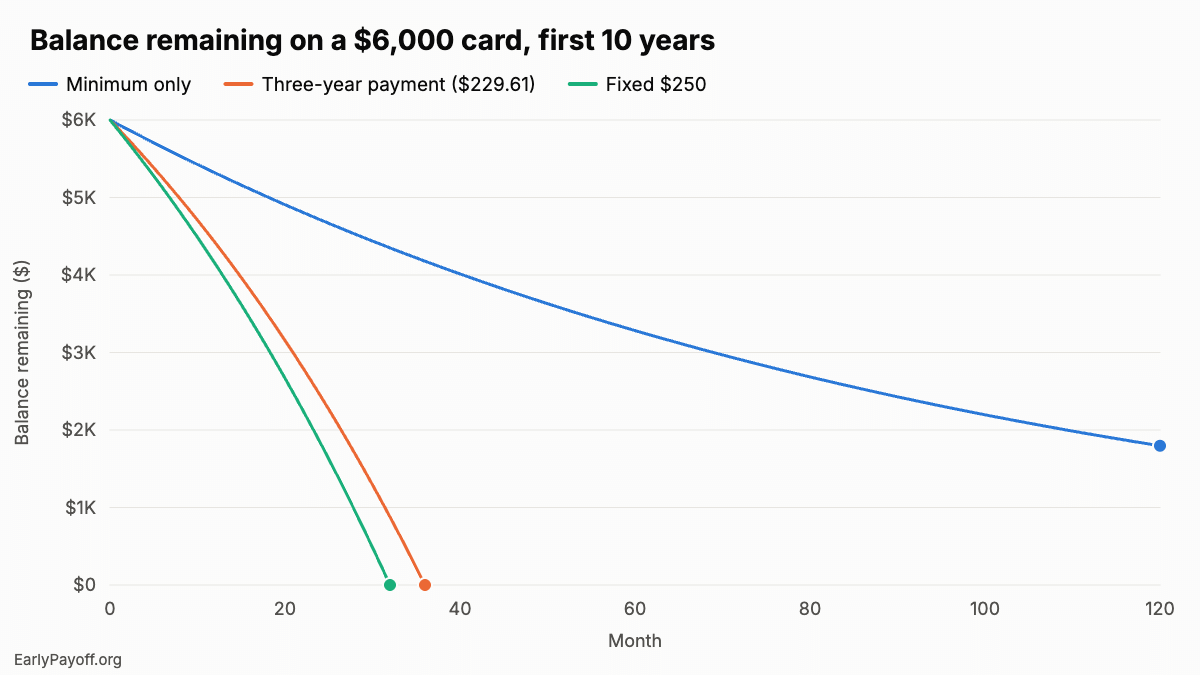
Three things stand out:
- Minimums cost more than the original debt. Paying only the minimum, you hand over $15,576.36 to clear $6,000. After five years you still owe $3,282.95.
- Simply not letting the payment shrink is powerful. Keep paying $170.75 even as the required minimum falls, and you are done in 58 months instead of 215. That costs nothing extra per month compared with where you started.
- Each step up has smaller returns. Going from the frozen minimum to $250 saves another $1,765.20 and 26 months. The three-year figure on your statement is a reasonable target if $250 is out of reach.
If you carry balances on more than one card, put the extra money on the highest-rate card first and pay minimums on the rest. Our guide to which debt to pay off first compares that approach with paying the smallest balance first.
Stop new charges first
None of the numbers above work if the balance keeps growing. Before you set up a payment plan, take the card out of your wallet and remove it from online stores and payment apps. Move recurring bills to a debit card or bank account. You don’t have to close the account. An open card with a zero balance still counts toward your available credit, which helps your credit utilization.
Then find the money for the fixed payment. List your take-home pay and fixed bills, and look at three months of card statements to see where the new charges came from. A small cash cushion for car repairs and medical copays keeps the next surprise off the card. If the debt came from a gap between income and spending, the CFPB notes that consolidation or a new loan won’t solve it unless the gap closes (CFPB, as of Oct 2026).
Balance transfers: how to make one pay off
A balance transfer moves your debt to a card with a low or 0% promotional rate. Federal rules require the promotional rate to last at least six months, and the issuer must tell you in advance how long it lasts and what rate applies afterward (12 CFR 1026.55(b)(1)). The card company can charge a transfer fee even on a 0% offer. The fee is usually a percentage of the amount moved or a flat dollar amount, whichever is higher (CFPB, as of Oct 2026).
Here is the same $6,000 moved to a card with a 3% fee and 0% for 15 months. The fee and term are illustrative, so use the numbers from your actual offer. The fee is $180, which makes the new balance $6,180.
| Scenario | Monthly payment | Months to pay off | Fee + interest |
|---|---|---|---|
| Transfer, paid off within the promotion | $412.00 | 15 | $180.00 |
| No transfer, same payment at 22.15% | $412.00 | 18 | $1,052.87 |
| Transfer, but only $250 a month | $250.00 | 26 | $453.15 |
| No transfer, $250 a month at 22.15% | $250.00 | 32 | $1,998.77 |
Paying $412 a month clears the transferred balance just as the promotion ends and saves $872.87 compared with paying the same amount on the old card. At $250 a month, $2,430 is still owed when the promotion ends, and that balance goes back to a regular rate. Even so, the transfer saves $1,545.62 compared with not transferring. Divide the new balance by the number of promotional months to get the payment that clears it in time.
Watch for three traps. If you make new purchases on the transfer card, they may not get a grace period, so interest can build until the entire balance, transferred amount included, is paid. A payment more than 60 days late lets the issuer raise the rate on all balances, including the transferred one (CFPB, as of Oct 2026). And a transfer only helps if the old card stays at zero.
0% APR is not the same as deferred interest
Store cards and financing offers often say “no interest if paid in full” within a set period. That is deferred interest, not 0%. With a true 0% promotion, interest starts only on whatever is left when the promotion ends. With deferred interest, interest builds in the background from the purchase date. If any part of the promotional balance is unpaid at the deadline, all of that back interest is added at once. In a CFPB example, a $400 purchase with $100 left at the end of a 12-month deferred-interest promotion at 25% leaves you owing $165 instead of $100 (CFPB, as of Oct 2026).
If a card has both a deferred-interest balance and other balances, the issuer normally applies extra payments to the highest-rate balance. In the last two billing cycles before the promotion ends, it must apply them to the deferred-interest balance first. You can also ask the issuer to apply extra payments to that balance at any time (12 CFR 1026.53(b)).
Call your issuer about a hardship plan
If a job loss, illness or other emergency means you can’t make the minimum, call the card company before you miss a payment. Many issuers will change your payment during a financial emergency (CFPB, as of Oct 2026). Programs and terms differ by issuer and aren’t required by federal law, so you have to ask. The CFPB suggests going into the call ready to explain:
- Why you can’t pay the minimum right now.
- How much you can afford to pay.
- When you expect to resume normal payments.
- The payment amount you are asking for and for how long.
Also ask whether the plan lowers your rate or waives fees, whether the card will be frozen or closed while you are on it, and how the account will be reported to the credit bureaus. Get the terms in writing before you make the first reduced payment.
Nonprofit credit counseling and debt management plans
A credit counselor reviews your budget and may offer a debt management plan. You make one monthly payment to the counseling agency, and it pays your card companies. The counselor generally doesn’t reduce what you owe. Instead, it works to lower your total monthly payment, for example by getting creditors to cut interest rates or waive late fees while you are on the plan. These agencies may charge fees, so ask about costs before you sign up (CFPB, as of Oct 2026). The FTC notes that a plan can take 48 months or more to finish and doesn’t cover secured debts like a mortgage or car loan (FTC, as of Oct 2026).
To find a reputable agency, start with the U.S. Trustee Program’s list of approved credit counseling agencies, organized by state. Walk away from any counselor who tells you to stop paying your cards, or who says a plan is your only option without first looking at your budget.
A credit counselor is not the same as a debt settlement company. Settlement companies charge to negotiate a lump-sum payoff for less than you owe, and they usually tell you to stop paying while you save. That damages your credit and can lead to lawsuits. For how that works and when doing it yourself makes sense, see how to negotiate a debt settlement.
When these strategies are a bad idea
- A balance transfer when you are still overspending. If the old card fills back up, you end up with two balances and a transfer fee.
- A deferred-interest offer you can’t clear in time. One dollar left at the deadline triggers all the back interest.
- Raiding retirement savings. Early withdrawals can bring income tax and an extra penalty, and the money stops growing for retirement.
- Swapping card debt for home-secured debt. A home equity loan may have a lower rate, but missed payments can now cost you the house (CFPB, as of Oct 2026).
- Paying extra while you have no cushion at all. Keep a small emergency fund so the next car repair doesn’t go back on the card.
A fixed-rate personal loan is another way to lower the rate with a set end date. It helps only when the rate and fees beat your card rates and the term isn’t stretched out. See debt consolidation with a personal loan for a full cost comparison.
FAQ
How long will it take me to pay off my card at the minimum?
Look for the Minimum Payment Warning on your monthly statement. It shows your issuer’s estimate of the payoff time and total cost if you pay only the minimum, based on your current balance and no new charges. In the example above, a $6,000 balance at 22.15% takes 215 months.
Should I close my credit cards once they are paid off?
Usually not, unless a card charges an annual fee you don’t want to pay or you can’t trust yourself with it. An open card with no balance adds to your available credit, which keeps your utilization low. If you keep it, put a small recurring bill on it and pay it in full each month.
Can I ask my card company to lower my interest rate?
Yes. Some creditors will lower the rate, waive fees, accept a lower payment or change the due date to line up with your payday (CFPB, as of Oct 2026). Ask directly, and get any change confirmed in writing.
Does a debt management plan hurt my credit?
The plan itself is not a loan, but creditors may close or freeze the cards you put on it, which can lower your available credit for a while. On-time payments through the plan build a positive history. Ask the counselor and each creditor how the accounts will be reported.
Is it worth paying a fee for a balance transfer?
Often, yes, if you will pay off most of the balance during the promotion. In the example above, a $180 fee saved $872.87 compared with paying the same amount on the old card. If you can only pay a little each month, compare the fee with the interest you would save before the promotion ends.
Sources
- Federal Reserve, Consumer Credit – G.19 (release of Oct 7, 2026), accessed Oct 2026
- CFPB, Regulation Z § 1026.7, Periodic statement (repayment disclosures), accessed Oct 2026
- CFPB, Regulation Z § 1026.55, Limitations on increasing annual percentage rates, fees, and charges, accessed Oct 2026
- CFPB, Regulation Z § 1026.53, Allocation of payments, accessed Oct 2026
- CFPB, What is a balance transfer fee?, accessed Oct 2026
- CFPB, What do I need to know about consolidating my credit card debt?, accessed Oct 2026
- CFPB, How to understand special promotional financing offers on credit cards (archived blog), accessed Oct 2026
- CFPB, What should I do if I can’t pay my credit card bills?, accessed Oct 2026
- CFPB, What is the difference between credit counseling and debt settlement?, accessed Oct 2026
- FTC, How To Get Out of Debt, accessed Oct 2026
- U.S. Trustee Program, List of Credit Counseling Agencies Approved Pursuant to 11 U.S.C. § 111, accessed Oct 2026
This article is general education, not individualized financial, tax or legal advice.