

Originally published on EarlyPayoff in October 2021. Fully rewritten and updated in October 2026.
To compare home insurance quotes, make every quote match on the same policy form, the same coverage limits and the same deductibles before you look at price. Set dwelling coverage to the cost of rebuilding your home, not its market value, and choose replacement cost for your belongings. Then compare what each quote excludes, how its wind or hurricane deductible works, and whether its liability and loss-of-use limits fit your household. Only after that is the lowest premium a fair comparison.
Key takeaways
- The NAIC’s latest national data (for 2023, published July 2026) put the average HO-3 premium at $1,737 a year and the average HO-5 premium at $1,891.
- Insure the dwelling for rebuilding cost. Market value includes land and local demand, which have nothing to do with what it costs to rebuild.
- A percentage wind or hurricane deductible is calculated on your dwelling limit: 2% of $400,000 is $8,000 out of pocket, not $2,000.
- A higher deductible pays off only if you go years without a claim. In our hypothetical example, moving from a $1,000 to a $2,500 deductible breaks even after 7.2 claim-free years.
- Flood and earthquake damage are excluded from standard homeowners policies and need separate coverage.
Step 1: Pick the same policy form for every quote
Homeowners policies come in standard forms, and quotes on different forms are not comparable. The NAIC’s annual homeowners report describes them this way:
- HO-3: open-perils (“all-risks”) coverage on the house, meaning everything is covered unless the policy excludes it, plus broad named-perils coverage on your belongings. It is the most common form: 77.1% of the dwelling fire and owner-occupied homeowners exposures in the NAIC’s 2023 data.
- HO-5: open-perils coverage on both the house and your belongings. Broader, and usually more expensive.
- HO-2 and HO-1: named-perils coverage on the house, which pays only for causes listed in the policy.
- HO-8: repair-cost coverage for older homes whose rebuilding cost far exceeds market value.
- HO-4 and HO-6: renters and condo or co-op unit owners.
For context, the NAIC’s countrywide average premium for 2023 was $1,737 for HO-3, $1,891 for HO-5 and $1,572 for HO-2. The HO-5 average was $154 (8.9%) higher than HO-3. Averages are only a reference point. The NAIC itself cautions that they are an imperfect measure of price because hazards, building costs and home values differ widely between states, and premiums have kept rising since 2023. An August 2026 NAIC analysis found that inflation-adjusted average premiums per policy rose between 18.3% and 43.3% from 2018 to 2024, depending on region.
Step 2: Match the coverage limits, line by line
Dwelling (Coverage A): rebuilding cost, not market value
Coverage A pays to repair or rebuild the house. The NAIC notes that replacement cost differs from market value, which includes the land and reflects the real estate market. A home in an expensive area can cost less to rebuild than it sold for, while an older home in a cheaper market can cost more. Ask each insurer how it estimated rebuilding cost, give every insurer the same square footage, construction type, roof age and upgrades, and make sure every quote uses a similar Coverage A figure. If one quote is cheap because it insures the house for $60,000 less, it is not cheaper coverage.
Some policies add extended replacement cost, which pays a set percentage above Coverage A if rebuilding costs spike after a disaster, and ordinance-or-law coverage, which pays to bring a rebuilt home up to current building codes. If one quote includes these and another does not, note it.
Other structures, personal property, loss of use and liability
Other structures (Coverage B) covers detached garages, sheds and fences, usually as a percentage of Coverage A. Personal property (Coverage C) covers belongings. The key difference is replacement cost versus actual cash value: the NAIC explains that actual cash value pays based on the item’s age and wear, which often is not enough to replace it, while replacement cost pays for a new item of like kind and quality. On a ten-year-old sofa or laptop, the gap can be most of the item’s price.
Loss of use (Coverage D) pays extra living costs, such as rent and meals, while your home is uninhabitable after a covered loss. Check the limit and any time cap. Personal liability (Coverage E) pays if someone is hurt on your property or you damage someone else’s property, and medical payments (Coverage F) covers small injury claims regardless of fault. Households with significant savings or home equity often choose higher liability limits, sometimes with a separate umbrella policy, because a lawsuit can reach those assets.
Step 3: Compare deductibles, including percentage deductibles
Most quotes show an all-perils dollar deductible, such as $1,000 or $2,500. In coastal and storm-prone states, many policies also carry a separate wind, hail or hurricane deductible set as a percentage of the dwelling limit. Florida law, for example, requires insurers to offer hurricane deductibles of $500, 2%, 5% and 10% of dwelling limits (with exceptions for higher-value homes) and applies the hurricane deductible once per calendar year across hurricanes.
On a home insured for $400,000, a 2% hurricane deductible is $8,000, a 5% deductible is $20,000 and a 10% deductible is $40,000. Two quotes with the same $1,000 all-perils deductible can therefore leave you with very different bills after a storm. If you have a mortgage, check your lender’s rules: Fannie Mae’s Selling Guide, for example, caps each deductible, including separate windstorm deductibles, at 5% of the property coverage amount for the loans it buys.
Worked example: when does a higher deductible pay off?
Assume Quote A has a $1,000 deductible and costs $1,737 a year, the NAIC’s 2023 national HO-3 average. The deductible credits below are hypothetical, since they vary by insurer and state: raising the deductible to $2,500 cuts the premium 12%, and raising it to $5,000 cuts it 20%. Break-even is the extra amount you would pay on a claim divided by the yearly saving.
| Deductible | Annual premium | Yearly saving vs $1,000 | Extra cost per claim | Break-even (claim-free years) | Net after 10 years with one claim |
|---|---|---|---|---|---|
| $1,000 | $1,737.00 | — | — | — | — |
| $2,500 | $1,528.56 | $208.44 | $1,500 | 7.2 | +$584.40 |
| $5,000 | $1,389.60 | $347.40 | $4,000 | 11.5 | −$526.00 |
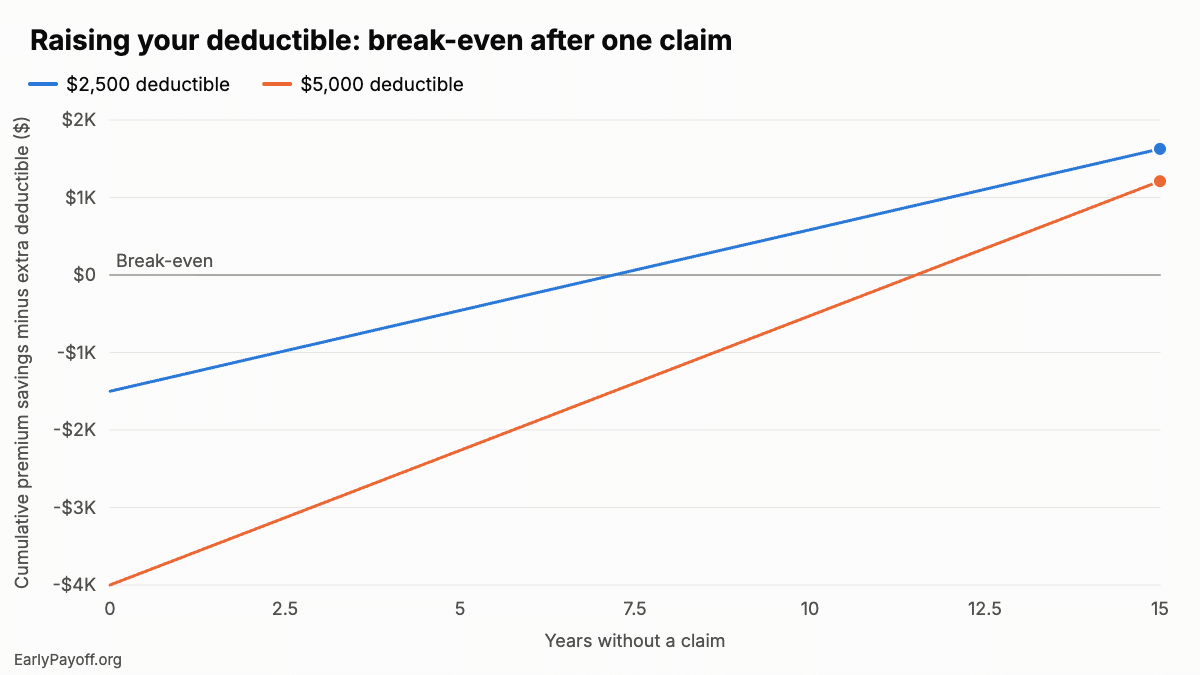
Moving to $2,500 saves $208.44 a year and breaks even after about 7.2 claim-free years. Over ten years with one claim, you come out $584.40 ahead; with two claims you would be $915.60 behind. The $5,000 deductible saves more each year, $347.40, but needs about 11.5 claim-free years to break even and leaves you $526.00 behind after ten years with one claim. A higher deductible makes sense when the premium saving is large relative to the extra exposure and you have cash set aside to pay it. Our guide on budgeting for home maintenance shows how to build that reserve alongside regular upkeep.
Step 4: Read the exclusions, especially flood and earthquake
Standard homeowners policies do not cover flood. FEMA notes that flood damage is not covered by most homeowners policies and that more than 30% of flood claims come from outside high-risk flood zones. National Flood Insurance Program (NFIP) policies cover up to $250,000 for the structure and $100,000 for contents, and new policies generally take 30 days to take effect, so you cannot wait for a storm forecast. If your mortgage is federally backed and the home is in a high-risk flood zone, the lender will require flood insurance. As of October 2026, the NFIP is authorized through December 11, 2026; during past lapses in authorization, new policies could not be written until Congress acted.
Earthquake damage is also excluded. The NAIC says homeowners policies do not cover earthquakes and that earthquake deductibles usually run 10% to 20% of the coverage limit. Other common exclusions include wear and tear, mold, sewer backup (often available as an add-on) and damage from poor maintenance. Compare which add-ons each quote includes rather than assuming they match.
Step 5: Understand what drives your price
Insurers price on the home’s location, construction, age, roof and claims history, and in many states on a credit-based insurance score. Your claims history is usually pulled from a national database often called a CLUE report, which, according to Washington’s insurance commissioner, generally holds up to seven years of home and auto claims. You are entitled to a free copy under the Fair Credit Reporting Act and can dispute errors. Check it before you shop, especially when buying a home, because past claims on the property can affect your quotes too.
A credit-based insurance score is not the same as your credit score, though it draws on similar information. The NAIC says not all states allow these scores in setting premiums, and in most states insurers cannot use them as the sole reason to raise rates. Some states restrict them further or ban certain uses, so ask your state insurance department. Paying on time and keeping balances low helps both scores; see how to improve your credit utilization.
Apples-to-apples comparison worksheet
| Item | What to match or record | Quote A | Quote B | Quote C |
|---|---|---|---|---|
| Policy form | HO-3, HO-5, etc. | |||
| Dwelling (A) | Same rebuilding-cost figure; extended replacement % | |||
| Other structures (B) | Dollar limit or % of A | |||
| Personal property (C) | Limit; replacement cost or actual cash value | |||
| Loss of use (D) | Limit and time cap | |||
| Liability (E) / Medical (F) | Limits | |||
| All-perils deductible | Dollar amount | |||
| Wind / hail / hurricane deductible | % and dollar equivalent | |||
| Roof coverage | Replacement cost or depreciated | |||
| Add-ons | Water/sewer backup, ordinance or law, scheduled jewelry | |||
| Discounts applied | Bundling, alarms, new roof, claims-free | |||
| Annual premium | Total, including fees |
When the cheapest quote is a bad idea
Picking the lowest premium without matching coverage is the most common shopping mistake. A low quote often means a lower Coverage A, actual cash value on belongings or the roof, a percentage wind deductible, or missing add-ons. Any of those can cost far more than the premium saved after one serious claim.
Switching insurers can also be a bad idea in the middle of an open claim, or if you would lose a long-tenure discount worth more than the savings. Never let coverage lapse between policies; a gap can break your mortgage terms and lead the servicer to buy expensive force-placed coverage on your behalf. And a very high deductible is a poor fit if you do not have the cash to pay it. If paying off your mortgage early is your goal, remember that you will still need insurance once the loan is gone; see whether to pay off your mortgage early for how that fits your budget.
Frequently asked questions
How many home insurance quotes should I get?
Three is a practical minimum, and more is better if your area has had large premium increases or non-renewals. Give every insurer or agent the same home details and request the same limits and deductibles so the quotes line up on the worksheet.
Should I insure my home for what I paid for it?
No. Dwelling coverage should reflect the cost to rebuild the structure with similar materials, which can be higher or lower than the purchase price. The price you paid includes land and market conditions that insurance does not cover.
Can I switch insurers before my policy renews?
Usually, yes. Most insurers refund unused premium when you cancel mid-term, though some keep a fee, so ask before you switch. Start the new policy before the old one ends, and send the new declarations page to your mortgage servicer if your premium is paid through escrow.
Is flood insurance worth it outside a high-risk zone?
It can be. FEMA reports that more than 30% of flood claims come from outside high-risk flood zones, and homeowners policies exclude flood. Policies in lower-risk areas often cost less, and the 30-day waiting period means you need to buy before a threat appears.
Why did my premium go up when I had no claims?
Rebuilding costs, regional catastrophe losses and reinsurance costs affect everyone in an area, not only those who filed claims. The NAIC found that average premiums rose in every region from 2018 to 2024 and that claim frequency and severity generally increased. Re-shopping with matched coverage is the best way to see whether your price is out of line.
Sources
- Dwelling Fire, Homeowners Owner-Occupied, and Homeowners Tenant and Condominium/Cooperative Unit Owner’s Insurance: Data for 2023 (July 2026), NAIC, accessed Oct 2026
- NAIC Releases First-of-Its-Kind National Analysis of Homeowners Insurance Market Trends (Aug 5, 2026), NAIC, accessed Oct 2026
- What’s the Difference Between Actual Cash Value Coverage and Replacement Cost Coverage?, NAIC, accessed Oct 2026
- What Are Earthquake Deductibles?, NAIC, accessed Oct 2026
- Credit-Based Insurance Scores, NAIC, accessed Oct 2026
- Credit-Based Insurance Scores Aren’t the Same as a Credit Score, NAIC, accessed Oct 2026
- Flood Insurance: An Important Resource for Floridians, FEMA, accessed Oct 2026
- What Happens If the National Flood Insurance Program (NFIP) Lapses? (Sept 11, 2026), Congressional Research Service, accessed Oct 2026
- Fla. Stat. §627.701, Liability of insureds; coinsurance; deductibles, Florida Legislature, accessed Oct 2026
- B7-3-02, Property Insurance Requirements for One- to Four-Unit Properties, Fannie Mae Selling Guide, accessed Oct 2026
- Comprehensive Loss Underwriting Exchange (CLUE) reports, Washington State Office of the Insurance Commissioner, accessed Oct 2026
This article is general education, not individualized financial, tax or legal advice.