

Originally published on EarlyPayoff in February 2016. Fully rewritten and updated in October 2026.
Paying off your mortgage early makes sense when your mortgage rate is higher than what your spare cash could safely earn elsewhere, and only after you have an emergency fund, your full employer retirement match and no high-interest debt. With new 30-year loans averaging 7.40% as of mid-October 2026, extra principal payments now earn a guaranteed return that beats most safe alternatives. If you locked in a low rate years ago, the case is much weaker.
Below is the math on a real-world loan, the tax angle, the rules on prepayment penalties, and a checklist to run through before you send the first extra dollar.
Key takeaways
- On a $350,000, 30-year loan at 7.40%, an extra $250 a month saves $156,237.02 in interest and ends the loan 7 years and 8 months early.
- Every extra dollar of principal “earns” your mortgage rate, risk-free. Compare that to safe yields (about 4.3% to 5.1% on Treasuries in mid-October 2026), not to hoped-for stock returns.
- Money sent to the lender is hard to get back. Build an emergency fund and pay off credit cards first.
- If you take the standard deduction, as many households do, prepaying costs you nothing in lost tax benefits.
- Mark each extra payment “apply to principal” and confirm it on your next statement.
What extra payments actually do
Your monthly mortgage payment is fixed, but the split between interest and principal is not. Interest is charged on the balance you still owe, so early in the loan most of each payment goes to interest. Any extra dollar you pay toward principal shrinks the balance immediately, which lowers the interest charged next month and every month after.
That is why small, steady extra payments add up. They don’t lower your required monthly payment. Instead, they move your payoff date closer and cut the total interest you pay over the life of the loan. If you want to see this month by month, our guide on how to read a mortgage amortization schedule walks through it.
Worked example: $350,000 at today’s average rate
Inputs: a new $350,000, 30-year fixed loan at 7.40%, the Freddie Mac Primary Mortgage Market Survey average for the week of October 15, 2026. The scheduled principal-and-interest payment is $2,423.33 (taxes and insurance not included). Each extra amount starts with the first payment and continues every month until the loan is paid off.
The last row adds one extra full payment per year by paying an extra $201.94 each month (1/12 of the regular payment). That has the same effect as true biweekly payments, without needing a special program.
| Scenario | Payoff time | Total interest | Interest saved | Time saved |
|---|---|---|---|---|
| Baseline (no extra) | 30 yr 0 mo | $522,397.97 | — | — |
| +$100/month | 26 yr 3 mo | $443,583.15 | $78,814.82 | 3 yr 9 mo |
| +$250/month | 22 yr 4 mo | $366,160.95 | $156,237.02 | 7 yr 8 mo |
| +$500/month | 18 yr 3 mo | $287,477.44 | $234,920.53 | 11 yr 9 mo |
| One extra payment/year (+$201.94/month) | 23 yr 5 mo | $387,374.08 | $135,023.89 | 6 yr 7 mo |
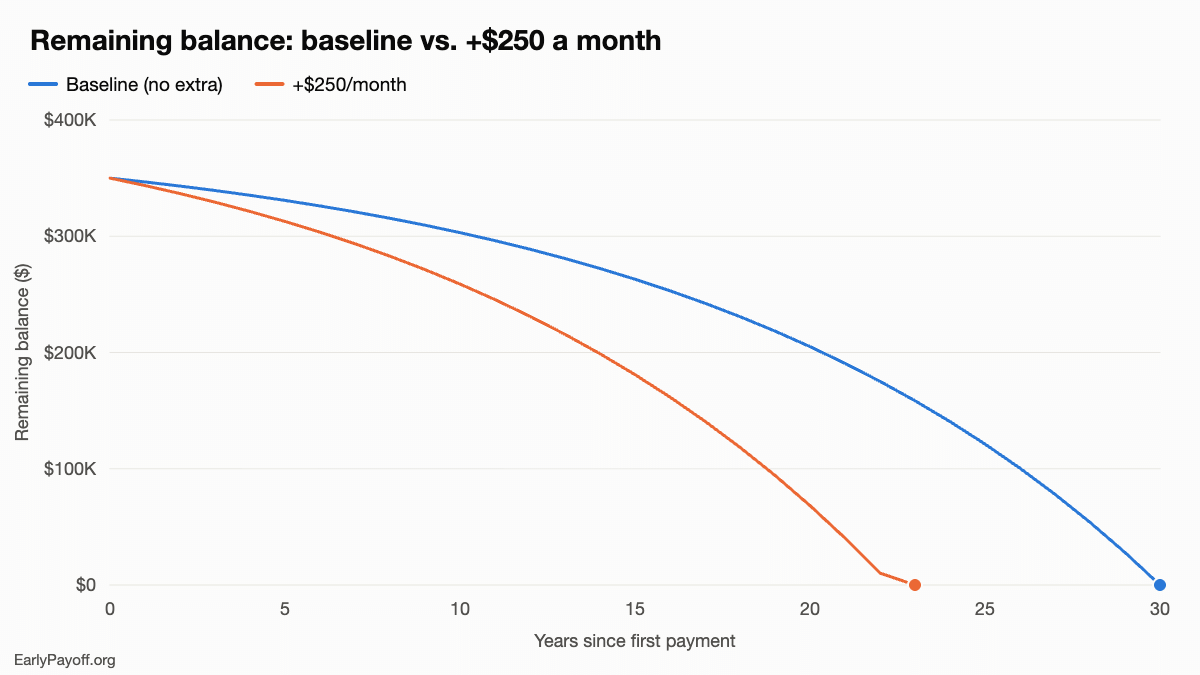
Two things stand out. First, savings grow faster than the extra amount: going from $250 to $500 a month adds another $78,683.51 in savings and ends the loan 4 years and 1 month sooner. Second, the benefit depends heavily on your rate. Run the same $250 a month on the same balance at 3.00% and the savings fall to $42,345.09, because there is far less interest to avoid.
Your own numbers will differ with your balance, rate and remaining term. Our walkthrough on how to calculate an early mortgage payoff shows how to plug in your loan.
Pay off early vs. invest the difference
Prepaying a 7.40% mortgage is like buying an investment that pays 7.40% with no market risk. The fair comparison is other low-risk options. As of October 16, 2026, the Federal Reserve’s H.15 release showed the 3-month Treasury bill at 4.26% and the 10-year Treasury note at 5.09%. Bank savings rates vary widely, so check what your own bank pays.
At today’s new-loan rates, prepaying beats those safe yields by a wide margin. The picture flips for many existing owners. If your rate is 3% or 4%, a Treasury or high-yield savings account can pay you more than prepaying saves you, and you keep access to the money.
Stocks are a different trade. Over long periods, a diversified stock portfolio has historically returned more than most mortgage rates, but with real risk of steep losses along the way and no guarantee for any 10- or 20-year window. Money in a tax-advantaged retirement account also grows with tax benefits that prepaying cannot match. Many people split the difference: they invest for retirement and send a smaller fixed amount to the mortgage.
Liquidity is the hidden cost
Extra principal is locked inside your house. If you lose your job, the lender still expects the full monthly payment; your extra payments do not count as a credit toward future months. Getting the money back means selling, refinancing or borrowing against your equity, and all of those depend on your income, credit and home value at that moment.
That is why an emergency fund comes first. Cash covers a rough patch; home equity may not be reachable when you need it most.
The tax angle: a deduction many people don’t use
Mortgage interest is deductible only if you itemize deductions on your federal return. For tax year 2026, the IRS set the standard deduction at $32,200 for married couples filing jointly, $16,100 for single filers and married people filing separately, and $24,150 for heads of household. You itemize only when your deductions add up to more than that.
In the example above, first-year interest is $25,789.89. A married couple would need about $6,410 in other itemizable deductions, such as state and local taxes or charitable gifts, before that interest saves them a single dollar. Many will never cross that line, so prepaying costs them nothing at tax time.
Even for itemizers, the effect is small early on. Adding $250 a month cuts first-year interest by just $103.86. The deduction is also capped: interest is deductible on up to $750,000 of home acquisition debt ($375,000 if married filing separately) for loans taken out after December 15, 2017, and up to $1 million for older loans. A 2025 law change also trims the value of itemized deductions for people in the top 37% bracket. Ask a tax professional how your situation plays out.
Check for a prepayment penalty first
Many mortgages have no penalty for paying early, but some do. Under the CFPB’s ability-to-repay rule (Regulation Z, section 1026.43(g)), a covered loan can carry a prepayment penalty only if it has a rate that cannot rise, is a qualified mortgage, and is not a higher-priced mortgage loan. State law must also allow it.
Even then, the penalty must end three years after closing. It can be no more than 2% of the amount prepaid in the first two years and 1% in the third. A lender offering a loan with a penalty must also offer you a comparable option without one.
To check your loan, look on page 1 of your Closing Disclosure, where the loan terms table asks whether the loan has a prepayment penalty. Your promissory note also has a section on your right to prepay. The CFPB notes that penalties usually apply to paying off the whole loan or a large chunk, not to small extra principal payments, but confirm with your servicer if your loan has one.
Your order of operations before prepaying
This is a general sequence, not a personal plan. Work down the list and start prepaying only when the items above it are handled.
- Stay current on every bill. A late mortgage payment brings fees and credit damage. On loans Fannie Mae owns, extra money sent while you’re behind goes first to catching up, not to principal, and other servicers often work the same way.
- Build a starter emergency fund, then grow it to several months of essential expenses, including the mortgage.
- Capture your full employer retirement match. A match is an immediate return that prepaying can’t touch.
- Pay off high-interest debt. The Federal Reserve’s G.19 release put the average credit card rate at 21.19% for August 2026, nearly three times today’s mortgage rate. See which debt to pay off first.
- Handle other debt that costs more than your mortgage, such as private student loans or car loans at higher rates.
- Set aside near-term goals such as a car replacement or a roof, so you don’t borrow at a higher rate later.
- Then prepay, if your mortgage rate beats what safe savings would earn you.
How to make extra payments that count
Servicers handle extra money in different ways, and an unmarked overpayment can sit in a suspense account or be applied to next month’s payment instead of principal. To avoid that:
- Use the “additional principal” field in your servicer’s online portal, or write “apply to principal” on a separate check or the payment coupon.
- Pay your regular installment in full first; the extra amount should be on top of it.
- Check your next monthly statement. The principal balance should drop by the regular principal portion plus your extra amount.
- Automate it. A fixed extra amount set up as a recurring payment is easier to keep up than a decision every month.
- Skip paid biweekly programs. Adding 1/12 of a payment each month gets the same result at no cost.
Prepaying vs. recasting
Regular prepayments shorten your loan but leave your monthly payment the same. A recast (re-amortization) does the opposite: after a large lump-sum payment, the lender recalculates your payment over the remaining term, so the monthly bill drops but the payoff date doesn’t move. Fannie Mae’s servicing guide lets servicers re-amortize at the borrower’s request after a substantial principal payment. Minimums and fees are set by each servicer, and not every loan or servicer offers it, so ask yours. For more tactics, see our early mortgage payoff strategies.
When paying early is a bad idea
- Your rate is low. If safe savings pay more than your mortgage rate, prepaying loses money compared with saving.
- Your emergency fund is thin or your income is unstable. Cash on hand matters more than equity.
- You carry credit card or other high-rate debt. Pay that first.
- You’re skipping a retirement match or are far behind on retirement savings.
- You plan to sell soon. You’ll repay the balance at sale anyway, and the cash may be more useful for your next down payment.
- Your loan has an active prepayment penalty that would cost more than you’d save.
After the last payment
Once the loan is gone, the payment you were making becomes free cash flow. Decide in advance where it goes, or it tends to disappear into everyday spending. Common choices are retirement accounts, a larger emergency fund, or savings for future home repairs.
If your lender paid property taxes and insurance from an escrow account, those bills now come to you. Set aside money each month so the annual tax bill and insurance renewal don’t catch you short. Also confirm that the lender sends a lien release and that it is recorded with your county.
Frequently asked questions
Does an extra payment lower my monthly payment?
No. On a standard fixed-rate loan, extra principal shortens the loan and cuts interest, but the required payment stays the same. To lower the payment, you’d need to ask your servicer about a recast or refinance.
Is one big lump sum better than monthly extras?
Money applied sooner saves more interest, so a lump sum today beats the same amount spread over a year. But don’t drain savings to make it. Steady monthly extras are easier to sustain and keep your cushion intact.
Can I stop making extra payments if money gets tight?
Yes. Extra payments are voluntary, and you can pause them anytime. What you can’t do is skip a required payment because you paid extra earlier; the regular installment is still due each month.
Should I refinance to a 15-year loan instead?
A 15-year loan usually carries a lower rate but forces the higher payment every month. Extra payments on a 30-year loan give you flexibility to scale back. Compare closing costs and the rate difference before deciding.
Will paying off my mortgage hurt my credit score?
Closing an installment loan can cause a small, usually temporary change in your score because your mix of active accounts changes. The paid account stays on your report as a positive history. For most people this isn’t a reason to keep a mortgage.
Sources
- Freddie Mac, Primary Mortgage Market Survey (30-year fixed average, week of Oct 15, 2026), accessed Oct 2026
- Federal Reserve, H.15 Selected Interest Rates (Treasury yields for Oct 16, 2026), accessed Oct 2026
- Federal Reserve, G.19 Consumer Credit (credit card interest rate, Aug 2026), accessed Oct 2026
- IRS, IRS releases tax inflation adjustments for tax year 2026, including amendments from the One, Big, Beautiful Bill, accessed Oct 2026
- IRS, Publication 936, Home Mortgage Interest Deduction, accessed Oct 2026
- IRS, Instructions for Form 1098, accessed Oct 2026
- CFPB, Regulation Z § 1026.43, Minimum standards for transactions secured by a dwelling, accessed Oct 2026
- CFPB, What is a prepayment penalty?, accessed Oct 2026
- CFPB, Closing Disclosure explainer, accessed Oct 2026
- Fannie Mae Servicing Guide, C-1.2-01: Processing Additional Principal Payments, accessed Oct 2026
Figures are as of October 2026. This article is general education, not individualized financial, tax or legal advice.