

To build an emergency fund from zero, open a separate federally insured savings account, set up an automatic transfer on payday, and aim first for $1,000. Then keep the same transfer running until you have three to six months of essential expenses, more if your income is irregular. At $50 a week, the first $1,000 takes 20 weeks. The larger target takes longer, and that is normal.
Key takeaways
- In 2025, 63% of U.S. adults said they would cover a $400 emergency with cash or its equivalent, and 55% had three months of emergency savings (Federal Reserve, as of October 2026).
- Using average household spending on housing, transportation, food and health care, three months of core costs is about $13,987.50.
- At $100 a week in a savings account earning an assumed 3.80%, you reach $1,000 in 10 weeks and that three-month target in 134 weeks.
- Keep the fund in an FDIC- or NCUA-insured account, where deposits are covered up to $250,000 per depositor, per ownership category, at each institution.
What an emergency fund is for
An emergency fund is cash set aside for costs you did not plan and cannot put off: a car repair you need to get to work, an urgent dental or medical bill, a furnace that fails in January, or a gap in income after a layoff. The CFPB describes it as a cash reserve kept specifically for unplanned expenses and financial emergencies. Without one, even a small shock tends to land on a credit card or a loan.
Many households are in that position. In the Federal Reserve’s survey of household finances for 2025, 63% of adults said they would pay a $400 emergency expense entirely with cash or its equivalent. That share has been 63% every year since 2022. In the same survey, 55% said they had emergency savings that would cover three months of expenses (Federal Reserve SHED, as of October 2026). If you are starting at zero, you are not unusual, and the steps below work from any income.
How big your emergency fund should be
Base the target on your essential monthly costs, not your full spending. Essentials are the bills you would still pay if your income stopped: housing, utilities, groceries, insurance, transportation to work, health costs and minimum debt payments. The CFPB suggests looking at the unexpected costs you have actually had in the past as a guide.
Job loss is the emergency that sets the upper end. In September 2026, the median length of unemployment was 11.5 weeks, and in August 2026 about 27% of unemployed people had been looking for 27 weeks or longer (BLS, via FRED, as of October 2026). Unemployment insurance replaces only part of your pay, and the amount and length of benefits vary by state, so check your state’s program before you count on it.
| Household situation | Suggested target | Why |
|---|---|---|
| Starting from zero, any household | $1,000 starter fund | Covers many single repairs or bills and stops the next one from going on a card |
| Two steady incomes, no dependents | 3 months of essentials | One income can usually cover part of the bills during a job search |
| Single income, or children or other dependents | 6 months of essentials | No second paycheck to fall back on; more people rely on the same income |
| Self-employed, commission or seasonal income | 6 to 12 months of essentials | Income swings are normal, and unemployment benefits may not apply |
| Homeowner | Add a separate repair cushion on top of the above | Roofs, water heaters and appliances fail on their own schedule |
| Retired, on fixed income | Enough to cover large irregular costs, such as several months of expenses | Lower job-loss risk, but selling investments in a down market to pay a bill is costly |
For a sense of scale, the BLS Consumer Expenditure Survey shows that the average U.S. household spent $78,535 in 2024. Of that, $55,950 went to housing, transportation, food and health care, or $4,662.50 a month (BLS, released December 2025, latest available as of October 2026). Three months of those core costs is $13,987.50, and six months is $27,975. Your number may be much lower or higher. Use your own bills.
Where to keep it
An emergency fund needs to be safe, quick to reach, and a little inconvenient to spend on everyday things. A savings or money market deposit account at a bank insured by the FDIC, or a credit union insured by the NCUA, meets all three. Deposits are insured up to $250,000 per depositor, per ownership category, at each insured institution (FDIC; NCUA, as of October 2026). Stocks, bonds, mutual funds and Treasury bills are not covered by deposit insurance.
The interest rate matters more as the fund grows. The FDIC’s national average savings rate was 0.38% as of its October 19, 2026 update, while some online savings accounts pay several percentage points more. Check that any account you choose is federally insured and has no monthly fee you would trigger. Federal rules no longer limit savings withdrawals to six a month; the Federal Reserve removed that limit in April 2020. Some banks still set their own limits, so read the account terms. Once the fund is large, you can hold part of it in short-term CDs or Treasury bills. Our guide to saving for a big purchase covers short-term savings options in more detail.
How to build it from $0, step by step
- Open a separate account. Use a different bank from your checking if you tend to dip in. Name it “Emergency fund” so its purpose is clear every time you see it.
- Automate the deposit. Schedule a transfer for the day after payday, or ask your employer to split your direct deposit between checking and savings. Start with any amount you can keep up, even $25 a week.
- Find the money in your budget. Pick one or two costs to cut and send the exact savings to the fund. Our guide to building a budget that works shows how to find them.
- Send windfalls straight in. Tax refunds, cash gifts, bonuses and money from selling things you no longer use can jump-start the fund.
- Raise the transfer when your pay rises. Add part of every raise to the automatic amount before you get used to spending it.
- Refill after you use it. Spending the fund on a real emergency is the point. Restart or increase the transfer right after.
Some employers now offer emergency savings features linked to a retirement plan. Separately, since 2024 you may be able to take one distribution a year of up to $1,000 from a retirement plan or IRA for a personal or family emergency without the 10% early-withdrawal penalty (IRS, as of October 2026). Income tax may still apply. After taking one, you generally cannot take another for three years unless you repay it or make new contributions of at least that amount. It also shrinks your retirement savings, so treat it as a backstop, not a substitute.
Worked example: how long it takes
Four households start at $0 and save a fixed amount each week. Each aims first for $1,000, then for three months of the core costs above, $13,987.50. Their savings account earns an assumed 3.80% APY, compounded weekly. The last columns show the same goal at the FDIC national average savings rate of 0.38%.
| Saved per week | About per month | Weeks to $1,000 | Weeks to $13,987.50 at 3.80% | Interest earned at 3.80% | Weeks at 0.38% | Interest earned at 0.38% |
|---|---|---|---|---|---|---|
| $25 | $108.33 | 40 | 471 (9.1 years) | $2,228.08 | 549 | $277.99 |
| $50 | $216.67 | 20 | 256 (4.9 years) | $1,245.41 | 277 | $140.35 |
| $100 | $433.33 | 10 | 134 (2.6 years) | $660.02 | 140 | $71.21 |
| $200 | $866.67 | 5 | 69 (1.3 years) | $342.10 | 70 | $35.29 |
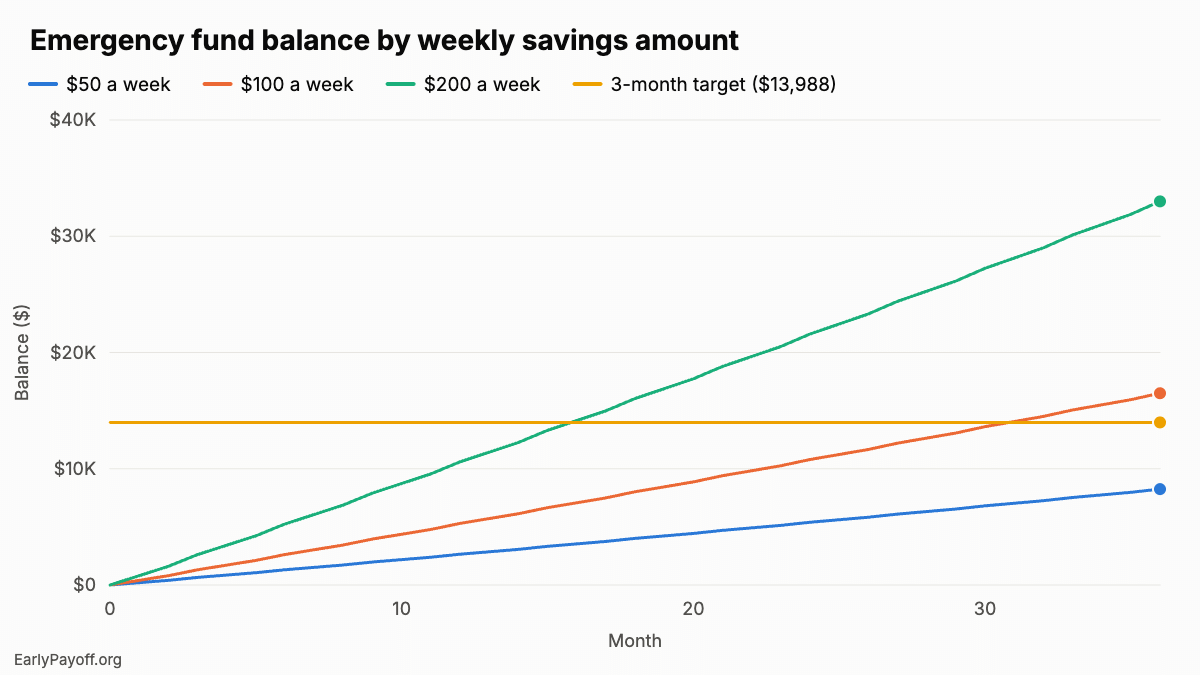
Two things stand out. First, the $1,000 starter fund is reachable quickly at almost any saving rate, and it removes the most common reason people borrow. The same $1,000 put on a credit card at 22.36%, the Federal Reserve’s August 2026 average for card accounts assessed interest, and repaid in 12 monthly payments of $93.77 costs $125.19 in interest (Federal Reserve G.19, as of October 2026). Second, the full target takes years at small amounts. Raising the weekly transfer has far more effect than the interest rate. At $50 a week, a higher rate earns $1,105.06 more interest than the national average and saves 21 weeks, but doubling the deposit to $100 cuts 122 weeks.
Emergency fund or debt payoff first?
Both matter, so most households do them in order. Build the $1,000 starter fund first while making minimum payments on everything. Then put most of your extra money toward high-interest debt, such as credit cards, while a smaller transfer keeps growing the fund. When the cards are gone, move that payment amount to the emergency fund until it reaches your full target. Our guide to which debt to pay off first explains the order for the debts themselves.
If your employer matches retirement contributions, contribute at least enough to get the full match while you build the fund. Missing a match gives up money you cannot get back later.
When this plan is a bad idea or needs changes
- You are already behind on essential bills. If rent, utilities or car payments are past due, catch up first. Late fees and shutoffs cost more than a small fund protects.
- The fund is far past your target. Holding many years of expenses in savings means missing growth elsewhere. Once your target is met, send new money to debt payoff or retirement.
- The fund sits in investments. A brokerage account can lose value the same month you lose your job. Keep at least the first few months in insured deposits.
- Your income is tight and the transfer causes overdrafts. An overdraft fee can wipe out weeks of saving. Start smaller, or move money manually after you check your balance.
FAQ
Is $1,000 enough for an emergency fund?
It is a good first goal, not a finish line. It covers many single repairs or bills, but not a job loss. Keep saving toward three to six months of essential expenses once the starter fund is in place.
Should I keep my emergency fund in a high-yield savings account?
For most people, yes, as long as the account is FDIC- or NCUA-insured and you can move money to checking within a day or two. Compare the rate, any fees and transfer limits before you open one.
Can I use a credit card as my emergency fund?
It can bridge a short gap, but it is not a fund. The issuer can lower your limit, and a balance at the average rate costs real money each month. Cash in savings has no interest cost and cannot be cut off.
What counts as an emergency?
Something unexpected, necessary and urgent: a job loss, a needed car or home repair, or a medical bill. Holidays, annual insurance premiums and vacations are predictable, so save for them separately.
Does interest on my emergency fund get taxed?
Yes. Interest on savings accounts is generally taxable income in the year it is credited, and your bank reports it to the IRS. On a small fund the tax is modest, but it is worth knowing at filing time.
Sources
- Federal Reserve, Federal Reserve Board issues Economic Well-Being of U.S. Households in 2025 report (May 13, 2026), accessed Oct 2026
- Federal Reserve, Report on the Economic Well-Being of U.S. Households: Unexpected expenses, accessed Oct 2026
- Federal Reserve, Report on the Economic Well-Being of U.S. Households: Emergency savings, accessed Oct 2026
- CFPB, An essential guide to building an emergency fund, accessed Oct 2026
- BLS, Consumer Expenditures – 2024 (released Dec 19, 2025), accessed Oct 2026
- BLS, Median Weeks Unemployed (UEMPMED), via FRED, accessed Oct 2026
- BLS, Of Total Unemployed, Percent Unemployed 27 Weeks and Over (LNS13025703), via FRED, accessed Oct 2026
- FDIC, National Rates and Rate Caps (Oct 19, 2026), accessed Oct 2026
- FDIC, Understanding Deposit Insurance, accessed Oct 2026
- NCUA, Share Insurance Coverage, accessed Oct 2026
- Federal Reserve, Interim final rule on Regulation D savings deposits (Apr 24, 2020), accessed Oct 2026
- IRS, Retirement topics: Exceptions to tax on early distributions, accessed Oct 2026
- Federal Reserve, Consumer Credit – G.19 (Oct 7, 2026), accessed Oct 2026
This article is general education, not individualized financial, tax or legal advice.