

Pay the minimum on every debt first, then send every extra dollar to the debt with the highest interest rate, usually a credit card. That order, called the avalanche method, costs the least in interest. The exceptions come from what happens if you fall behind: a mortgage or car loan is backed by your home or car, a federal student loan has repayment options most other debts lack, and some debts can be moved to a lower rate.
Key takeaways
- Stay current on every account before paying extra on any of them. Late payments can bring penalty rates and can stay on your credit reports for up to seven years.
- In the example below, paying highest rate first (avalanche) cost $468.61 less in interest than paying smallest balance first (snowball). Both finished in 40 months.
- Paying only the minimums on the same debts takes 242 months and costs $29,803.39 in interest, $21,895.25 more than avalanche and $21,426.64 more than snowball.
- Low-rate secured debt (mortgage, car) and flexible federal student loans usually come last for extra payments, even though falling behind on secured debt has the worst consequences.
- Keep a small emergency cushion and take any employer retirement match before you start aggressive payoff. Without a cushion, the next surprise bill goes back on a card.
Step one: keep every account current
Every strategy below assumes you pay at least the minimum on every debt, every month. Being late costs you three ways.
Fees. Card issuers charge late fees. A 2024 federal rule that would have capped most credit card late fees at $8 never took effect. A federal court vacated it on April 15, 2025, so larger issuers can still charge the higher amounts allowed under the older rules. Your card agreement lists your actual fee (CFPB, as of Oct 2026).
Penalty rates. A card issuer generally can’t raise the rate on a balance you already have. One exception is a minimum payment that arrives more than 60 days after the due date. A missed payment can also end a promotional balance transfer rate (CFPB, as of Oct 2026).
Credit damage. Late payments that get reported can stay on your credit reports for up to seven years (CFPB, as of Oct 2026). A lower score also makes refinancing and balance transfers harder to get.
If you can’t cover all your minimums, call your lenders before you miss a payment. Auto lenders and mortgage servicers may offer payment plans, due-date changes or short-term forbearance. Get any agreement in writing (CFPB, as of Oct 2026).
Avalanche vs. snowball: a worked example
Once every account is current, decide where the extra money goes:
- Avalanche: extra money goes to the highest interest rate first.
- Snowball: extra money goes to the smallest balance first.
With either method, when a debt is paid off, its payment moves to the next debt on the list, so the total you pay each month stays the same.
The example household below owes $51,600 across five debts. The rates are based on Federal Reserve data. In the second quarter of 2026, the average rate on credit card accounts that were charged interest was 22.15%. The averages were 11.86% for a 24-month personal loan and 6.97% for a 72-month new-car loan (Federal Reserve G.19, released Oct 7, 2026). The student loan uses 6.52%, the fixed rate on new undergraduate federal Direct Loans for 2026–27 (Federal Student Aid, as of Oct 2026).
| Debt | Balance | APR | Required payment (month 1) |
|---|---|---|---|
| Card A (higher-rate card) | $7,400 | 24.99% | $228.10 |
| Card B (average-rate card) | $3,800 | 22.15% | $108.14 |
| Personal loan (24 months left) | $2,900 | 11.86% | $136.33 |
| Car loan (48 months left) | $16,500 | 6.97% | $394.89 |
| Federal student loan (10-year plan) | $21,000 | 6.52% | $238.67 |
| Total | $51,600 | $1,106.13 |
The household pays a fixed $1,506.13 a month, which is the starting minimums plus $400. Interest accrues monthly on each balance and no new charges are added. The card minimum is that month’s interest plus 1% of the balance, with a $35 floor. Issuers’ formulas vary. The installment loans keep their fixed payments.
| Strategy | Payoff order | First debt gone | Debt-free | Total interest |
|---|---|---|---|---|
| Avalanche (+$400/mo) | Card A, Card B, personal loan, car loan, student loan | Month 14 | Month 40 | $7,908.14 |
| Snowball (+$400/mo) | Personal loan, Card B, Card A, car loan, student loan | Month 6 | Month 40 | $8,376.75 |
| Minimums only | Personal loan, car loan, student loan, Card B, Card A | Month 24 | Month 242 | $29,803.39 |
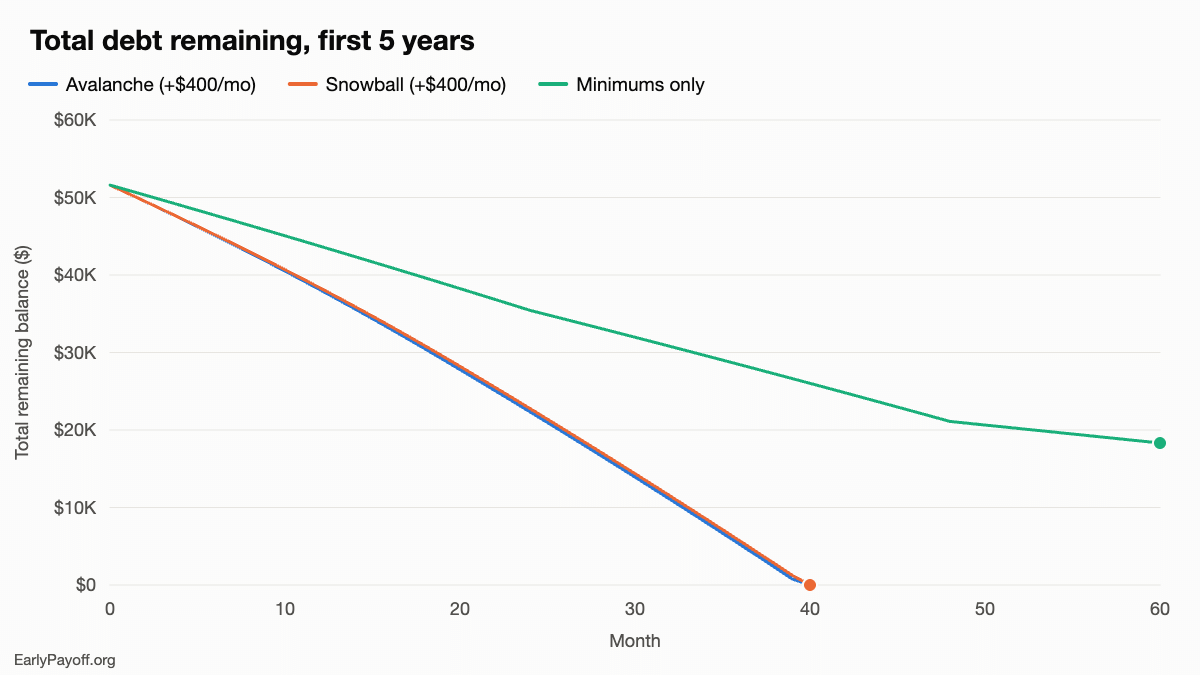
Here is what the comparison shows:
- Avalanche costs the least. It saved $468.61 compared with snowball. The gap is small because both methods clear the cards early. It grows when a large balance has the highest rate.
- Snowball gives a faster first win. The first debt is gone in month 6 instead of month 14. If early wins keep you going, that may be worth the cost.
- The $400 matters more than the order. Paying only the minimums takes more than 20 years and costs $21,426.64 to $21,895.25 more in interest than the two plans. The cards finish last because their minimums shrink with the balance.
If one card has several balances at different rates, federal rules generally require the issuer to apply anything above the minimum to the highest-rate balance first (CFPB, as of Oct 2026). On a federal student loan, extra money may be counted as an early payment of next month’s bill instead of reducing your balance. Ask your servicer to apply it to principal (CFPB, as of Oct 2026).
Beyond the interest rate: a priority framework
The interest rate doesn’t tell you what happens if you fall behind, whether the interest is tax-deductible, or whether the lender can lower your payment. The table below covers those factors.
| Debt type | If you stop paying | Tax treatment | Flexibility | Typical extra-payment priority |
|---|---|---|---|---|
| Mortgage | Foreclosure. The legal process generally can’t start until you are at least 120 days behind; after that, timelines vary by state. | Interest may be deductible if you itemize (IRS Pub. 936). | Servicer loss-mitigation programs; free HUD-approved housing counselors. | Last. Always stay current. |
| Car loan | Repossession. In many states this can happen without warning after a missed payment. | Interest on certain new-vehicle loans taken out after 2024 may be deductible for 2025–2028, up to $10,000 a year, with income limits. | Lender may offer a payment plan, due-date change or forbearance. | Low. Always stay current. |
| Credit cards | Late fees, a possible penalty rate, collections, and a lawsuit in some cases. | Not deductible. | Hardship plans vary by issuer; nonprofit debt management plans. | First (highest rate). |
| Personal loan | Collections and possible lawsuit; unsecured. | Generally not deductible for personal use. | Limited; ask the lender. | By rate, usually after cards. |
| Federal student loans | Default carries serious consequences, and federal student loans have no statute of limitations. | Up to $2,500 of interest a year may be deductible, subject to income limits (IRS Topic 456). | Income-driven repayment, deferment and forbearance. | Low, unless the rate is high and your income is steady. |
| Medical bills | Collections. The credit-reporting rules are covered below. | Not deductible as interest. | Providers often accept payment plans; ask about financial assistance. | Negotiate first; often low. |
| Buy now, pay later | Late fees, collections; reporting varies by lender. | Not deductible. | Little; short fixed schedules. | Keep current; avoid stacking new plans. |
Secured vs. unsecured debt
Secured debt is backed by property you can lose, like a house or a car. That makes staying current on it the top priority, but not paying it off early, since these loans usually carry lower rates than cards. If money is tight, cover the mortgage and car payment before card minimums.
In the example, the car loan rate is close to the student loan rate. If the car loan qualifies for the new car-loan interest deduction, its after-tax cost may drop below the student loan’s. To qualify, the vehicle must be new, for personal use and assembled in the U.S. Income limits start at $100,000 of modified AGI for single filers and $200,000 for joint filers (IRS, as of Oct 2026). Check whether yours qualifies before you choose between the two.
Federal student loans: flexibility counts
Federal loans can tie your payment to your income. Repayment changed on July 1, 2026. The new Repayment Assistance Plan sets payments at 1% to 10% of income, minus $50 a month for each dependent. Borrowers with loans made before that date can choose that plan, a tiered standard plan, or Income-Based Repayment until July 1, 2028 (U.S. Department of Education, as of Oct 2026). The plan list is still changing, so confirm your options at studentaid.gov before you rely on them. For details, see how to apply for income-driven repayment.
Paying off a federal loan early gives up that flexibility and any progress toward forgiveness. If your income is unstable, put extra money toward cards and savings first.
Medical debt: what is reported now
In January 2025, the CFPB finalized a rule to remove most medical debt from credit reports. On July 11, 2025, a federal court in the Eastern District of Texas vacated the rule in Cornerstone Credit Union League v. CFPB, so it never took effect (CFPB, as of Oct 2026). Under the three national credit bureaus’ own policies, unpaid medical debt can show up only after it is more than 365 days past due and over $500. Paid medical collections are removed (CFPB, as of Oct 2026).
Several states have their own limits, but the same court said federal law preempts such rules, so their effect is unsettled. Medical debt usually doesn’t charge interest, so it moves to the front of the line mainly when it is close to being reported or sent to collections. Before paying, ask for an itemized bill and about financial assistance.
Buy now, pay later
Buy-now-pay-later plans usually charge no interest, so they rarely belong at the top of an avalanche list. Reporting is inconsistent. Some lenders report to the credit bureaus and others don’t, and the bureaus have handled the data in different ways (CFPB, 2022). In May 2025, the CFPB withdrew its 2024 rule that would have treated these plans more like credit cards (CFPB, as of Oct 2026). The bigger risk is losing track of several plans with different due dates, so budget them like any other minimum.
How balance transfers and consolidation change the order
A balance transfer or consolidation loan doesn’t reduce what you owe. It moves the debt to a lower rate, and that changes the order. A card at 0% is no longer the most expensive debt, so the next-highest rate becomes the avalanche target until the promotion ends.
Transfers usually come with a fee, which is generally a percentage of the amount moved or a flat dollar minimum, whichever is greater. The issuer can charge the fee even on a 0% offer (CFPB, as of Oct 2026). On Card A, each percentage point of fee costs $74. One month of interest on that card at 24.99% is $154.10. So a 3% fee is about $222, roughly a month and a half of interest, and a long 0% period can more than pay for it. Before you transfer, check three things:
- The promotional rate must last at least six months, and the rate after it ends applies to whatever balance is left (CFPB).
- New purchases on the transfer card may be charged interest right away, with no grace period, until the whole balance is paid (CFPB).
- A payment more than 60 days late can bring a penalty rate on all balances, including the transferred one (CFPB).
A fixed-rate personal loan does a similar job with a set end date. It helps only if the rate and fees beat what you pay now and the term isn’t stretched out. A lower monthly payment over more years can cost more in total. For the details, see debt consolidation with a personal loan. Consolidation works only if you stop adding new charges.
Emergency fund, retirement match and the mortgage
A common rule-of-thumb order:
- Pay all minimums on time.
- Build a small starter emergency fund so a car repair doesn’t go on a card.
- Contribute enough to get any employer retirement match. A match is usually an immediate return on your contribution that beats even a 25% card rate.
- Pay off high-rate debt with the avalanche or snowball method.
- Grow the emergency fund to cover several months of expenses.
- Then decide about mid-rate and low-rate debt, including the mortgage.
Prepaying the mortgage usually comes last. It often has your lowest rate, the interest may be deductible, and money sent to it can’t come back out without a new loan. It can make sense once higher-rate debt is gone and savings are solid. For the full trade-off, see should you pay off your mortgage early.
When this approach is a bad idea
A payoff order assumes you can cover every minimum with money left over. It is the wrong tool when:
- You can’t cover your minimums. Talk to a nonprofit credit counselor before you fall behind. Counselors can set up a debt management plan with a single monthly payment and may get your rates or fees lowered. They are allowed to charge fees, so ask about costs up front (CFPB). To find one, start with the U.S. Trustee Program’s list of approved credit counseling agencies, which is organized by state and judicial district.
- Some debts are already in collections. A collection account follows different rules, and paying it may not help your score as much as staying current on your active accounts. Read how to deal with a debt collector before you pay anything.
- An old debt may be past the statute of limitations. Most states set limits of three to six years for lawsuits over debt. In some states, a small payment or a written acknowledgment can restart the clock (CFPB). Check your state’s rules, or ask a lawyer, before you pay on an old account.
- You have no emergency savings. Without a cushion, the next surprise bill lands on a card.
- Your income is uncertain. Cash is more flexible than a paid-down balance.
FAQ
Is the avalanche or snowball method better?
Avalanche almost always costs the same or less in interest. In the example above, it saved $468.61. Snowball pays off the first debt sooner, in month 6 instead of month 14. Choose the method you will keep up for years, because sticking with a plan matters more than the difference between the two.
Should I pay off my car loan or my credit card first?
Keep the car loan current, since missing payments can lead to repossession. Send extra money to the credit card, because card rates are usually much higher. The 2026 Q2 averages were 22.15% on cards that charged interest and 6.97% on 72-month new-car loans (Federal Reserve G.19).
Does paying off a debt early hurt my credit?
Paying a card balance down usually helps, because you are using less of your available credit. Paying off an installment loan closes the account. Your score may shift a little, but the on-time payment history stays on your report. Avoid closing old credit cards you have paid off unless they charge an annual fee.
Should I pay medical bills before credit cards?
Usually not for extra payments, because most medical bills don’t charge interest. Do set up a payment plan with the provider so the bill doesn’t go to collections. Under the credit bureaus’ current policies, unpaid medical debt can appear on your report only after a year and above $500.
Where should a tax refund or bonus go?
Follow the same order. If your emergency fund is short, fill it first. Then put the money toward the debt your method targets. A one-time payment to the highest-rate card saves interest every month after.
Sources
- Federal Reserve, Consumer Credit – G.19 (release of Oct 7, 2026), accessed Oct 2026
- Federal Student Aid, Interest Rates for Federal Direct Loans First Disbursed Between July 1, 2026 and June 30, 2027, accessed Oct 2026
- U.S. Department of Education, Fact Sheet: Simplifying Student Loan Repayment, accessed Oct 2026
- CFPB, Credit card penalty fees, accessed Oct 2026
- CFPB, When can my credit card company increase my interest rate?, accessed Oct 2026
- CFPB, How long does information stay on my credit report?, accessed Oct 2026
- CFPB, How does my credit card company calculate the amount of interest I owe?, accessed Oct 2026
- CFPB, Can I make additional payments on my student loan?, accessed Oct 2026
- CFPB, How long will it take before I’ll face foreclosure?, accessed Oct 2026
- CFPB, What happens if my car is repossessed?, accessed Oct 2026
- CFPB, What should I do if I can’t make my car payments?, accessed Oct 2026
- CFPB, Prohibition on Creditors and Consumer Reporting Agencies Concerning Medical Information (Regulation V), accessed Oct 2026
- CFPB, Do medical bills affect my credit?, accessed Oct 2026
- CFPB, Buy Now, Pay Later (BNPL) products, accessed Oct 2026
- CFPB, Buy Now, Pay Later and Credit Reporting (2022, archived), accessed Oct 2026
- CFPB, What is a balance transfer fee?, accessed Oct 2026
- CFPB, What do I need to know about consolidating my credit card debt?, accessed Oct 2026
- CFPB, What is the difference between credit counseling and debt settlement?, accessed Oct 2026
- CFPB, Can debt collectors collect a debt that’s several years old?, accessed Oct 2026
- U.S. Trustee Program, List of Credit Counseling Agencies Approved Pursuant to 11 U.S.C. § 111, accessed Oct 2026
- IRS, Topic No. 456, Student Loan Interest Deduction, accessed Oct 2026
- IRS, Publication 936, Home Mortgage Interest Deduction, accessed Oct 2026
- IRS, FS-2025-03, New tax deductions for working Americans and seniors (car loan interest), accessed Oct 2026
This article is general education, not individualized financial, tax or legal advice.