

To choose a federal student loan repayment plan now that SAVE is gone, start with one date: whether you received any Direct Loan on or after July 1, 2026. If you did, your only choices are the Repayment Assistance Plan (RAP) and the Tiered Standard plan. If all your loans are older, you can also use the 10-year Standard, Graduated, Extended and Income-Based Repayment (IBR) plans. Then pick by goal. The 10-year Standard plan costs the least if you can afford it, RAP or IBR keeps payments tied to income, and only certain plans count toward Public Service Loan Forgiveness (PSLF).
Key takeaways
- SAVE ended in March 2026, when a court approved the Education Department’s settlement with Missouri. Former SAVE borrowers who don’t pick a plan are placed in the Standard or Tiered Standard plan.
- For a single borrower with $34,000 at 6.52% and $48,000 of income, payments range from $160.00 a month on RAP to $386.41 on the 10-year Standard plan.
- The lowest payment is rarely the cheapest plan. The 25-year Extended plan costs $68,996.63 in total, versus $46,369.04 on the 10-year Standard.
- The Education Department says Tiered Standard payments do not count toward PSLF. RAP, IBR and the 10-year Standard plan do.
Which plans you can choose, as of October 2026
The 2025 budget law (Public Law 119-21) rewrote federal repayment, and the Education Department’s final rule took effect July 1, 2026 (91 FR 23768). The plans available to you depend on when your loans were made.
| Plan | Who can use it | Monthly payment | Ends with | Counts for PSLF |
|---|---|---|---|---|
| 10-year Standard | Loans made before July 1, 2026, with no newer Direct Loan | Fixed; at least $50 | Paid off in 10 years | Yes |
| Graduated | Same as above | Starts low and rises; no payment more than three times another | Paid off in up to 10 years (longer for some consolidation loans) | Only months paying at least the 10-year Standard amount |
| Extended | Same as above, with more than $30,000 in Direct Loans | Fixed or graduated; at least $50 | Paid off in up to 25 years | Only months paying at least the 10-year Standard amount |
| Tiered Standard | Anyone with a Direct Loan made on or after July 1, 2026 (RAP is the only alternative); former SAVE borrowers who miss their deadline can also be placed in it | Fixed; at least $50 | Paid off in 10, 15, 20 or 25 years for balances under $25,000, under $50,000, under $100,000, or $100,000 and up | No, per the Education Department |
| Income-Based Repayment (IBR) | Loans made before July 1, 2026, with no newer Direct Loan | 10% of income above 150% of the poverty guideline (15% for pre-July 2014 borrowers), capped at the 10-year Standard payment | Forgiveness after 20 or 25 years | Yes |
| Repayment Assistance Plan (RAP) | Most Direct Loan borrowers; not parent PLUS loans | 1% to 10% of AGI, minus $50 per dependent; $10 minimum; no cap | Forgiveness after 360 qualifying payments (30 years) | Yes |
| PAYE and ICR | Existing enrollees only | Income-based | Closing no later than July 1, 2028 | ICR payments count only through June 30, 2028 |
Two rules catch people off guard. First, a single new Direct Loan disbursed on or after July 1, 2026, including a new consolidation loan, moves all your loans to the RAP-or-Tiered-Standard menu. You lose IBR, Graduated and Extended even for older loans. Second, PAYE and ICR are being phased out. If you are on either, you must move to RAP, IBR, Standard, Graduated or Extended by July 1, 2028.
If you were on SAVE
The Education Department said that in March 2026 a court approved its settlement with the State of Missouri, which ended SAVE. Starting July 1, 2026, servicers began sending SAVE borrowers notices with a personal deadline of at least 90 days to choose a new plan. Borrowers who don’t choose are placed in the Standard or the Tiered Standard plan automatically (U.S. Department of Education, as of October 2026). If you want an income-driven plan, apply rather than wait. The step-by-step process is in how to apply for income-driven repayment.
Worked example: one borrower, five plans
A single borrower with no dependents owes $34,000 in unsubsidized Direct Loans, first borrowed after July 1, 2014. The example uses a 6.52% rate, the 2026–27 undergraduate Direct Loan rate, for the whole balance. Adjusted gross income (AGI) is $48,000. RAP charges 4% at that income. IBR counts income above $23,940, which is 150% of the 2026 poverty guideline of $15,960 for one person (HHS), leaving $24,060 of discretionary income.
Income-based payments change over time, so the table shows two cases for RAP and IBR: income stays at $48,000, or income and the poverty guideline both rise 3% a year. Both are assumptions, not forecasts.
| Plan | First monthly payment | Total paid, income flat | Left to forgive, income flat | Total paid, income +3% a year |
|---|---|---|---|---|
| 10-year Standard | $386.41 | $46,369.04 (10 years) | $0.00 | $46,369.04 |
| Tiered Standard (15 years) | $296.55 | $53,379.19 (15 years) | $0.00 | $53,379.19 |
| Extended (25 years, fixed) | $230.00 | $68,996.63 (25 years) | $0.00 | $68,996.63 |
| IBR (10%) | $200.50 | $48,120.00 (20 years) | $26,249.12 | $64,650.24 ($473.18 forgiven at 20 years) |
| RAP | $160.00 | $57,600.00 (30 years) | $14,869.20 | $57,990.31 (paid off in 199 months) |
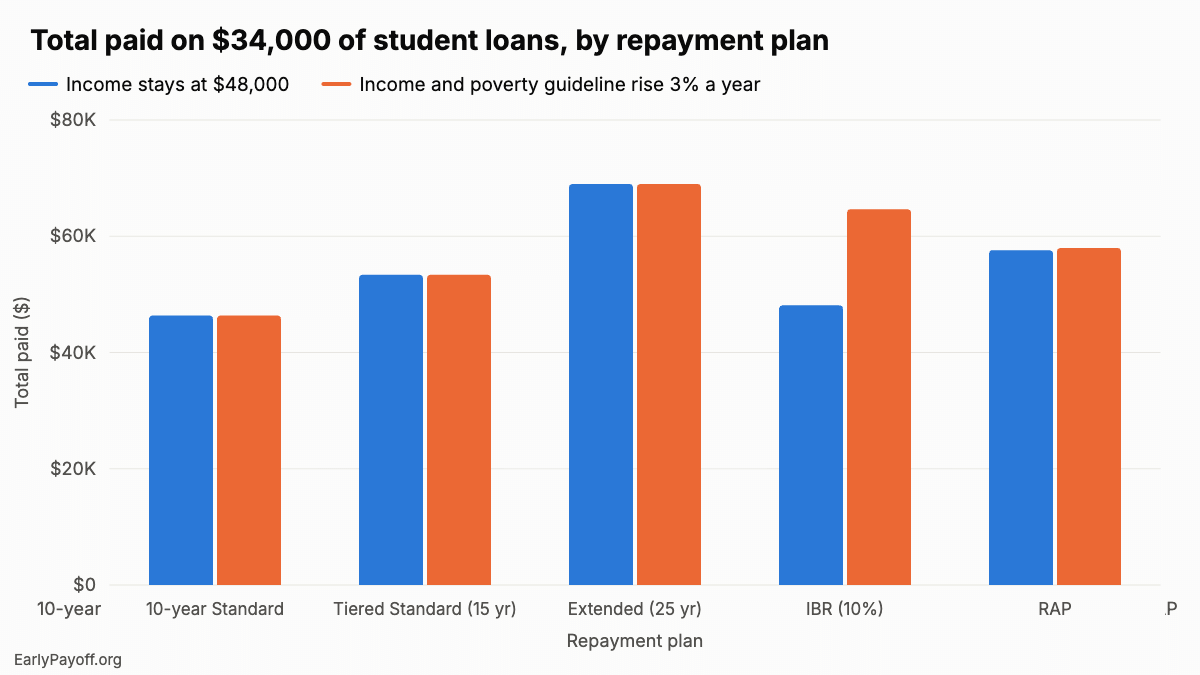
The 10-year Standard plan is the cheapest way to repay. At $386.41 a month, it costs $46,369.04 and is done in a decade. Every plan with a lower payment either costs more in total or leaves a balance to be forgiven.
Stretching a fixed plan is expensive. The 25-year Extended plan cuts the payment to $230.00 but adds $22,627.59 in interest compared with the 10-year plan. The Tiered Standard plan, which this balance would get only after a new loan, takes 15 years and costs $7,010.15 more than the 10-year plan.
RAP’s protections show up when the payment is low. In the first month, interest is $184.73 and the $160.00 payment doesn’t cover it. Under RAP, the $24.73 shortfall is waived for on-time payments, and because no principal was paid, the Department adds a $50.00 principal match. The balance still falls each month. Under IBR, unpaid interest on unsubsidized loans would instead be added to what you owe.
RAP’s brackets don’t move with inflation. The regulation sets them in fixed dollar amounts. With 3% raises, this borrower’s RAP rate rises from 4% to 5% in year three and to 6% in year nine. That pays the loan off in 199 months. Under IBR, the deduction for the poverty guideline grows too, so payments rise more slowly and the balance takes the full 20 years.
New borrowers: how the Tiered Standard tiers work
If you are still in school, or borrowed for the 2026–27 year, your loans will be repaid under RAP or Tiered Standard. The Tiered Standard term is set by your total Direct Loan balance when you enter repayment, and the jump between tiers is abrupt. At 6.52%, a $24,900 balance falls in the 10-year tier at $282.99 a month and $9,058.43 of interest. A $25,100 balance falls in the 15-year tier at $218.92 a month and $14,306.81 of interest.
An extra $200 of borrowing lowers the payment by $64.07 but adds $5,248.38 of interest, because the loan runs five years longer. If you land just over a threshold, you can still pay on the shorter schedule. Extra payments carry no penalty, so you can follow a 10-year pace while keeping the lower required payment as a fallback for tight months.
How PSLF changes the choice
If you work full time for a government or qualifying nonprofit employer, PSLF forgives what is left after 120 qualifying payments, and that forgiveness is not taxable (Taxpayer Advocate Service, as of October 2026). Then the goal flips: you want the lowest qualifying payment, not the fastest payoff.
With income flat, the borrower above would pay $19,200.00 over 120 RAP payments and have $28,000.00 forgiven. Under IBR, it would be $24,060.00 paid and $31,341.93 forgiven. On the 10-year Standard plan, the loan is fully repaid at $46,369.04, so nothing is left for PSLF to forgive. Avoid the Tiered Standard plan if you are pursuing PSLF. In its final rule, the Department said those payments do not qualify (91 FR 23768).
How to choose, step by step
- Check your loan dates. Sign in at StudentAid.gov and note each loan’s type and disbursement date. One loan on or after July 1, 2026, limits you to RAP and Tiered Standard.
- Name your goal. Lowest total cost, lowest monthly payment, or PSLF. Each points to a different plan.
- Test the 10-year payment first. If it fits your budget with room for savings, it is usually the best choice. See how to budget while paying student loans.
- If not, compare RAP and IBR. Run both formulas with your AGI and family size. Larger households often come out ahead on IBR, while very low payments get more help from RAP’s interest waiver and match.
- Think before you borrow or consolidate again. Either can cost you IBR, Graduated and Extended for good.
- Revisit every year. If income rises, you can switch to a fixed plan or simply pay more. You can generally prepay without penalty, but ask the servicer to apply extra money to principal rather than to future payments (CFPB, as of October 2026).
When the lowest payment is a bad idea
- You can afford the 10-year payment. Every lower-payment option above costs more over time, unless you are pursuing PSLF.
- You are counting on forgiveness decades away. Since January 1, 2026, balances forgiven under income-driven plans are generally taxable income (Taxpayer Advocate Service, as of October 2026). The $26,249.12 left on IBR in the flat-income case could bring a tax bill in the year it is forgiven.
- Your income is high. RAP has no payment cap, so at 10% of a large AGI it can exceed the 10-year Standard payment. IBR is capped at that amount.
- You need a lower payment to buy a home. A smaller required payment can help your debt-to-income ratio, but lenders count it differently by loan type. See how to buy a home with student debt.
- You are thinking of refinancing privately. That permanently ends access to RAP, IBR and PSLF. It fits only high, stable earners who will repay in full.
FAQ
What happens if I don’t choose a plan after SAVE?
The Education Department said borrowers who don’t move out of SAVE within their deadline are placed in either the Standard or the Tiered Standard plan. Those fixed payments can be much higher than an income-driven payment, so choose before the deadline in your servicer’s notice.
Can I switch repayment plans later?
Generally yes, among the plans you are eligible for, and you can always pay more than required. Each plan has its own forgiveness timeline, and the counts do not always transfer both ways. The 2025 law lets past IBR payments count toward RAP’s 30-year forgiveness, but it does not clearly let RAP months count toward IBR’s 20- or 25-year forgiveness if you switch back. Ask your servicer, in writing, how a switch affects your count before you make it.
Does the Tiered Standard plan count for PSLF?
No. In its May 2026 final rule, the Education Department said Tiered Standard is not a qualifying PSLF plan under the Higher Education Act. If you have a loan made on or after July 1, 2026, and want PSLF, use RAP.
Can parent PLUS borrowers use RAP?
No. Parent PLUS loans, and consolidation loans that repaid them, are excluded from RAP. Older consolidated parent PLUS loans have limited income-driven options, and the rules depend on dates. See the parent PLUS details in how to apply for income-driven repayment.
Should I pay extra on an income-driven plan?
If you are not pursuing PSLF and want to finish sooner, extra payments cut interest. On RAP, a payment credited ahead to a future month doesn’t get the interest waiver or principal match for that month, so ask your servicer to apply extra money to principal instead.
Sources
- U.S. Department of Education, Federal Student Loan Program Final Regulations, 91 FR 23768 (May 1, 2026), accessed Oct 2026
- U.S. Department of Education, Next Steps for Borrowers Enrolled in the SAVE Plan (March 2026), accessed Oct 2026
- Federal Student Aid, Interest Rates for Direct Loans First Disbursed Between July 1, 2026, and June 30, 2027, accessed Oct 2026
- HHS ASPE, Poverty Guidelines (2026), accessed Oct 2026
- Taxpayer Advocate Service, What to Know About Student Loan Forgiveness and Your Taxes (March 2026), accessed Oct 2026
- CFPB, Can I make additional payments on my student loan?, accessed Oct 2026
- Federal Student Aid, Income-Driven Repayment Plans, accessed Oct 2026
This article is general education, not individualized financial, tax or legal advice.