

To negotiate a lower bill, call the company with three things ready: what you pay now, a lower price you could get elsewhere, and a willingness to cancel. Ask for the retention or loyalty department, request a specific lower rate, and get any new terms in writing. The bills most open to negotiation are internet and phone service, insurance (by shopping around), credit card interest rates, medical bills and subscriptions.
Key takeaways
- Call when a promotional rate ends or a contract term is up. That is when providers expect you to shop and are most willing to match.
- In the example, four negotiated bills free up $127.97 a month, or $1,535.64 a year.
- Putting those savings toward a $6,000 card balance at a lower rate cuts payoff from 45 months to 22 and saves $1,745.54 in interest.
- Nonprofit hospitals must have written financial assistance policies. Ask about assistance before you agree to a payment plan.
- The FTC’s 2024 “click-to-cancel” rule was vacated in July 2025 and is not in effect as of October 2026. Online subscriptions are still covered by an older federal law that requires a simple way to cancel.
Which bills you can negotiate
Some bills have room to move and some don’t. Regulated utility rates for electricity, gas and water are generally set by a state commission, so a phone call won’t change the rate. You may still find budget billing, payment plans or low-income assistance. Taxes and most loan terms are fixed. The bills below are where calls tend to pay off.
| Bill | What to ask for | Your leverage | Best timing |
|---|---|---|---|
| Internet and cable | A new promotional rate, a cheaper plan or waived equipment fees | Competing offers at your address; willingness to cancel | The month a promotion or contract ends |
| Cell phone | A lower tier that fits your actual data use; loyalty discounts | Your usage history; competing plans | When you have paid off the device or the contract ends |
| Auto and home insurance | Discounts you qualify for, a higher deductible, or a new quote from another insurer | Quotes for the same coverage from other insurers | About a month before renewal |
| Credit card interest rate | A lower APR or a hardship plan | On-time payment record; better offers | After 6–12 months of on-time payments |
| Medical bills | An itemized bill, financial assistance, a discount for paying promptly, or an interest-free plan | Billing errors; hospital financial assistance policies | Before the bill goes to collections |
| Subscriptions and memberships | Cancellation, a pause or a cheaper tier | Willingness to leave | Before the next renewal date |
How to make the call
Prepare before you dial. Pull your last few bills, note the date your current rate started, and look up what the company and its competitors charge new customers for the same service at your address. Write down the specific number you want.
- Open with the facts. Say how long you have been a customer, what you pay now, and that you have found a lower price. Ask what they can do to keep you.
- Ask for retention. First-line agents often can’t change pricing. If the first answer is no, say you are thinking about canceling and ask to speak with the department that handles cancellations. Those teams usually have more room to offer discounts.
- Name a number. Ask for the new-customer price, or a specific amount. A clear target is easier to approve than “anything you can do.”
- Check the terms. Ask how long the new rate lasts, whether it needs a new contract, and whether fees or equipment charges change.
- Get it in writing. Note the date, the agent’s name and any reference number. Check your next bill.
Be prepared to follow through. If a competitor really is cheaper for the same service, switching is a valid result. Set a calendar reminder a month before the new rate ends so you can repeat the process.
Insurance: shop instead of haggling
Insurance premiums are based on rates filed with your state, so you lower them mainly by changing the inputs or the insurer. The NAIC suggests getting quotes from several companies using exactly the same coverage details, so the prices are comparable. It also suggests asking about discounts, such as for multiple vehicles, safety and anti-theft devices, low mileage and bundling auto with home. Not every state offers every discount (NAIC, as of Oct 2026).
Raising your deductible can lower your premium, but only do it if you have enough savings to cover the higher deductible. For a home policy, compare the coverage limits line by line, not just the price. Our guide to comparing home insurance quotes walks through what to check.
Credit card interest rates
In the second quarter of 2026, the average rate on credit card accounts that paid interest was 22.15% (Federal Reserve G.19, as of Oct 2026). Issuers can lower your rate whenever they choose, and some will if you ask, especially after a year of on-time payments. Lower rates are more likely when your credit has improved or you have competing offers. If you are struggling to pay, ask about a hardship program. These programs may lower your rate for a period, but they may also close or limit the card.
If the issuer says no, you still have options. You can transfer the balance to a lower-rate card or use a structured plan to get out of credit card debt. Avoid closing old accounts as a negotiating tactic, since it can raise your credit utilization.
Medical bills and financial assistance
Medical bills are often the most negotiable bill you have. Start by asking for an itemized bill and comparing it with your insurer’s explanation of benefits. Look for duplicate charges, services you didn’t receive and claims your plan should have paid.
- Nonprofit hospital financial assistance. Tax-exempt hospitals must have a written financial assistance policy covering emergency and medically necessary care. They must tell patients about it on billing statements. Before taking extraordinary collection actions, such as reporting you to credit bureaus or suing, they generally must wait at least 120 days from the first bill after discharge. You can apply for assistance for at least 240 days from that bill (IRS, as of Oct 2026). Eligibility levels are set by each hospital, so ask for the policy and application.
- Uninsured or self-pay patients. Providers generally must give you a good faith estimate of charges if you aren’t using insurance. If the bill comes in at least $400 above the estimate, you may be able to dispute it through a federal process. You must start within 120 days of the first bill (CMS, as of Oct 2026).
- Ask directly. Billing offices may offer a discount for paying in full, or an interest-free payment plan. Get any reduction in writing before you pay.
Be careful about putting a medical bill on a credit card or taking out a loan to pay it before you have tried these steps. See whether a loan for medical bills makes sense.
Phone and internet help: Lifeline and the ended ACP
The Affordable Connectivity Program, which discounted internet bills for eligible households, ended on June 1, 2024, because Congress did not provide more funding (FCC, as of Oct 2026). If your bill went up when it ended, the long-running Lifeline program may help. Lifeline provides up to $9.25 a month off phone, internet or bundled service, or up to $34.25 on qualifying Tribal lands. Only one Lifeline discount is allowed per household.
You may qualify for Lifeline with income at or below 135% of the 2026 Federal Poverty Guidelines. You may also qualify if someone in your household receives Medicaid, SNAP, SSI, federal public housing assistance, or the Veterans Pension and Survivors Benefit (USAC, as of Oct 2026). You apply through the program administrator, then sign up with a participating company. Many providers also have their own low-income plans, so ask.
Canceling subscriptions: where the rules stand
In October 2024, the FTC finalized amendments to its Negative Option Rule, often called “click-to-cancel.” The rule would have required canceling to be as easy as signing up. On July 8, 2025, the U.S. Court of Appeals for the Eighth Circuit vacated those amendments before most of them took effect. It found that the FTC had skipped a required preliminary regulatory analysis. The FTC published an advance notice of proposed rulemaking on March 13, 2026, to start over. As of October 2026, it has not issued a new proposed or final rule (Federal Register; FTC).
That doesn’t leave you without protection. The Restore Online Shoppers’ Confidence Act still requires sellers of online subscriptions to disclose material terms clearly and get your express consent to the billing. They must also give you a simple way to stop recurring charges. Many states have their own automatic-renewal laws. To cancel, use the company’s online cancellation path, keep the confirmation, and check your next statement. If you are still charged, dispute it with your card issuer and report it to the FTC.
Worked example: annual savings, redirected to debt
A household negotiates four recurring bills. The dollar amounts are illustrative, so use your own bills.
| Bill | Before (monthly) | After (monthly) | Saved per month | Saved per year |
|---|---|---|---|---|
| Home internet (promotion ended; retention offer) | $85.00 | $60.00 | $25.00 | $300.00 |
| Cell phone (lower tier) | $140.00 | $100.00 | $40.00 | $480.00 |
| Auto insurance (re-shopped: $1,800 to $1,500 a year) | $150.00 | $125.00 | $25.00 | $300.00 |
| Three unused subscriptions canceled | $37.97 | $0.00 | $37.97 | $455.64 |
| Total | $127.97 | $1,535.64 |
The same household carries a $6,000 credit card balance at 22.15%, the Federal Reserve’s 2026 second-quarter average, and pays $200 a month. After one call, the issuer lowers the rate to 18.15%, an assumed result. The household then adds the $127.97 in monthly bill savings to the card payment.
| Scenario | APR | Monthly payment | Months to pay off | Total interest |
|---|---|---|---|---|
| No changes | 22.15% | $200.00 | 45 | $2,823.31 |
| Lower rate only | 18.15% | $200.00 | 41 | $2,056.38 |
| Lower rate + bill savings redirected | 18.15% | $327.97 | 22 | $1,077.77 |
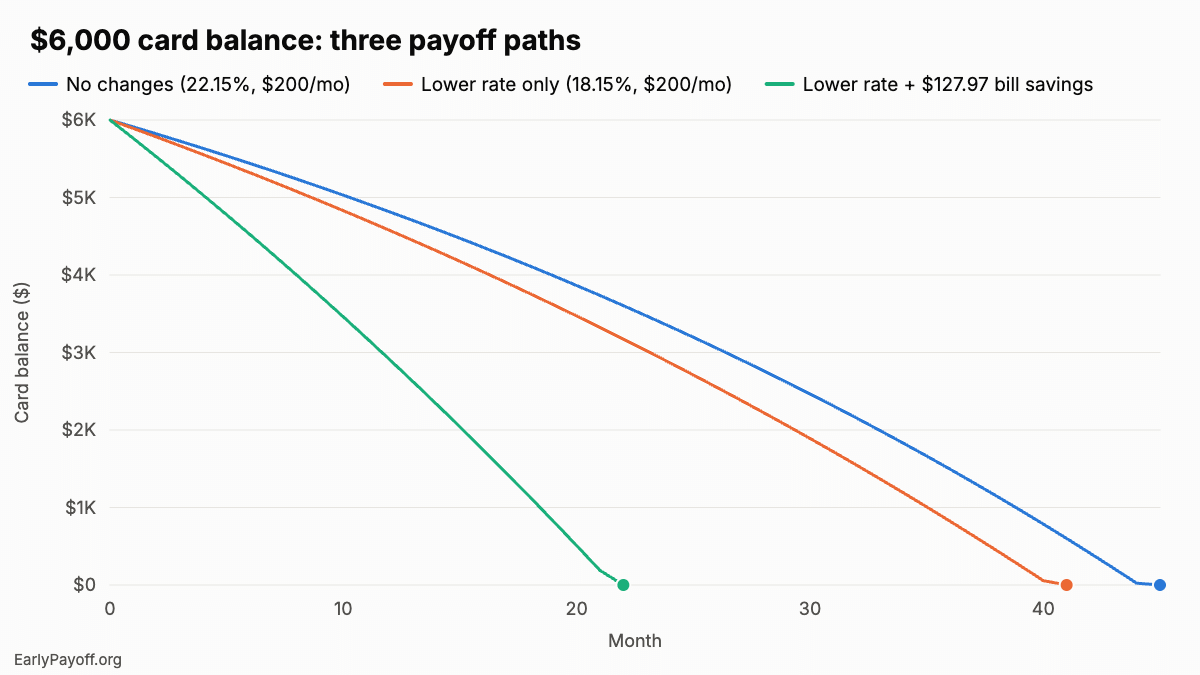
The lower rate alone saves $766.93. Redirecting the bill savings matters more. Together, the two changes cut payoff by 23 months and save $1,745.54 in interest. If the household also gets a $2,400 hospital bill reduced by 40% through financial assistance, that is a one-time $960.00 saving, and the balance owed drops to $1,440.00. Once the card is paid off, the same monthly amount can go to the next debt on your list.
When negotiating is not worth it
- A new contract costs more than it saves. A discount that requires a two-year contract with an early termination fee can leave you worse off if you move or the rate rises after the promotion.
- Cheaper insurance with less coverage. Cutting liability limits or taking a deductible you can’t pay trades a small saving for a large risk.
- Hardship plans that close your card. A lower rate can be worth it, but losing an old account may raise your utilization. Ask what happens to the account before you agree.
- Paid “bill negotiation” services. Some charge a share of what they save you, sometimes for a year or more. Most of these calls you can make yourself in under an hour.
- The savings disappear into spending. If the freed-up money isn’t assigned to a goal, it tends to vanish. Set up an automatic transfer or a higher debt payment the same day.
FAQ
What do I say to get a lower internet bill?
State what you pay, mention a specific lower offer available at your address, and ask what they can do to keep you as a customer. If the first agent can’t help, ask for the cancellation or retention department. Confirm how long the new rate lasts.
Does asking for a lower credit card rate hurt my credit?
Asking for a lower rate on an existing card doesn’t typically involve a new credit application. Ask the issuer whether it will check your credit. Applying for a new balance transfer card does mean a credit inquiry.
Can I negotiate a medical bill after it goes to collections?
Often yes, but it is easier before. If the bill is from a nonprofit hospital, you may still apply for financial assistance within the application period, which runs at least 240 days from the first post-discharge bill. Get any settlement in writing before you pay.
Is the FTC click-to-cancel rule in effect?
No. A federal appeals court vacated the 2024 amendments on July 8, 2025. As of October 2026, the FTC is gathering comments on a possible new rule. Online subscriptions are still covered by the Restore Online Shoppers’ Confidence Act, and many states have their own auto-renewal laws.
Is the Affordable Connectivity Program coming back?
It ended on June 1, 2024, after its funding ran out, and it is not available as of October 2026. Lifeline is still running and can lower an eligible household’s phone or internet bill.
Sources
- Federal Register, Rule Concerning the Use of Prenotification Negative Option Plans, ANPRM (Mar 13, 2026), accessed Oct 2026
- FTC, Negative Option Rule, accessed Oct 2026
- FTC, FTC Seeks Public Comment in Response to Advance Notice of Proposed Rulemaking Regarding Negative Option Marketing Practices (Mar 2026), accessed Oct 2026
- FCC, Affordable Connectivity Program Consumer FAQ, accessed Oct 2026
- USAC, About Lifeline, accessed Oct 2026
- USAC, Lifeline: How to Qualify, accessed Oct 2026
- IRS, Financial Assistance Policies (FAPs), accessed Oct 2026
- IRS, Billing and Collections – Section 501(r)(6), accessed Oct 2026
- CMS, What is a good faith estimate?, accessed Oct 2026
- CMS, Dispute a medical bill, accessed Oct 2026
- Federal Reserve, Consumer Credit – G.19 (Oct 7, 2026), accessed Oct 2026
- NAIC, Auto Insurance consumer guide, accessed Oct 2026
This article is general education, not individualized financial, tax or legal advice.