

Originally published on EarlyPayoff in February 2016. Fully rewritten and updated in October 2026.
The early mortgage payoff strategies that work all do the same thing: they get more money to principal, sooner, at no extra cost. A fixed monthly extra payment, a free do-it-yourself version of biweekly payments, and sending windfalls such as tax refunds or bonuses straight to principal are the most reliable. Paid biweekly programs and HELOC “velocity banking” schemes add cost or risk without changing the basic math.
Below, every strategy is run on the same loan so you can compare them directly, followed by the habits that keep a payoff plan going for years.
Key takeaways
- On a new $350,000, 30-year loan at 7.40%, an extra $200 a month saves $134,106.34 in interest and ends the loan 6 years and 6 months early.
- Adding 1/12 of your payment each month ($201.94 here) matches a biweekly plan for free. A paid program with fees like those the CFPB challenged in 2015 saved $11,459.08 less in our example.
- A recast lowers your payment after a lump sum but keeps the original end date, so it saves far less interest than leaving the payment alone.
- Velocity banking’s speed comes from your spare cash flow, not the HELOC. In our model its edge was a few hundred dollars a year at best, and it turned into a loss without the paycheck float.
The example loan
All results below use a new $350,000, 30-year fixed loan at 7.40%, the Freddie Mac weekly average for 30-year loans as of October 15, 2026. The principal-and-interest payment is $2,423.33, and with no extra payments the loan charges $522,397.97 of interest over 30 years. Taxes, insurance and mortgage insurance are left out because they don’t change the payoff math.
The extra amounts are illustrations, not recommendations. To plug in your own balance and rate, use our guide on how to calculate an early mortgage payoff.
| Strategy | Extra cash per year | Payoff time | Interest saved | Flexibility | Risk |
|---|---|---|---|---|---|
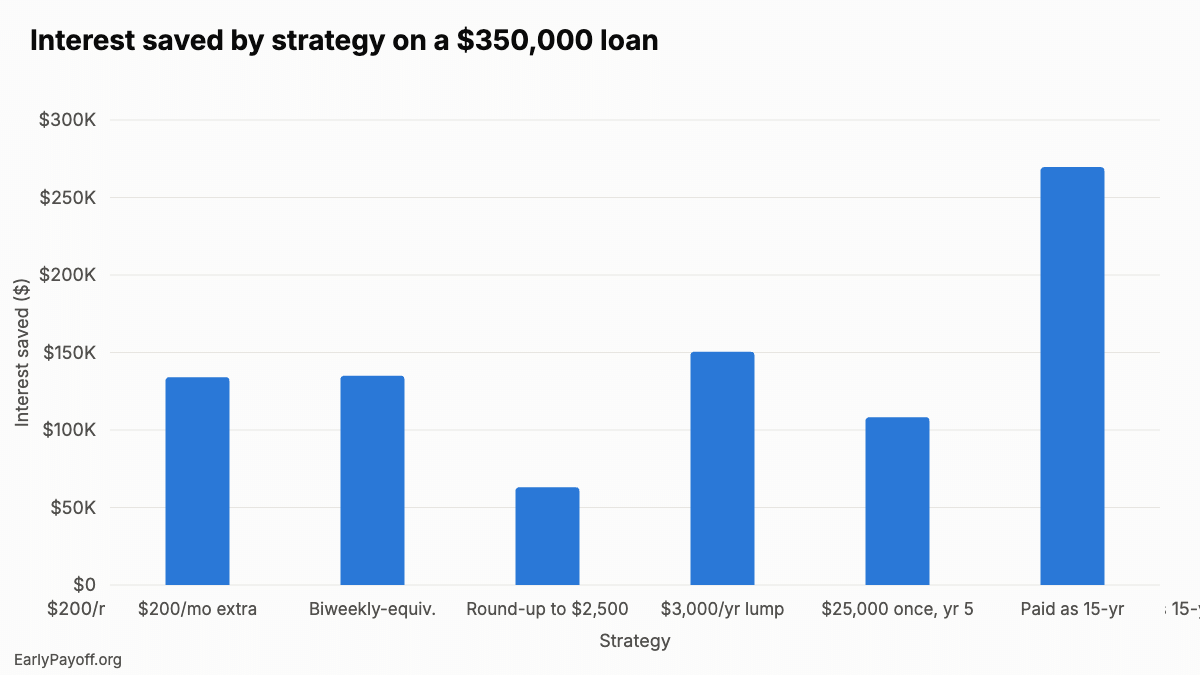
| $200 a month extra | $2,400.00 | 23 yr 6 mo | $134,106.34 | High: change or pause anytime | Low |
| Biweekly-equivalent (+$201.94 a month) | $2,423.28 | 23 yr 5 mo | $135,023.89 | High | Low |
| Paid biweekly program (fees deducted) | $2,423.33 plus fees | 23 yr 10 mo | $123,564.81 | Low: enrollment contract | Fees; money held by a third party |
| $3,000 lump sum each year | $3,000.00 | 22 yr 7 mo | $150,497.23 | High | Low |
| Round payment up to $2,500 | $920.04 | 27 yr 0 mo | $63,069.16 | High | Low |
| $25,000 windfall in year 5, keep payment | One time | 25 yr 6 mo | $108,280.00 | Medium: cash is locked in | Liquidity |
| $25,000 windfall in year 5, then recast | One time | 30 yr 0 mo | $29,940.30 | Medium; payment falls $183.12 | Liquidity; possible fee |
| 15-year loan at 6.71% | $7,993.20 | 15 yr 0 mo | $316,301.67 | Low: higher payment required | Payment shock if income drops |
| 30-year loan paid like a 15-year ($3,089.43) | $7,993.20 | 16 yr 4 mo | $269,671.07 | High | Low |
Strategy 1: A fixed monthly extra payment
This is the workhorse. You add a set amount to every payment and mark it for principal. Because the money arrives every month, each dollar starts cutting interest right away, and you can raise, lower or pause the amount as life changes. An extra $200 a month on the example loan saves $134,106.34 and cuts 6 years and 6 months off the term.
A round-up is the gentle version. Paying $2,500 instead of $2,423.33 adds only $76.67 a month, yet it still saves $63,069.16 and three years. It’s a good starting point if your budget is tight, and easy to raise later.
Strategy 2: Biweekly payments, the free way
Paying half your payment every two weeks works because a year has 26 half-payments, which equals 13 full payments instead of 12. You get exactly the same yearly cash effect by adding 1/12 of your payment to each monthly payment: $201.94 here. That saves $135,023.89 and 6 years and 7 months, with no new account and no enrollment.
Why to avoid paid biweekly programs
Some companies sell biweekly plans that debit your account every two weeks and forward money to your servicer. In May 2015 the CFPB sued one such company, alleging it charged enrollment fees of up to $995 plus $84 to $101 a year in processing fees, and misled people about the savings. A lawsuit is an allegation, not a finding, but the fee structure is a useful warning.
To see the cost, the table models a program that keeps $995 from the first extra payment, charges $84 a year and sends the extra payment once a year. Net of fees it saves $123,564.81, which is $11,459.08 less than doing it yourself monthly, and the loan runs 5 months longer. Total fees over the life of the plan come to $3,011.00. Before signing up for any payment service, ask your servicer whether it already offers a free biweekly or extra-principal option.
Strategy 3: Annual lump sums and windfalls
If your income is lumpy, a once-a-year payment may be easier than a monthly one. Sending a $3,000 tax refund or bonus to principal at the end of each year saves $150,497.23 and ends the loan 7 years and 5 months early. Timing matters a little: one extra payment of $2,423.33 made once a year saves $129,915.37, versus $135,023.89 when the same money goes in monthly.
One-time windfalls such as an inheritance or the sale of a second car work the same way. A single $25,000 payment in year 5 saves $108,280.00 and cuts 4 years and 6 months. Before you send a windfall to the lender, make sure your emergency fund is full and you have no higher-rate debt.
Strategy 4: Recast after a lump sum
A recast (re-amortization) takes your lower balance after a big payment and recalculates the monthly payment over the time left. Fannie Mae’s servicing guide lets servicers re-amortize at the borrower’s request after a substantial principal payment. Minimum amounts and fees are set by the servicer, and not every loan or servicer offers it.
In the example, the balance at month 60 is $330,830.38. After the $25,000 payment it falls to $305,830.38, and a recast over the remaining 300 months cuts the payment to $2,240.21, $183.12 less than before. But the loan still ends in year 30, so interest savings are only $29,940.30, against $108,280.00 if you keep paying the original amount. Recast when you need breathing room in the budget; keep the old payment when your goal is to be debt-free sooner.
Strategy 5: A 15-year loan, or paying like one
A 15-year loan usually carries a lower rate. Freddie Mac’s average for 15-year loans was 6.71% for the week of October 15, 2026. On $350,000 that means a payment of $3,089.43 and total interest of $206,096.30. Paying the 30-year loan at the same $3,089.43 instead ends it in 16 years and 4 months, with $46,630.60 more interest, because the rate is higher.
That gap is the price of flexibility: on the 30-year loan, you can drop back to $2,423.33 in a bad year. If you already have a mortgage, getting a 15-year loan means refinancing, and Freddie Mac estimates closing costs at 3% to 6% of the loan amount, or $10,500.00 at 3% on $350,000. That eats a large share of the rate advantage. Our guide on when to refinance walks through the break-even math.
The HELOC “velocity banking” pitch, examined
Velocity banking, sometimes sold as a course or software, works like this: you open a home equity line of credit, draw a chunk such as $10,000 and pay it onto the mortgage, then deposit every paycheck into the HELOC and pay bills from it. When the line is paid back down, you draw another chunk. Promoters often claim this pays a 30-year mortgage off in a fraction of the time.
The speed comes almost entirely from one input: the cash you have left after expenses. The HELOC just routes it. To test the claim, take a household with $8,000 of take-home pay a month and $500 left over after all spending, including the regular mortgage payment. The HELOC rate is 8.00%, an assumed 1-point margin over the 7.00% prime rate the Federal Reserve reported in October 2026; your margin may differ.
| Approach ($500 a month spare cash) | Payoff time | Total interest and fees | Versus paying $500 directly |
|---|---|---|---|
| $500 a month straight to the mortgage | 18 yr 3 mo | $287,477.44 | — |
| HELOC at 8.00%, full paycheck float | 18 yr 2 mo | $282,435.27 | $5,042.17 less |
| HELOC at 8.00%, half the float | 18 yr 2 mo | $284,660.68 | $2,816.76 less |
| HELOC at 8.00%, float plus $75 annual fee | 18 yr 2 mo | $283,813.85 | $3,663.59 less |
| HELOC at 8.00%, no float benefit | 18 yr 5 mo | $292,370.60 | $4,893.16 more |
Both approaches finish in about 18 years, nowhere near the fast payoffs often advertised. Under the most favorable assumptions, velocity banking comes out $5,042.17 ahead over 18 years, about $277.55 a year. That edge comes from parking your paycheck against an 8% balance for a few weeks. Keep the same $4,000 average in an account earning the 4.26% three-month Treasury yield (Federal Reserve H.15, October 16, 2026) and you’d earn about $170.40 a year before tax, closing much of the gap with no new debt.
The risks are larger than the reward. HELOC rates are variable. Every dollar you spend flows through a line of credit, so a few months of overspending quietly add debt secured by your home. And the lender can freeze or cut the line: the Office of the Comptroller of the Currency explains that a bank may stop advances when your home’s value drops significantly. If that happens in a downturn, the money you counted on as your checking account is gone. Read what a HELOC is before using one for anything.
Habits that keep a payoff plan on track
- Automate it. Set the extra amount as a recurring payment through your servicer, timed for the day after payday, so it never depends on willpower.
- Label it. Use the “additional principal” field, or mark a check “apply to principal,” and confirm on each statement that the balance fell by the regular principal plus your extra.
- Raise it with raises. When income rises, increase the extra by part of the raise before you get used to spending it.
- Pre-commit windfalls. Decide in advance what share of a refund or bonus goes to principal, and send it the week it arrives.
- Track one number. Check your principal balance or projected payoff date once a quarter. Watching it move is the best motivation there is.
- Review yearly. If your rate is low or your goals change, scale the extra down and redirect it. The plan should serve you, not the other way around.
When these strategies are a bad idea
Prepaying is a poor use of cash when your emergency fund is thin, when you carry credit card or other high-rate debt, or when you’d be giving up an employer retirement match. It’s also weak when your mortgage rate is lower than what safe savings pay; see should you pay off your mortgage early for that comparison.
Check for a prepayment penalty on page 1 of your Closing Disclosure. Under the CFPB’s ability-to-repay rule, where a penalty is allowed it must end after three years and can’t exceed 2% of the amount prepaid in years one and two or 1% in year three. Avoid any plan that requires a fee, a contract or new borrowing to “unlock” savings you can get for free.
Frequently asked questions
Which strategy saves the most interest?
Whichever sends the most money to principal the soonest. For the same yearly amount, monthly extras beat a once-a-year payment slightly because the money starts working earlier. The biggest savings come from simply paying more, which is why the 15-year-style payment tops the chart.
Can my servicer set up biweekly payments for free?
Some servicers offer it, but a servicer may hold a half-payment until the second half arrives, which removes much of the benefit. Ask how and when each payment is credited. If the answer is unclear, add 1/12 of your payment each month instead.
Should I recast or keep paying the same amount?
Keep the payment if your goal is to finish early; it saves far more interest. Recast if a lower required payment would protect your budget, such as before a planned drop in income. Ask your servicer about minimums and any fee first.
Is velocity banking a scam?
The math itself isn’t fraudulent, but the marketing often overstates it. In our model, payoff speed came from spare cash flow, and the HELOC added only a small, fragile edge. Be wary of anyone charging for software or coaching to run it.
Do extra payments count toward next month’s bill?
Usually not. On a standard fixed-rate loan, extra principal shortens the loan but doesn’t excuse the next payment. Your regular installment is still due every month.
Sources
- Freddie Mac, Primary Mortgage Market Survey (30-year and 15-year fixed averages, week of Oct 15, 2026), accessed Oct 2026
- Federal Reserve, H.15 Selected Interest Rates (bank prime loan rate and 3-month Treasury bill, Oct 2026), accessed Oct 2026
- CFPB, CFPB files suit against biweekly payment company over mortgage savings claims (May 11, 2015), accessed Oct 2026
- Fannie Mae Servicing Guide, C-1.2-01: Processing Additional Principal Payments, accessed Oct 2026
- Freddie Mac, Costs of refinancing, accessed Oct 2026
- Office of the Comptroller of the Currency, What constitutes a significant decline in home value?, accessed Oct 2026
- CFPB, Regulation Z § 1026.43, Minimum standards for transactions secured by a dwelling (prepayment penalty limits), accessed Oct 2026
Figures are as of October 2026. This article is general education, not individualized financial, tax or legal advice.