
To lock in a mortgage rate, you ask your lender to guarantee a specific interest rate and points for a set number of days, usually once you have a signed purchase contract or a firm refinance plan and a closing date. Choose a lock long enough to reach closing with a cushion, get the terms in writing, and confirm the lock on page 1 of your Loan Estimate. A lock protects you if rates rise, but it can cost extra for longer periods, and it can be broken if your loan details change.
Key takeaways
- The CFPB says locks are typically available for 30, 45 or 60 days, sometimes longer. Longer locks usually cost more in rate or points.
- On a $350,000 30-year loan at 7.40%, a 0.25-point rate rise adds $59.97 a month and $21,589.20 of interest over the full term.
- Over the 52 weeks to October 15, 2026, the Freddie Mac 30-year average rose 0.25 point or more within a four-week span in 9 of 52 windows and never fell that much.
- Changes in loan amount, income, credit, appraisal or loan type can void or reprice a lock. Missing the expiration date can mean paying for an extension.
- If your rate was not locked when you got the Loan Estimate, the lender must send a revised one within three business days after you lock.
What a rate lock is
A rate lock is a lender’s promise that your interest rate and points will not change between the offer and closing, provided your application stays the same and you close before the lock expires. Without a lock, you are “floating”: your rate is set whenever you do lock, at whatever the market offers that day.
A lock covers a specific combination of rate, points or lender credits, loan type, loan amount and lock length. Ask for a written lock confirmation that lists each of these, the expiration date and time, and the fees for extensions or cancellations. Lock practices are set by each lender, so the details vary.
When to lock: timing with the Loan Estimate
Most borrowers lock after they have a ratified purchase contract and have chosen a lender. Some lenders lock as part of issuing the Loan Estimate and some do not, according to the CFPB. Federal rules require the Loan Estimate to state, at the top of page 1, whether the rate is locked and until when. The same section shows when the estimated closing costs expire.
If your rate was floating when you received the Loan Estimate, the lender must give you a revised Loan Estimate no later than three business days after you lock, showing the locked rate, points and lender credits (Regulation Z, 12 CFR 1026.19(e)(3)(iv)(D)). Compare it with the original before you go further.
Also watch the closing-cost clock. If you do not tell the lender you intend to proceed within 10 business days of receiving the Loan Estimate (or a longer period the lender sets), the lender may issue new cost estimates. Shopping for closing costs and comparing several Loan Estimates in that window gives you leverage before you commit.
Worked example: what a 0.25-point move costs
Say you are borrowing $350,000 on a 30-year fixed loan. As of the week of October 15, 2026, the Freddie Mac Primary Mortgage Market Survey (PMMS) 30-year average was 7.40%. Here is what happens if your rate rises a quarter point before you lock. All figures are EarlyPayoff calculations and cover principal and interest only.
| Measure | At 7.40% | At 7.65% | Difference |
|---|---|---|---|
| Monthly principal and interest | $2,423.33 | $2,483.30 | $59.97 |
| Total interest over 30 years | $522,398.80 | $543,988.00 | $21,589.20 |
| Balance after 7 years | $320,950.76 | $322,110.36 | $1,159.61 |
Many people sell or refinance well before 30 years. If you keep this loan seven years, you would pay $5,037.48 more in payments and still owe $1,159.61 more. In present-value terms, discounted at the 7.40% loan rate, that quarter point is worth about $4,614.32, or 1.32 points (one point is 1% of the loan, here $3,500.00). That is a useful yardstick when you weigh what a lock, an extension or a float-down is worth paying for.
How often rates move that much
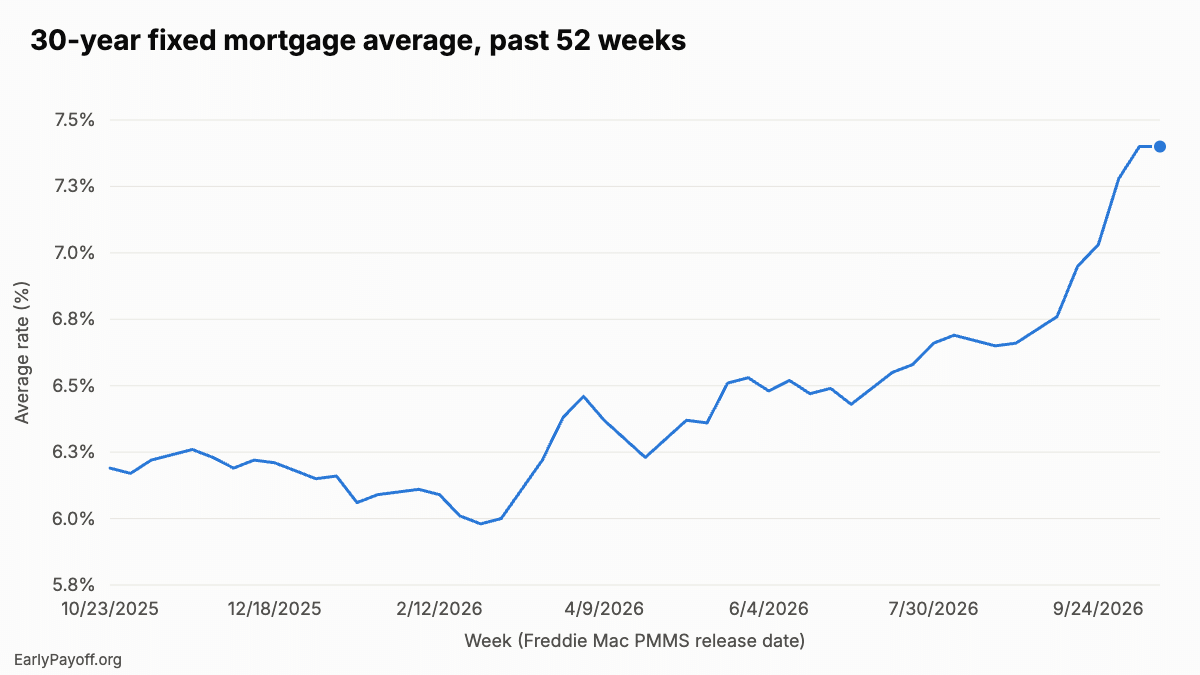
Rates do not always drift slowly. The PMMS 30-year average hit a 52-week low of 5.98% in late February 2026 and then climbed to 7.40% by mid-October, including a 0.69-point jump between September 3 and October 8. Looking at every four-week span ending in the past 52 weeks (roughly a 30-day lock), the average rose by 0.25 point or more 9 times and never fell by that much. Over nine-week spans (roughly 60 days), it rose that much 15 times and fell that much 3 times.
That history is not a forecast. It does show that a month-long float can easily cost a quarter point, and that the risk is not symmetric for a borrower who needs to qualify at a given payment.
Choosing a lock period
Pick a lock that covers the time to closing plus a buffer for appraisal, title or underwriting delays. Lenders typically charge more for longer locks, through a slightly higher rate or added points, because they carry the market risk longer. The CFPB notes that your Loan Estimate will not show what other lock lengths or extensions would cost, so ask.
| Lock length | Typical use | Pricing | Trade-off |
|---|---|---|---|
| 15–30 days | Refinances or purchases already in underwriting | Usually the best-priced | Little room for delays; extension fees likely if anything slips |
| 45 days | Typical purchase timeline | Modestly higher cost than 30 days | Balances price and cushion for appraisal or title issues |
| 60 days | Longer closings, complex files | Higher cost | Pays for protection you may not need if you close early |
| 90 days or longer | New construction, extended closings | Highest; may require an upfront, sometimes nonrefundable, fee | Strong protection against rising rates; expensive if rates fall and no float-down applies |
Extensions, expirations and float-downs
Lock extensions
If closing slips past your expiration date, most lenders let you extend for a fee, often quoted in points. The CFPB warns that extending can be expensive. Suppose your lender charges 0.125 point per 15 days; this is an illustrative price, not a standard. On $350,000, a 15-day extension would cost $437.50 and a 30-day extension $875.00.
Compare that with letting the lock lapse and relocking after a quarter-point rise. The $437.50 extension equals about 7.3 months of the $59.97 payment difference; the $875.00 extension equals about 14.6 months. If you will keep the loan for years, extending is usually the cheaper choice. If rates have fallen since you locked, ask whether a relock at the lower market rate is allowed; some lenders relock at the worse of the old and new price, so get it in writing.
Ask who pays if the delay is the lender’s fault. Some lenders absorb extension costs when their own processing causes the delay, but that is a policy choice, not a legal requirement.
Float-down options
A float-down lets you lock now and take a lower rate if the market falls before closing. Not every lender offers one. Typical conditions include a minimum drop in market rates before it applies, a single use, a window close to closing, and an upfront fee or a slightly higher starting rate. Use the points-equivalent yardstick above: if the float-down costs more than the drop you realistically expect, it may not be worth it.
What can break or reprice a lock
The CFPB lists several changes that can cost you your locked rate:
- A different loan amount, down payment or loan type than the one you locked.
- An appraisal that comes in higher or lower than expected, which changes your loan-to-value ratio.
- A lower credit score, for example from a new loan or a missed payment.
- Income the lender cannot verify, such as overtime or bonuses.
- A closing delay that runs past the lock’s expiration.
Until closing, avoid opening new credit, changing jobs if you can help it or moving large sums without documentation. Respond quickly to underwriting requests so the file does not stall.
When locking early is not the right move
- No contract and no closing date yet. A lock that expires before you find a home is wasted, and long locks are expensive.
- You have not compared lenders. Locking with the first lender can cost far more than a quarter point. Get at least three Loan Estimates for the same loan first.
- Your loan details are still moving. If the price, down payment or loan program may change, the lock may be repriced anyway.
- You can absorb a higher rate and have a strong reason to expect a drop. Floating is a bet. If a higher payment would push you out of qualifying, the downside outweighs the upside.
Remember that a refinance can lower a rate later, but only if the savings beat the costs; see when to refinance your mortgage. To see how a rate difference flows through your payments year by year, read how to read a mortgage amortization schedule.
Step by step: how to lock your rate
- Get Loan Estimates from several lenders on the same day for the same loan type, amount and points, so the rates are comparable.
- Ask each lender for its lock periods, the cost of each, extension pricing, relock rules and any float-down option.
- Count the days to your scheduled closing and add a cushion.
- Lock, then get written confirmation of the rate, points, lock length and exact expiration.
- Check that page 1 of your Loan Estimate, or the revised one sent after you lock, shows the rate as locked with the correct date.
- Track the expiration and push your closing team weekly so it does not lapse.
Frequently asked questions
Does it cost money to lock a mortgage rate?
Standard-length locks are often built into the rate rather than charged as a separate fee, but longer locks usually carry a higher rate or added points. Some lenders charge an upfront fee for extended locks. Ask for the cost of each lock length in writing.
Can I lock my rate before I find a house?
Some lenders offer locks tied to a preapproval, but most locks require a specific property and closing date. A lock without a property usually needs to be long and therefore expensive. Ask whether a lock-and-shop option exists and what happens if you do not find a home in time.
What happens if rates drop after I lock?
Without a float-down option, you generally keep your locked rate. The CFPB notes a lock can keep you from getting a lower rate if the market falls. You could switch lenders, but that restarts the process and may risk your closing date.
Can a lender change my rate after I lock?
Only under the conditions in your lock agreement, such as a change in loan amount, credit score, income verification, appraisal or loan type, or a lapsed lock. If the rate changes, you should receive a revised disclosure showing the new terms.
Sources
- What’s a lock-in or a rate lock?, CFPB, accessed Oct 2026
- Loan Estimate explainer, CFPB, accessed Oct 2026
- What are discount points and lender credits and how do they work?, CFPB, accessed Oct 2026
- 12 CFR 1026.19 Certain mortgage and variable-rate transactions (Regulation Z), CFPB, accessed Oct 2026
- 12 CFR 1026.37 Content of disclosures for certain mortgage transactions (Loan Estimate) (Regulation Z), CFPB, accessed Oct 2026
- Mortgage Rates – Primary Mortgage Market Survey, Freddie Mac (and historical data file), accessed Oct 2026
This article is general education, not individualized financial, tax or legal advice.