

A mortgage amortization schedule is a table that shows, payment by payment, how much of each installment goes to interest, how much goes to principal, and what you still owe afterward. Read it top to bottom and you’ll see the core pattern of a fixed-rate loan: the payment never changes, but early payments are mostly interest and later payments are mostly principal. Knowing where you are on that curve tells you how much an extra payment is worth and when your equity will start to build quickly.
Key takeaways
- On a new $350,000, 30-year loan at 7.40%, 88.7% of the first year’s payments go to interest: $25,789.89 of interest against $3,290.07 of principal.
- Principal doesn’t overtake interest until payment 249, more than 20 years in. Half the loan isn’t repaid until payment 265.
- Taxes and insurance paid through escrow sit outside the schedule; they don’t reduce what you owe.
- An extra $250 a month moves the crossover up to payment 157 and ends the loan in 268 payments instead of 360.
- Adjustable-rate loans get a new schedule at each rate reset, calculated on the balance and time left.
What each column means
Schedules from lenders, servicers and calculators vary in layout, but almost all share these columns:
- Payment number and date. A 30-year loan has 360 rows. The first payment is often due on the first day of the second month after closing.
- Payment. The scheduled principal-and-interest amount. On a fixed-rate loan it is the same every month, except the last one, which absorbs leftover cents.
- Interest. The balance after the previous payment times the monthly rate (annual rate ÷ 12). Interest is paid in arrears, so the December payment covers November’s interest.
- Principal. Whatever is left of the payment after interest. This is the part that reduces your debt.
- Extra principal (on some schedules). Additional amounts you choose to pay.
- Balance. The previous balance minus this month’s principal. Some schedules also add running totals of interest and principal paid.
To check any row, multiply the prior balance by the monthly rate, round to the cent, and subtract that from the payment. If your numbers match your servicer’s, you understand your loan exactly.
A real schedule: the first 12 months
Inputs: a new $350,000, 30-year fixed loan at 7.40%, the Freddie Mac weekly average for 30-year loans as of October 15, 2026. The monthly rate is 0.074 ÷ 12, and the principal-and-interest payment is $2,423.33. For illustration, the first payment is due December 1, 2026.
| # | Due | Payment | Interest | Principal | Balance |
|---|---|---|---|---|---|
| 1 | Dec 2026 | $2,423.33 | $2,158.33 | $265.00 | $349,735.00 |
| 2 | Jan 2027 | $2,423.33 | $2,156.70 | $266.63 | $349,468.37 |
| 3 | Feb 2027 | $2,423.33 | $2,155.05 | $268.28 | $349,200.09 |
| 4 | Mar 2027 | $2,423.33 | $2,153.40 | $269.93 | $348,930.16 |
| 5 | Apr 2027 | $2,423.33 | $2,151.74 | $271.59 | $348,658.57 |
| 6 | May 2027 | $2,423.33 | $2,150.06 | $273.27 | $348,385.30 |
| 7 | Jun 2027 | $2,423.33 | $2,148.38 | $274.95 | $348,110.35 |
| 8 | Jul 2027 | $2,423.33 | $2,146.68 | $276.65 | $347,833.70 |
| 9 | Aug 2027 | $2,423.33 | $2,144.97 | $278.36 | $347,555.34 |
| 10 | Sep 2027 | $2,423.33 | $2,143.26 | $280.07 | $347,275.27 |
| 11 | Oct 2027 | $2,423.33 | $2,141.53 | $281.80 | $346,993.47 |
| 12 | Nov 2027 | $2,423.33 | $2,139.79 | $283.54 | $346,709.93 |
Take the first row. One month of interest on $350,000 at 7.40% is $2,158.33, so only $265.00 of the $2,423.33 payment reduces the debt. Because the balance fell by $265.00, the next month’s interest is $1.63 lower and principal is $1.63 higher. That small shift repeats every month and compounds over time.
After a full year you’ve paid $29,079.96, but your balance has dropped by just $3,290.07. That isn’t a sign of a bad loan; it’s how every long fixed-rate mortgage works at today’s rates.
Selected years across the full 30
| Loan year | Interest paid that year | Principal paid that year | Balance at year end | Interest paid to date |
|---|---|---|---|---|
| 1 | $25,789.89 | $3,290.07 | $346,709.93 | $25,789.89 |
| 5 | $24,660.58 | $4,419.38 | $330,830.38 | $126,230.18 |
| 10 | $22,689.15 | $6,390.81 | $303,109.40 | $243,909.00 |
| 15 | $19,838.27 | $9,241.69 | $263,022.35 | $349,221.75 |
| 20 | $15,715.64 | $13,364.32 | $205,052.87 | $436,652.07 |
| 25 | $9,753.92 | $19,326.04 | $121,223.74 | $498,222.74 |
| 30 | $1,132.79 | $27,946.34 | $0.00 | $522,397.97 |
Two numbers stand out. By the end of year 15, the halfway point in time, you’ve paid $349,221.75 in interest, nearly the original loan amount, and still owe $263,022.35. Over the full term, interest totals $522,397.97, so you repay $872,397.97 for $350,000 borrowed.
The crossover month
The crossover is the first payment where principal is larger than interest. On this loan it is payment 249, due August 2047: $1,217.26 of principal against $1,206.07 of interest. The payment before it, number 248, was still slightly interest-heavy at $1,213.53 of interest and $1,209.80 of principal.
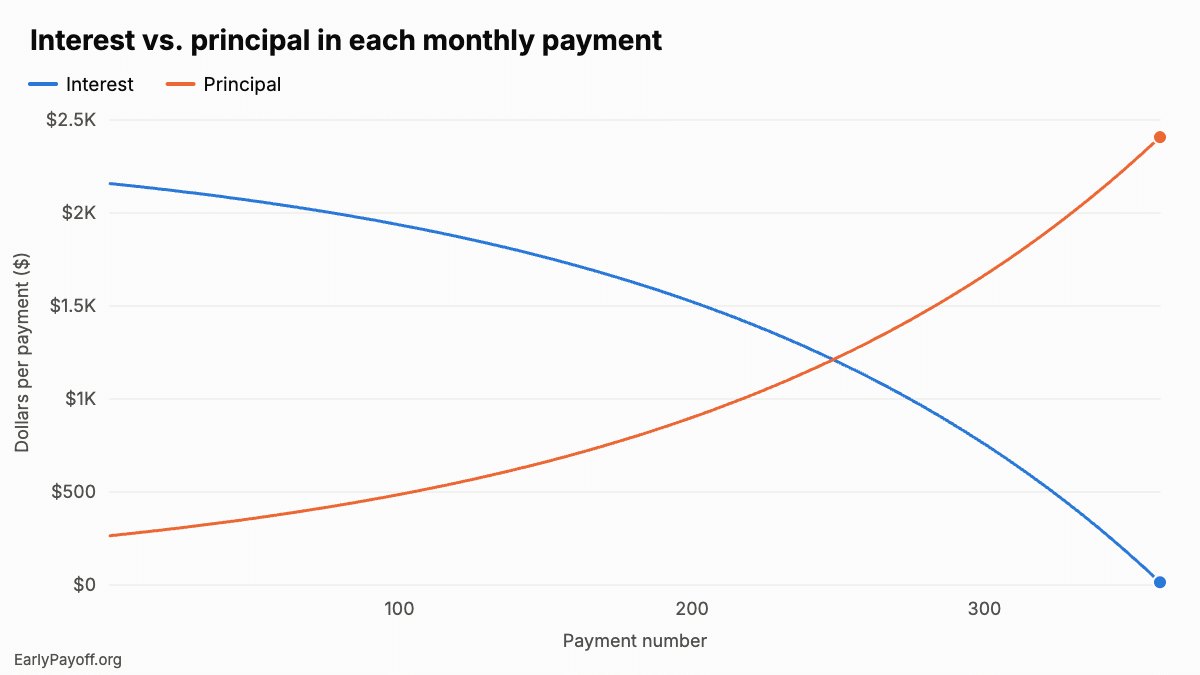
The higher the rate, the later the crossover, because a larger share of each payment is needed just to cover interest. Equity from paying down the loan builds slowly at first and then quickly in the last decade: half of the original principal is not repaid until payment 265, in December 2048. The final payment, number 360, is $2,422.50 in November 2056, 83 cents less than usual because of rounding.
Escrow is a separate account
Your monthly bill may be larger than the schedule’s payment because it includes escrow for property taxes and homeowners insurance. Federal rules (Regulation Z, section 1026.41) require most servicers to show on each statement how your payment splits among principal, interest and escrow. Only the principal portion lowers your loan balance.
Say, hypothetically, your taxes are $4,200 a year and insurance is $2,400. Escrow adds $550.00 a month, so your bill is $2,973.33, but the amortization schedule doesn’t change. Under RESPA’s Regulation X, section 1024.17, the servicer reviews the escrow account every year and may hold a cushion of no more than one-sixth of the year’s expected payments, here $1,100.00. If the annual review finds a surplus of $50 or more and you’re current, the servicer must refund it within 30 days.
That’s why your total payment can rise even on a fixed-rate loan. A tax or insurance increase changes escrow, never the principal-and-interest line.
How extra payments change the schedule
An extra principal payment lowers the balance immediately, so every row after it has less interest and more principal. The required payment stays the same; the schedule simply runs out sooner.
Add $250 a month to the loan above, starting with payment 1. The first payment now puts $515.00 toward principal, and the second payment’s interest falls to $2,155.16 from $2,156.70. After 12 months you owe $343,606.07 instead of $346,709.93. The crossover arrives at payment 157 instead of 249, and the loan ends after 268 payments, in March 2049, saving $156,237.02 in interest. Our guide on how to calculate an early mortgage payoff shows how to run your own numbers, and early payoff strategies compares ways to fund extra payments.
Your servicer won’t usually send a new schedule after an extra payment. Check your statement instead: the principal balance should drop by the regular principal portion plus your extra amount. A recast is different: after a large lump sum, some servicers will recalculate a lower payment over the remaining term, which creates a new schedule with the same end date.
Adjustable-rate loans re-amortize at each reset
An adjustable-rate mortgage (ARM) starts with a schedule based on the initial rate. When the rate resets, the servicer recalculates the payment so the remaining balance is paid off over the remaining term at the new rate. In effect, you get a new amortization schedule at every adjustment.
Here’s an illustration with hypothetical rates. A $350,000 five-year ARM at 6.50% has a payment of $2,212.24. After 60 payments the balance is $327,638.26. If the rate resets to 8.00%, the new payment over the remaining 300 months is $2,528.77, an increase of $316.53. Interest jumps from $1,777.06 in payment 60 to $2,184.26 in payment 61, so the schedule moves back toward interest-heavy rows.
You’ll get warning. Under Regulation Z, section 1026.20(d), the servicer must send a notice 210 to 240 days before the first payment at the first new rate, and section 1026.20(c) requires notice 60 to 120 days before later payment changes. The notices show the new rate and payment, the expected balance and the remaining term. Use them to rebuild your schedule, or to decide whether to refinance.
Limits and risks of relying on a schedule
- It assumes perfect payments. Late payments, skipped payments and loan modifications all change the real path. Your statement is the record; the schedule is a projection.
- It doesn’t show your full cost of owning. Escrow, mortgage insurance, maintenance and closing costs sit outside it.
- The interest-heavy early years can push people into bad moves. Draining your emergency fund to “beat” the interest column, or refinancing just to feel progress, can cost more than it saves.
- ARM schedules beyond the first reset are guesses. Treat any later rows as illustrations, not promises.
Frequently asked questions
Where can I get my own amortization schedule?
Many servicers offer one in their online portal or will send one on request. You can also build one in a spreadsheet from your balance, rate and payment. Make sure it starts from your current balance, not the original loan amount, if you’ve made extra payments.
Why is so much of my payment going to interest?
Interest is charged on the balance you owe, which is largest at the start. With a $350,000 balance at 7.40%, a month of interest is $2,158.33, so little is left for principal. The split improves a little every month as the balance falls.
Does my schedule change if my taxes go up?
No. Taxes and insurance flow through escrow, which is reviewed each year. Your total payment may rise, but the principal and interest rows stay the same on a fixed-rate loan.
Is the crossover month important?
It’s a useful milestone, not a deadline. It shows how long you’d wait for most of each payment to build equity. Extra payments made before the crossover save the most interest, because they avoid interest for the longest time.
Sources
- Freddie Mac, Primary Mortgage Market Survey (30-year fixed average, week of Oct 15, 2026), accessed Oct 2026
- CFPB, Regulation Z § 1026.41, Periodic statements for residential mortgage loans, accessed Oct 2026
- CFPB, Regulation X § 1024.17, Escrow accounts, accessed Oct 2026
- CFPB, Regulation Z § 1026.20, Disclosure requirements regarding post-consummation events (ARM adjustment notices), accessed Oct 2026
Figures are as of October 2026. This article is general education, not individualized financial, tax or legal advice.