

To prepare your finances for a layoff, figure out how many months your cash would last, cut your budget to the essentials now, and learn your options for unemployment insurance and health coverage before you need them. Then sort out what happens to your severance and any 401(k) loan when you leave, and call your mortgage servicer the moment you expect trouble paying. The worked example below shows that a bare-bones budget can stretch the same savings from 6.3 months to 10.0 months.
Key takeaways
- Measure your emergency fund in months of bare-bones spending, not in dollars. In the example, cutting $2,100 a month adds about 3.7 months of runway.
- Unemployment benefits replace only part of your pay and last up to 26 weeks in most states. Amounts and rules vary by state, and the benefits are taxable.
- COBRA lets you keep your job-based health plan, but you can be charged up to 102% of its full cost. You have at least 60 days to elect it. Losing job-based coverage also opens a 60-day window to buy a Marketplace plan.
- An unpaid 401(k) loan can be offset against your account when you leave. You have until your tax-filing deadline, including extensions, to roll that amount over and avoid taxes on it.
- Call your mortgage servicer before you miss a payment. Forbearance pauses or lowers payments for a while, but you still owe the skipped amounts.
Step 1: Size your emergency fund in months
Your runway is the number of months your savings can cover the gap between what comes in and what goes out. A dollar balance alone tells you little. A $20,000 fund is a long runway for one household and a short one for another.
Work out three numbers. First, your cash: checking, savings and any money you could reach without penalties. Second, your income after a layoff: a partner’s pay, unemployment benefits and severance. Third, your spending, counted twice: once as you live now and once as a stripped-down budget. Add the full cost of health coverage to both versions, because your employer is no longer paying part of it.
Common rules of thumb call for three to six months of expenses. Those are starting points, not rules. Aim higher if you are the only earner, work in a field where job searches take longer, or have a mortgage and children. If you can, keep adding to the fund while you still have a paycheck. For more on setting up categories, see how to build a budget that works.
Step 2: Write a bare-bones budget now
A bare-bones budget covers what keeps your household housed, insured, fed, connected and working toward a new job. Write it while you are still employed, so the cuts are decisions instead of emergencies.
- Keep: mortgage or rent, utilities, groceries, insurance premiums, minimum debt payments, transportation, phone and internet.
- Pause: extra principal payments on your mortgage or loans, retirement contributions above what you can afford, and savings goals for big purchases. Cash on hand matters more than early payoff while your income is uncertain.
- Cut: dining out, subscriptions, travel and nonessential shopping. Cancel recurring charges ahead of time, since some services require notice.
If you have been paying extra toward your mortgage, stop now and build cash instead. A prepaid mortgage does not lower next month’s required payment, and that equity is hard to reach without income. Early payoff makes sense again once you have a steady paycheck and a full emergency fund.
Worked example: runway under two budgets
A two-parent household has $18,000 in savings. One partner earns $78,000 a year and gets 8 weeks of severance, or $12,000. The other partner keeps working and brings home $2,800 a month. The family’s health plan was through the job that ended, so they elect COBRA.
- Severance: withholding of 22% federal income tax, 7.65% Social Security and Medicare, and an assumed 5% state tax leaves $7,842. That brings starting cash to $25,842.
- Unemployment benefits: an illustrative $450 a week for 26 weeks, with 10% federal tax withheld. That works out to $1,755 a month for six months. Your state’s amount may be higher or lower.
- COBRA: in 2025, the average total premium for private-sector family coverage was $26,281, and employees paid $7,314 of it (AHRQ, as of Oct 2026). At the 102% maximum, COBRA would cost $2,233.89 a month, compared with the $609.50 a month the employee had been paying. That is $1,624.39 more each month.
- Spending, not counting health coverage: $6,300 a month now, or $4,200 on a bare-bones budget.
| Scenario | Monthly shortfall while benefits last | Monthly shortfall after benefits end | Months until cash runs out |
|---|---|---|---|
| Current budget, with unemployment benefits | $3,978.89 | $5,733.89 | 6.3 |
| Bare-bones budget, with unemployment benefits | $1,878.89 | $3,633.89 | 10.0 |
| Current budget, no unemployment benefits | n/a | $5,733.89 | 4.5 |
| Bare-bones budget, no unemployment benefits | n/a | $3,633.89 | 7.1 |
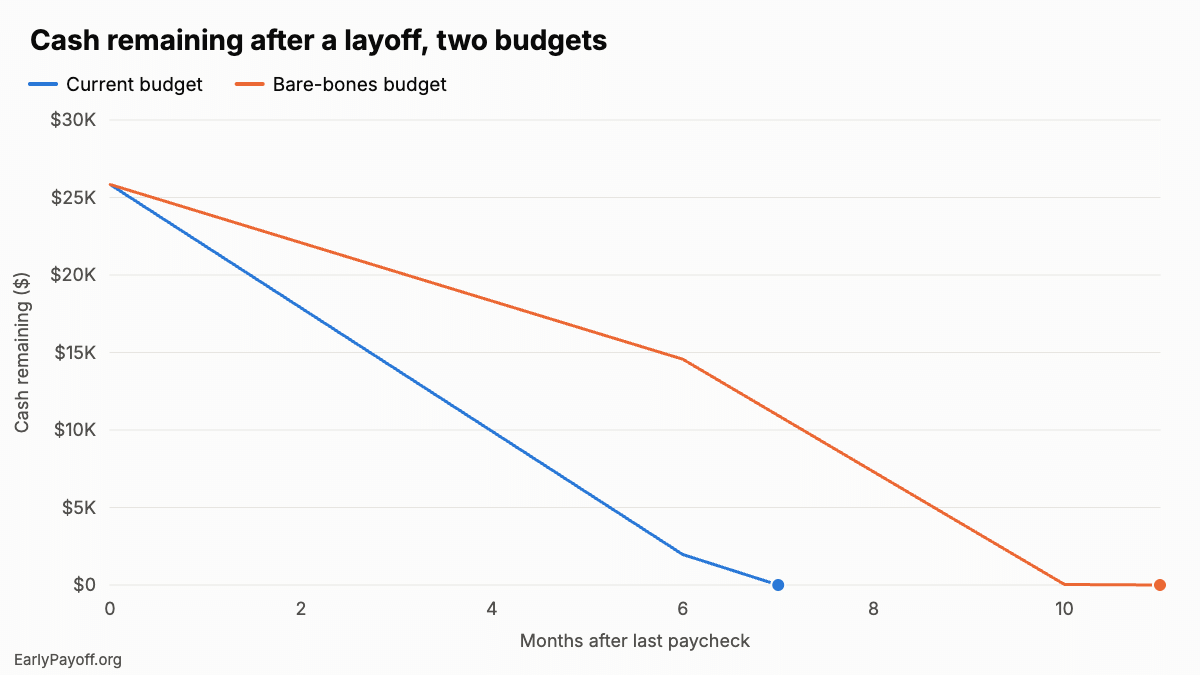
The bare-bones budget cuts $2,100 a month and buys about 3.7 more months. Unemployment benefits matter almost as much. Without them, the current budget lasts only 4.5 months. The COBRA premium is the largest line in this household’s bare-bones budget, so comparing it against a Marketplace plan is worth an hour of your time.
Your actual taxes on severance and benefits are settled on your tax return. Withholding is only an estimate, so a year with a layoff can end with a refund or with a bill.
Step 3: Know how unemployment insurance works
Each state runs its own unemployment insurance program under federal guidelines. In most states you qualify if you lost your job through no fault of your own and earned enough during a recent base period, usually four of the last five completed calendar quarters (U.S. Department of Labor, as of Oct 2026).
- Where to file: generally in the state where you worked. File as soon as you are out of work. Online, phone and in-person filing are all used. The Labor Department says the first payment typically arrives two to three weeks after you file. CareerOneStop, a Labor Department site, lists each state’s claims office.
- How much: a percentage of your recent earnings, up to a state maximum. The percentage and the cap vary by state, so look up your state’s benefit formula instead of guessing.
- How long: up to 26 weeks in most states. Some states pay for fewer weeks, and extra weeks may be available when unemployment is high (U.S. Department of Labor, as of Oct 2026).
- Taxes: benefits count as federal taxable income. You can have 10% withheld by filing Form W-4V with your state agency, or you can make estimated payments (IRS, as of Oct 2026).
Severance can delay or reduce benefits in some states, and the rules for weekly job-search reporting vary. Read your state’s claimant handbook before you file.
Step 4: Plan your health coverage
COBRA. If your employer had at least 20 employees, federal COBRA rules generally let you and your family stay on the same plan for up to 18 months after a layoff. You get at least 60 days to elect coverage, and at least 45 days after electing to make the first payment. The plan can charge up to 102% of its cost. Many states have “mini-COBRA” laws for smaller employers (U.S. Department of Labor, as of Oct 2026).
Marketplace. Losing job-based coverage qualifies you for a Special Enrollment Period. You can apply up to 60 days before your coverage ends or within 60 days after. Being offered COBRA does not make you ineligible for a Marketplace plan or for premium tax credits. Those credits depend on your household size and expected income for the year (HealthCare.gov, as of Oct 2026).
Timing matters. HealthCare.gov says that dropping COBRA on purpose outside Open Enrollment does not qualify you for a Special Enrollment Period. Neither does simply stopping your COBRA payments. Compare both options inside your 60-day window rather than starting COBRA and planning to switch later. A spouse’s employer plan is a third option, since losing coverage usually opens a special enrollment window there as well. Check that plan’s deadline with its HR office.
Step 5: Handle severance and 401(k) loans
Severance is taxable wages. It is subject to income tax withholding and to Social Security and Medicare taxes. The IRS treats severance as supplemental wages. When it is paid separately from your regular pay, employers may withhold federal income tax at a flat 22% for 2026 (IRS Publication 15, as of Oct 2026). If your actual tax rate is higher, set money aside. Before you sign a severance agreement, read what it requires of you, such as a release of claims, and when payment arrives.
401(k) loans. Many plans offset an unpaid loan against your account when you leave. You then have until your tax return due date for that year, including extensions, to roll over the offset amount to an IRA or another plan using other money (IRS, as of Oct 2026). Any amount you don’t roll over is taxed as a distribution. If you are under 59½, you may also owe a 10% additional tax. That tax doesn’t apply to distributions from the plan of an employer you leave during or after the year you turn 55. In the example, a $10,000 offset that isn’t rolled over would cost $2,200 at a 22% federal tax rate plus a $1,000 additional tax, $3,200 in all. Ask your plan administrator how your plan handles loans at separation.
Step 6: Call your mortgage servicer early
If you think you’ll have trouble making your mortgage payments, call your servicer as soon as you know. Don’t wait until after a missed payment. Forbearance lets you pause or reduce payments for a set period. It does not erase anything you owe (CFPB, as of Oct 2026). How you repay determines what the relief really costs:
- Lump sum when forbearance ends: one large bill at the end.
- Added to the end of the loan, or set aside as a separate amount: your term may get longer, or a balance may come due when the loan ends.
- Reduced payments, repaid over a set number of months: your payment goes up for a while afterward.
Ask how interest accrues on paused amounts and get the terms in writing. A HUD-approved housing counselor can go over your options at no charge. The same approach works for car loans and credit cards: call early and ask for a hardship plan. If you can’t pay everything, use a clear order for which debts to keep current.
Layoff preparation checklist
| When | Action | Why it matters |
|---|---|---|
| Now, while employed | Calculate runway under current and bare-bones budgets | Shows how many months you can cover and which cuts help most |
| Now | Pause extra debt payments; build cash | Cash covers bills; prepaid principal does not |
| Now | Download pay stubs, benefits summaries and 401(k) loan statements | You may lose access to employer portals on your last day |
| Now | Schedule medical, dental and vision visits under current coverage | Your current plan’s cost-sharing applies until coverage ends |
| At notice or separation | Read the severance agreement and payment dates | Payment timing and tax withholding affect your runway |
| Within days of your last day | File for unemployment in the state where you worked | First payment typically takes two to three weeks |
| Within 60 days | Compare COBRA, the Marketplace and a spouse’s plan | Dropping COBRA voluntarily later doesn’t open a Marketplace window |
| Before your tax filing deadline | Roll over any 401(k) loan offset if you can | Avoids tax and a possible 10% additional tax |
| As soon as a payment is at risk | Call your mortgage servicer and other lenders | More options before you fall behind |
Risks: when this plan can backfire
- Draining retirement accounts first. Withdrawals before 59½ can trigger income tax and a 10% additional tax, and they shrink savings you can’t easily rebuild. Use them only after cash, and know the exceptions before you withdraw.
- Counting on benefits you may not get. If you quit, were fired for misconduct, or didn’t earn enough in the base period, you may not qualify. Run the no-benefits scenario too.
- Going without health coverage to save money. One emergency room visit can wipe out more than the premiums you saved. If COBRA costs too much, look at the Marketplace before you drop coverage altogether.
- Cutting what helps you get hired. Keep your internet, phone and transportation.
- Moving a big expense onto credit cards. The average rate on card accounts charged interest was 22.15% in the second quarter of 2026 (Federal Reserve, as of Oct 2026). A balance you carry eats into your runway. Card interest will be charged even after you find work.
If you work in a field with long hiring cycles or you’re the only earner, also check whether you have disability coverage. Group coverage through work usually ends with the job. See how to choose disability insurance.
FAQ
How many months of expenses should I save before a layoff?
Three to six months of bare-bones expenses is a common target. Count the full cost of health coverage, and subtract any income that continues, such as a partner’s pay. In the example, three months of the shortfall comes to $10,901.66 and six months to $21,803.31.
Can I collect unemployment if I get severance?
It depends on your state. Some states reduce or delay benefits while severance is being paid, and others don’t count it. File promptly anyway, and report the severance exactly as your state asks.
Is COBRA or a Marketplace plan cheaper?
It depends on your income and your family’s medical needs. COBRA keeps your doctors and your deductible progress, but you may pay the full premium. A Marketplace plan may cost less if your lower income qualifies you for premium tax credits. Compare both within your 60-day window.
What happens to my 401(k) loan if I’m laid off?
Many plans subtract the unpaid balance from your account, which is called a loan offset. You can avoid tax by rolling over the same amount, using other money, by your tax filing deadline including extensions. Any amount you don’t roll over is taxed, and you may owe a 10% additional tax if you are under 59½.
Should I keep making extra mortgage payments if a layoff is likely?
Usually not. Extra principal doesn’t lower your required monthly payment, and home equity is hard to reach without income. Pause extra payments, build cash and start again when you have a steady paycheck.
Sources
- U.S. Department of Labor, Unemployment Insurance, accessed Oct 2026
- U.S. Department of Labor, ETA, Unemployment Insurance Program Fact Sheet, accessed Oct 2026
- IRS, Topic No. 418, Unemployment Compensation, accessed Oct 2026
- IRS, Form W-4V, Voluntary Withholding Request, accessed Oct 2026
- U.S. Department of Labor, An Employee’s Guide to Health Benefits Under COBRA, accessed Oct 2026
- U.S. Department of Labor, Continuation of Health Coverage (COBRA), accessed Oct 2026
- HealthCare.gov, Special Enrollment Period, accessed Oct 2026
- HealthCare.gov, COBRA coverage and the Marketplace, accessed Oct 2026
- AHRQ, MEPS Insurance Component National Tables, 2025 (Tables I.D.1 and I.D.2), accessed Oct 2026
- IRS, Publication 15 (2026), Employer’s Tax Guide, accessed Oct 2026
- IRS, Publication 525, Taxable and Nontaxable Income, accessed Oct 2026
- IRS, Retirement Plans FAQs Regarding Loans, accessed Oct 2026
- IRS, Retirement Topics: Exceptions to Tax on Early Distributions, accessed Oct 2026
- Federal Reserve, Consumer Credit – G.19 (Oct 7, 2026), accessed Oct 2026
- CFPB, What is mortgage forbearance?, accessed Oct 2026
This article is general education, not individualized financial, tax or legal advice.