To read a Loan Estimate, start on page 1 for the loan terms, the monthly payment and whether your rate is locked. Use page 2 for the itemized closing costs and page 3 for the comparison figures, the “In 5 Years” cost, the APR and the Total Interest Percentage. Every lender must use the same three-page federal form, so you can lay two estimates side by side and compare them line by line. The most useful single number for comparing offers is the five-year cost on page 3.
Key takeaways
- Lenders must send a Loan Estimate within three business days of your application. Until you get it and say you want to proceed, they can charge only a credit report fee.
- Check two expiration times on page 1: when the rate lock ends and when the closing cost estimate expires.
- In our example, paying $2,800.00 more upfront for a 7.125% rate instead of 7.40% pays for itself after 35 months and puts you $6,926.36 ahead after 10 years.
- Lender fees can’t rise at closing unless a valid reason, such as a change you requested, triggers a revised estimate.
When you get a Loan Estimate
Under federal rules, you have applied for a mortgage once a lender has six pieces of information: your name, income and Social Security number (to pull credit), the property address, an estimate of its value and the loan amount you want. The lender then has three business days to deliver or mail your Loan Estimate (Regulation Z, 12 CFR 1026.2 and 1026.19, as of October 2026).
Before you receive the estimate and tell the lender you intend to go ahead, the only fee it may charge is a reasonable credit report fee. That means you can collect estimates from several lenders without paying appraisal or application fees. Request them on the same day, for the same loan amount, loan type and lock period, so the differences reflect pricing and not market moves.
The estimate covers most purchase and refinance mortgages. Home equity lines of credit and reverse mortgages use different disclosures (CFPB, as of October 2026).
Page 1: the loan you are being offered
The top section lists the loan term, purpose, product (fixed, adjustable or step rate) and loan type (conventional, FHA, VA or other). Confirm these match what you asked for. Next to them is the rate lock box. It says whether the rate is locked and, if so, the date and time the lock ends. It also gives the date and time your estimated closing costs expire. An unlocked rate can change any day.
Loan Terms shows the loan amount, interest rate and monthly principal and interest. Beside each is a yes-or-no answer to “Can this amount increase after closing?” On a fixed-rate loan, all three should say no. The same table tells you whether the loan has a prepayment penalty or a balloon payment. If either says yes, find out the amount and when it applies.
Projected Payments breaks your payment into principal and interest, mortgage insurance and estimated escrow for taxes and homeowners insurance. Separate columns show when the payment changes, such as when mortgage insurance is expected to end. Costs at Closing gives your total closing costs and the estimated cash you need to close.
Page 2: closing cost details
Page 2 itemizes costs in lettered sections. Section A is the lender’s own charges, including any discount points, and it is the section most worth comparing across lenders. Sections B and C are third-party services, and Sections E through H are taxes, prepaid items, escrow deposits and other costs. Our guide to estimating and lowering closing costs walks through each section with a full example.
One tip: taxes, insurance and prepaid amounts aren’t set by the lender. If those differ sharply between two estimates, the CFPB suggests asking why, because one lender may simply have used different assumptions.
Page 3: the comparison numbers
- In 5 Years. Two figures: the total you will have paid in principal, interest, mortgage insurance and loan costs over the first 60 months, and how much of that is principal. Subtract the second from the first to get your five-year cost of borrowing, which the CFPB recommends comparing.
- Annual Percentage Rate (APR). The yearly cost of the loan including certain fees, spread over the full term. It is useful for comparison but assumes you keep the loan for 30 years, which most people don’t.
- Total Interest Percentage (TIP). All interest over the life of the loan as a percentage of the loan amount. A TIP of 149.257% means you would pay about $1.49 of interest per dollar borrowed if you kept the loan to the end.
The “Other Considerations” section below these numbers covers whether a buyer could assume your loan, the late fee and how many days late it applies, whether the lender plans to service the loan or transfer it, and your right to a copy of the appraisal. Read it before you commit.
What can change before closing
A Loan Estimate is an estimate, but federal “good faith” rules cap how much many charges can rise by closing. If the lender charges more than the limit allows, it must refund the difference.
| Tolerance | Charges covered | What to check |
|---|---|---|
| Zero: can’t increase | Fees paid to the lender, a broker or companies tied to either (including points); services you weren’t allowed to shop for; transfer taxes | Section A and most of Section B should match your Closing Disclosure exactly |
| 10% in total | Recording fees and shoppable services when you pick a provider from the lender’s written list | Add these up; the closing total can be at most 10% higher |
| No fixed limit | Prepaid interest, homeowners insurance, escrow deposits, property taxes, optional services, and providers you found yourself | Must be based on the best information available, but can change with your closing date or quotes |
A lender can reset those limits only with a revised Loan Estimate for a listed reason. These include a changed circumstance such as a low appraisal or income it couldn’t verify, a change you request such as a smaller down payment, locking a rate that was floating, or waiting more than 10 business days after the estimate to say you want to proceed. The revised estimate must arrive within three business days of the triggering event (12 CFR 1026.19(e)(3)(iv) and (e)(4), as of October 2026).
You must receive your Closing Disclosure at least three business days before closing. A new three-day wait starts if the APR becomes inaccurate, the loan product changes or a prepayment penalty is added. When you lock, use our guide on how to lock in a mortgage rate to pick a lock period that covers these timelines.
Worked example: comparing two estimates
Two lenders quote a $350,000, 30-year fixed loan on the same day. Lender A offers 7.40%, the Freddie Mac weekly average for 30-year loans as of October 15, 2026, with no points and a $1,995.00 origination fee. Lender B offers 7.125% with one discount point ($3,500.00) and a $1,295.00 fee. Both list the same $3,640.00 for Sections B and C. The fees and the rate trade-off are illustrative, since pricing varies by lender and day.
| Line on the estimate | Lender A | Lender B |
|---|---|---|
| Interest rate | 7.40% | 7.125% |
| Monthly principal and interest | $2,423.33 | $2,358.01 |
| Section A, origination charges | $1,995.00 | $4,795.00 |
| Section D, total loan costs | $5,635.00 | $8,435.00 |
| In 5 Years: total paid | $151,035 | $149,916 |
| In 5 Years: principal paid off | $19,170 | $20,103 |
| Five-year cost (difference) | $131,865 | $129,813 |
| APR | 7.458% | 7.263% |
| Total Interest Percentage | 149.257% | 142.54% |
| Interest plus Section A after 10 years | $245,904.00 | $238,977.64 |
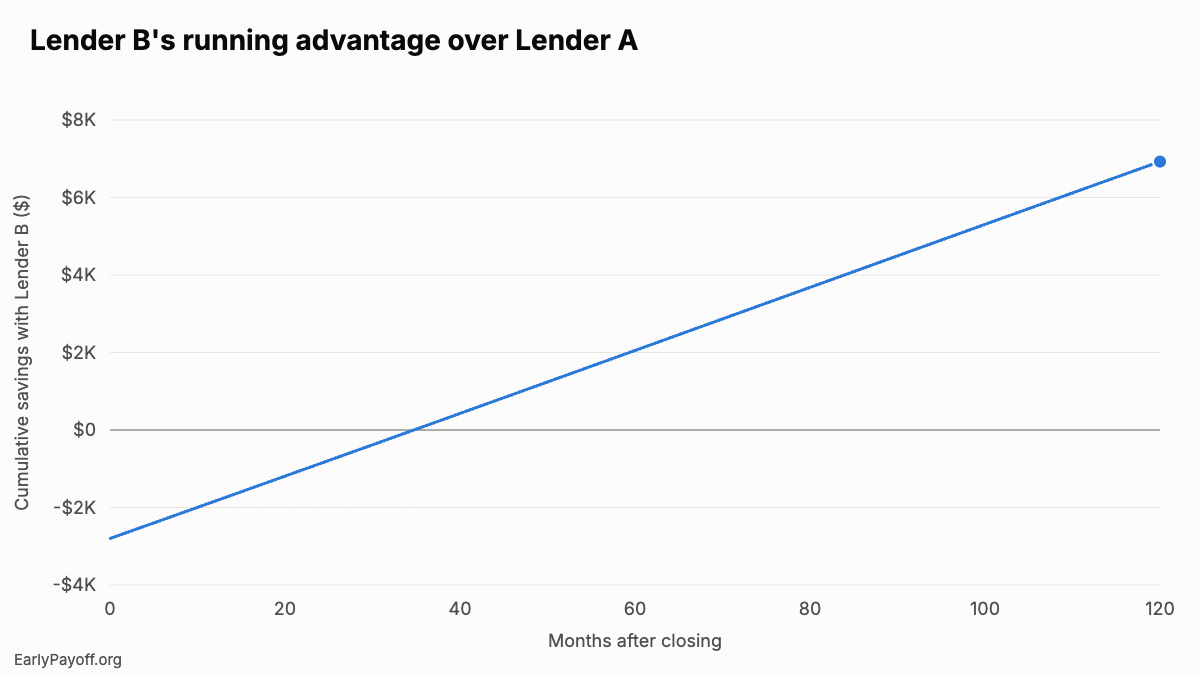
Lender B costs $2,800.00 more at closing and saves $65.32 a month. Dividing one by the other gives a break-even of 42.9 months. But the lower rate also pays down principal faster, so counting interest plus upfront lender charges, Lender B pulls ahead after 35 months. By month 60 it is ahead by $2,052.37, which matches the $2,052 gap in the two five-year costs on page 3. After 10 years, the lead grows to $6,926.36.
If you might sell or refinance within three years, Lender A is cheaper. If you expect to keep the loan longer, Lender B is. That’s why the five-year figure is more useful than the APR for most people: the APR assumes you keep the loan for all 30 years. For a refinance decision later, see when to refinance your mortgage.
A checklist for comparing offers
- Confirm the loan amount, term, product and loan type are identical on each estimate.
- Check each rate lock status and the expiration times on page 1.
- Compare Section A and the points each lender charges for its rate.
- Calculate the five-year cost from page 3 and, if you plan to stay longer, a 10-year cost.
- Ask about any yes answers in Loan Terms, and why taxes or insurance differ.
- Show your preferred lender the best competing estimate and ask it to match.
When the cheapest-looking estimate is not the best
- The rate isn’t locked. An attractive floating rate can disappear by the time you lock. Compare locked offers with locked offers.
- Points you may never earn back. Paying points only pays off if you keep the loan past the break-even. Job moves, growing families and rate drops often end loans early.
- Low fees paired with a higher rate. A “no closing cost” offer usually builds the cost into the rate. Check the five-year number.
- Low escrow estimates. A lender that underestimates taxes or insurance makes the monthly payment look smaller, but your real bills won’t change.
- A lender that can’t close on time. Switching late to save a small fee can cost you an extension fee or your purchase contract deadline.
FAQ
Does getting a Loan Estimate commit me to the lender?
No. You commit only when you tell the lender you intend to proceed. Until then, the lender may charge only a credit report fee, so you can collect several estimates.
How long is a Loan Estimate good for?
Page 1 shows the date and time the closing cost estimates expire. If you wait more than 10 business days to say you want to proceed, or longer if the lender allows, the lender can issue a revised estimate. An unlocked rate can change at any time.
Why is the APR higher than my interest rate?
The APR adds certain fees, such as origination charges and points, to the interest and spreads them over the loan term. Higher upfront fees widen the gap. In the example, Lender B’s APR is 7.263% on a 7.125% rate.
Can the lender raise my fees at closing?
Not lender fees, unless a valid reason triggered a revised estimate. Some third-party charges may rise up to 10% in total, and items like insurance and prepaid interest can change. Compare your Closing Disclosure with your latest Loan Estimate and ask about every increase.
Is a Loan Estimate the same as a preapproval?
No. A Loan Estimate describes the terms a lender is offering for a specific property and loan amount. It doesn’t mean the loan is approved; underwriting still has to verify your income, assets and the property.
Sources
- CFPB, What is a Loan Estimate?, accessed Oct 2026
- CFPB, Compare Loan Estimates, accessed Oct 2026
- eCFR, 12 CFR 1026.19, Certain mortgage and variable-rate transactions (timing, tolerances, revised estimates), accessed Oct 2026
- eCFR, 12 CFR 1026.37, Content of disclosures for certain mortgage transactions (Loan Estimate), accessed Oct 2026
- eCFR, 12 CFR 1026.2, Definitions (application), accessed Oct 2026
- CFPB, Revised Loan Estimate with a higher rate and closing costs: what it means, accessed Oct 2026
- Freddie Mac, Primary Mortgage Market Survey (30-year fixed average, week of Oct 15, 2026), accessed Oct 2026
Figures are as of October 2026. This article is general education, not individualized financial, tax or legal advice.