
A balance transfer card lets you move debt from one or more credit cards onto a new card that charges a low or 0% promotional rate for a set period, usually in exchange for a fee of a few percent of the amount you move. You save money only if you pay off most or all of the balance before the promotion ends. Whatever is left after that is charged the card’s regular rate, often called the go-to rate.
Key takeaways
- Transfer fees averaged 4.3% of the amount moved among the 25 largest card issuers in the second half of 2024, according to the CFPB.
- On $8,000 at 22.15%, a 4% fee is $320, about 2.2 months of interest on the old card. An 18-month 0% offer pays for that fee many times over if you use the time.
- Paying $462.23 a month clears the transferred balance in 18 months for $320.00 total, versus $1,726.86 in interest without a transfer. Paying $300 a month still saves $2,467.52, but leaves $2,920.00 at the regular rate when the promotion ends.
- New purchases on the transfer card usually lose their grace period, and a payment more than 60 days late can trigger a penalty rate on the whole balance.
How a balance transfer works, step by step
- You apply for a card with a transfer offer. The application triggers a hard inquiry. Your approved credit limit caps how much you can move, and the fee counts against that limit.
- You request the transfer. You give the new issuer the old account numbers and amounts. The new issuer pays the old card directly, and the amount plus the fee appears on your new card. Check whether the offer excludes balances from cards issued by the same company, and whether transfers must be made within a set number of days after the account opens to get the promotional rate.
- Keep paying the old card until the transfer posts. A transfer can take days or weeks. Missing a payment on the old card in the meantime can cost you a late fee and a late mark on your credit report.
- Pay down the new balance on a schedule. Divide the new balance, fee included, by the number of promotional months. That is the monthly payment that clears it before the go-to rate starts.
The four costs and terms to check
1. The transfer fee
Card companies are allowed to charge a balance transfer fee even on a 0% offer (CFPB, as of October 2026). The fee is generally a percentage of the amount moved, with a dollar minimum. Among the 25 largest issuers, the average fee was 4.3% of the transferred amount in the second half of 2024, with an average minimum of $5.51. That was up from 3.9% in 2022 (CFPB, December 2025 credit card market report). Some offers charge less, and a few charge nothing, so compare.
2. The length of the promotion
Under Regulation Z, a promotional rate must last at least six months, and before it starts the issuer must tell you in writing how long it lasts and what rate applies afterward (12 CFR 1026.55(b)(1)). Longer promotions give you more time, but many come with higher fees. Count the months from when the transfer posts, not from when you applied.
3. The go-to rate
When the promotion ends, any remaining transferred balance is charged the card’s regular purchase or transfer rate. The average rate on card accounts that were charged interest was 22.15% in the second quarter of 2026 (Federal Reserve G.19, released October 7, 2026). The go-to rate on your offer may be higher or lower, depending on your credit. It is printed in the rate table you get with the application.
4. Waived interest vs. deferred interest
A true 0% promotion waives interest: if a balance is left at the end, interest starts on that remaining amount from then on. A deferred-interest offer, usually worded as “no interest if paid in full” by a date, is different. Interest builds in the background from the start, and if any of the promotional balance is unpaid at the deadline, all of it is added at once. Read the terms to see which kind you have. For how deferred-interest payments must be applied near the deadline, see how to get out of credit card debt.
Worked example: $8,000 with and without a transfer
A household owes $8,000 on a card charging 22.15%, the Federal Reserve’s average for accounts charged interest. It is offered a card with 0% for 18 months and a 4% transfer fee. The fee is $320, so the new balance is $8,320. The fee and promotion are illustrative, and the example assumes the new card’s go-to rate is also 22.15%. No new charges are made.
| Scenario | Monthly payment | Months to pay off | Fee + interest | Saved by transferring |
|---|---|---|---|---|
| No transfer, 22.15% | $462.23 | 22 | $1,726.86 | — |
| Transfer, paid off within 18 months | $462.23 | 18 | $320.00 | $1,406.86 |
| No transfer, 22.15% | $300.00 | 38 | $3,116.20 | — |
| Transfer, $300 a month ($2,920.00 left at month 18) | $300.00 | 29 | $648.68 | $2,467.52 |
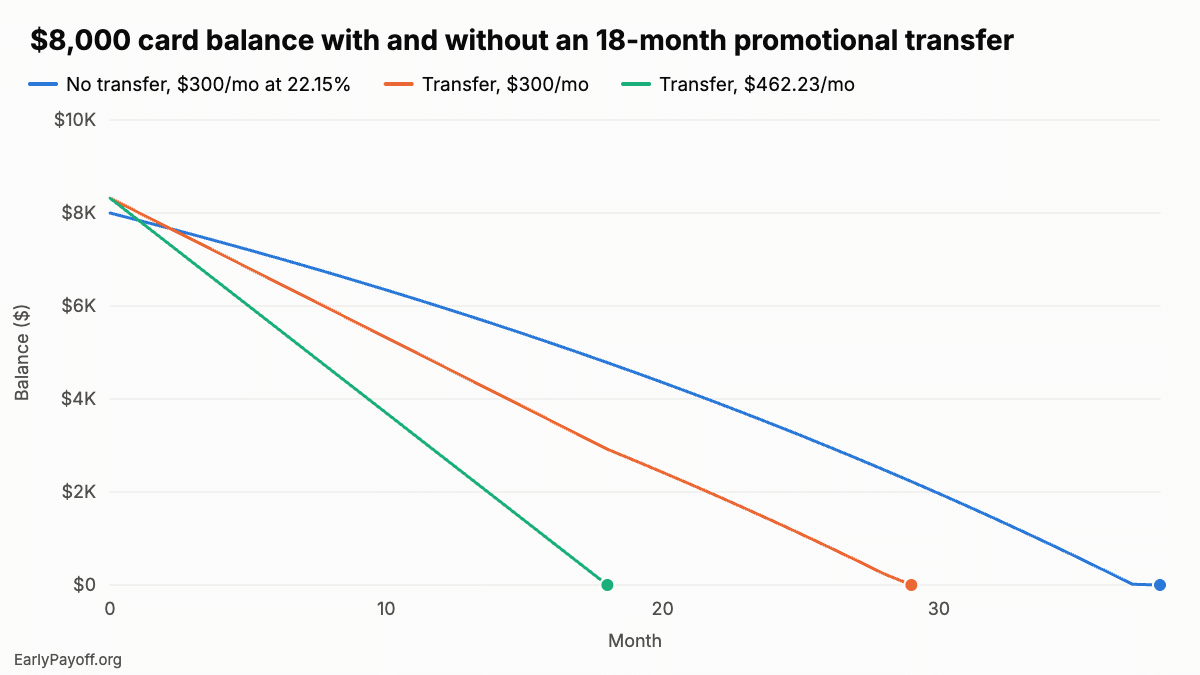
The first pair shows the fair comparison: the same $462.23 a month either way. On the old card it takes 22 months and $1,726.86 in interest. With the transfer, the balance is gone in 18 months and the only cost is the $320 fee, a saving of $1,406.86.
The second pair is the more common real-world result. At $300 a month, the household pays $5,400 during the promotion and still owes $2,920.00 when it ends. That balance then takes 11 more months at 22.15% and adds $328.68 in interest. Even so, the transfer saves $2,467.52 compared with staying put, because the bulk of the debt was paid down at 0%.
The deferred-interest trap would change that picture. If the same 18-month offer had deferred interest instead of waiving it, the $300-a-month household would owe about $1,917.08 in back interest at the deadline, using the same monthly interest method. That is why the difference between “0% APR” and “no interest if paid in full” matters.
Rules that can undo the savings
- New purchases lose the grace period. On most cards, if you carry a balance from month to month, new purchases are charged interest from the day you make them, even if the balance you carry is a 0% transfer (CFPB, as of October 2026). Use a different card or a debit card for spending.
- Payments go to the highest rate first, but only above the minimum. The issuer must apply any amount you pay above the minimum to the balance with the highest APR first (12 CFR 1026.53). If you do make purchases, extra payments will go to them before the 0% balance, which can leave more of the transfer unpaid at the deadline.
- A payment more than 60 days late can end the deal. The issuer may then raise the rate on existing balances, including the transferred one. It must lower the rate again after six consecutive on-time minimum payments (12 CFR 1026.55(b)(4)). Set up autopay for at least the minimum the day the account opens.
How a transfer affects your credit
Applying for the new card adds a hard inquiry. Most scoring models look at how recently and how often you apply for credit (CFPB, as of October 2026). The new account also lowers the average age of your accounts.
Utilization moves in two directions. Your total balance doesn’t change at first, and it even rises by the fee. But the new card’s limit adds to your total available credit, so overall utilization usually falls if you keep the old card open. The new card itself may look nearly maxed out if the transfer uses most of its limit. As you pay it down, both measures improve. Closing the old card removes its limit and pushes overall utilization back up. See how to improve your credit utilization.
When a balance transfer is a bad idea
- You will keep using the old card. If the old balance fills back up, you end up with two balances and a fee.
- The balance is small or nearly paid off. If you can clear it in two or three months, the fee may cost more than the interest you would save. In the example, the 4% fee equals about 2.2 months of interest.
- You can’t afford a payment that makes real progress. A transfer buys time, not a lower balance. If you need a lower payment for years, a fixed-rate loan with a set end date may suit you better. Compare the two in debt consolidation with a personal loan.
- You are applying for a mortgage or car loan soon. A new inquiry and account right before a big application can work against you. Do the transfer well ahead, or wait until after closing.
- The approved limit covers only part of the debt. Moving a slice of a balance still helps, but plan how you will handle the rest. Put your extra payments on whichever balance carries the highest rate.
FAQ
Is a balance transfer fee worth paying?
Usually, if you will pay off most of the balance during the promotion. Compare the fee with a few months of interest on your current card. In the example, the $320 fee equaled about 2.2 months of interest, and the 18-month promotion saved far more than that.
What happens to the balance when the 0% period ends?
With a true 0% offer, whatever is left starts accruing interest at the card’s regular rate from that point on. The issuer must have told you that rate before the promotion began. With a deferred-interest offer, the interest that built up during the promotion can be charged all at once.
Can I transfer a balance more than once?
You can apply for another transfer card when a promotion ends, but each move costs a new fee and a new hard inquiry, and approval isn’t guaranteed. Treat a second transfer as a backup plan, not the plan. Size your payments to finish within the first promotion.
Should I close my old card after the transfer?
Usually not. Keeping it open preserves your available credit, which helps utilization. If you don’t trust yourself with it, take it out of your wallet and remove it from online accounts. Close it only if it charges an annual fee you don’t want to pay.
Do I need good credit to get a balance transfer card?
It helps a lot. From 2015 through 2021, 78% of card accounts opened with an introductory promotional rate went to consumers with prime or higher credit scores (CFPB, December 2025 report). The issuer also sets your limit after approval. If you get a shorter promotion or a lower limit than you need, recalculate the payment before you transfer.
Sources
- CFPB, The Consumer Credit Card Market (December 2025), Section 7.4 Balance transfers, accessed Oct 2026
- CFPB, What is a balance transfer fee? Can a balance transfer fee be charged on a zero percent interest rate offer?, accessed Oct 2026
- CFPB, Do I pay interest on new purchases after I get a zero or low rate balance transfer?, accessed Oct 2026
- CFPB, What is a credit inquiry?, accessed Oct 2026
- 12 CFR 1026.55, Limitations on increasing annual percentage rates, fees, and charges, accessed Oct 2026
- 12 CFR 1026.53, Allocation of payments, accessed Oct 2026
- Federal Reserve, Consumer Credit – G.19 (Oct 7, 2026), accessed Oct 2026
This article is general education, not individualized financial, tax or legal advice.