
Biweekly mortgage payments work by splitting your monthly payment in half and paying that half every two weeks. A year has 52 weeks, so you make 26 half-payments, which equals 13 full payments instead of 12. That extra payment goes to principal, and the loan ends years early. But the savings depend entirely on what your servicer does with each half-payment when it arrives, and in some setups you save nothing at all.
This guide explains the three ways servicers handle biweekly money, how to tell which one you have, and how to get the same result for free.
Key takeaways
- On a new $350,000, 30-year loan at 7.40%, a loan that truly amortizes every two weeks saves $139,610.11 in interest. Adding $201.94 a month (1/12 of the payment) saves $135,023.89.
- If your servicer parks half-payments and uses the surplus to pay future installments ahead, you save $0.00. The money just sits there.
- “Twice a month” is not biweekly. Twenty-four half-payments equal exactly 12 full payments and change nothing.
- A paid program with fees like those in a 2015 CFPB order nets $8,218.24 less than doing it yourself in our example.
Where the savings come from
Biweekly payments have no special power. The interest rate is the same and the loan terms are the same. What changes is how much you pay each year: one extra monthly payment, or about 8.3% more. Every dollar of that extra goes to principal, so later interest is charged on a smaller balance.
A small part of the benefit can also come from timing. If each half-payment reduces your balance the day it arrives, interest is charged on a slightly lower balance between due dates. On most mortgages, though, interest is calculated monthly, so a half-payment sitting with the servicer for two weeks does nothing until it is applied. That is why the handling rules below matter more than the schedule itself.
Three ways a servicer can handle half-payments
1. A true biweekly loan
Some loans are written to amortize every 14 days from the start. Interest is charged for each two-week period, and each half-payment is applied immediately. This is the version most calculators assume. It is uncommon, because it has to be built into the note at closing. You can’t convert an existing monthly loan into one by changing how you pay.
2. Half-payments held, extra applied to principal
More often, a servicer that accepts biweekly money holds each half in a suspense or “unapplied funds” account. Federal rules allow this. Under Regulation Z, a servicer holding a partial payment must show the amount on your periodic statement. Once the account holds enough for a full payment, the servicer must credit it as a payment (12 CFR 1026.36(c), as of October 2026).
Under this setup, two halves become one monthly payment, and twice a year a third half arrives. Over a year, that surplus adds up to one extra full payment. If the servicer sends it to principal, you get most of the biweekly benefit, just later in the year.
3. Half-payments held, extra used to pay ahead
This is the trap. When a full extra payment builds up, some servicers treat it as next month’s installment paid early rather than as extra principal. Your account shows “paid ahead,” but the balance doesn’t drop any faster. Each installment is still applied on its own due date, so total interest is the same as paying monthly. In effect, you have lent the servicer money for free.
Your periodic statement tells you which version you have. Look for the unapplied funds line, the principal applied each month, and the next due date. If the due date keeps moving further into the future while principal falls only by the scheduled amount, your extra is being used to pay ahead.
Worked example: $350,000 at 7.40%
The example uses a new $350,000, 30-year fixed loan at 7.40%, the Freddie Mac weekly average for 30-year loans as of October 15, 2026. The monthly principal-and-interest payment is $2,423.33, so a half-payment is $1,211.67. With no extra payments, the loan charges $522,397.97 of interest over 360 months. Taxes and insurance are left out because they don’t affect payoff.
| Method | Paid per year | Payoff time | Total interest | Interest saved |
|---|---|---|---|---|
| Monthly, no extra | $29,079.96 | 30 yr 0 mo | $522,397.97 | — |
| Twice a month (24 half-payments) | $29,080.08 | 30 yr 0 mo | $522,397.97 | $0.00 |
| True biweekly loan (interest every 14 days) | $31,503.42 | about 23 yr 2 mo (605 payments) | $382,787.86 | $139,610.11 |
| Monthly plus 1/12 extra ($201.94) | $31,503.24 | 23 yr 5 mo | $387,374.08 | $135,023.89 |
| Halves held; extra sent to principal once a year | $31,503.42 | 23 yr 8 mo | $392,477.74 | $129,920.23 |
| Halves held; extra used to pay ahead | $31,503.42 | 30 yr 0 mo on the note | $522,397.97 | $0.00 |
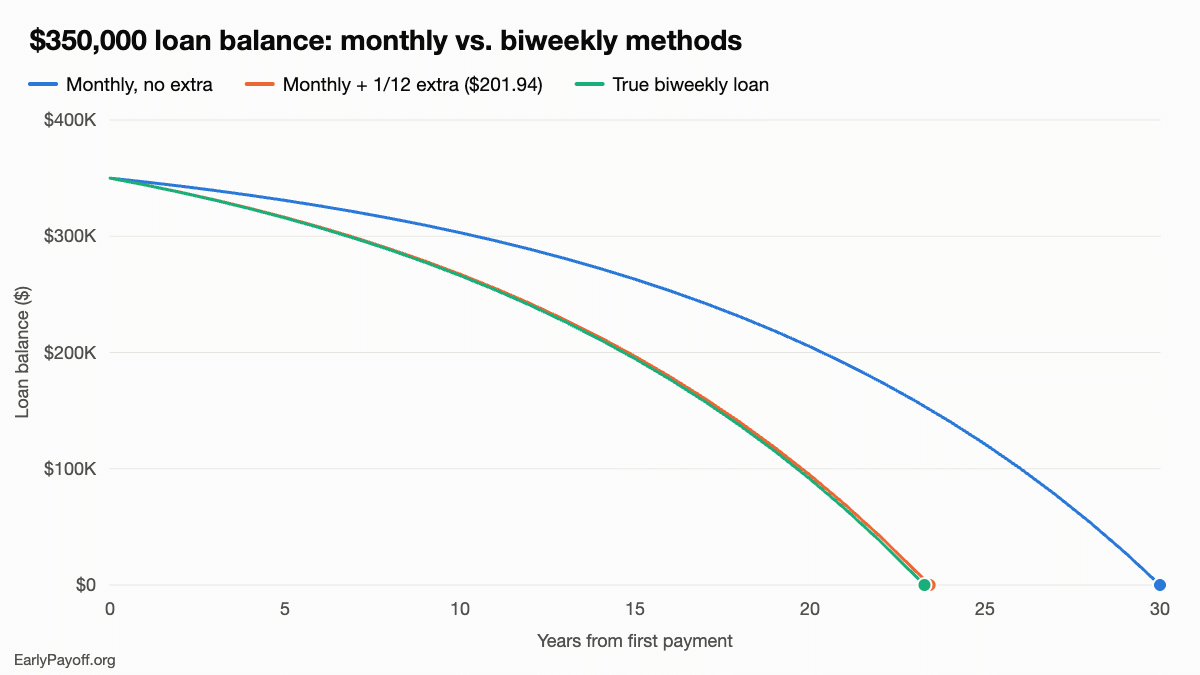
Three things stand out. First, the true biweekly loan and the 1/12 method are within $4,586.22 of each other over two decades, so the timing benefit of a true biweekly loan is real but small. Second, getting the extra payment once a year instead of spread across the year costs $5,103.66 compared with the 1/12 method. Third, the two “held” rows take exactly the same cash from you, yet one saves $129,920.23 and the other saves nothing. The difference is a single servicing decision.
After one year, the balance is $346,709.93 if you pay monthly and $344,202.75 with the 1/12 extra. That $2,507.18 gap looks small, but it compounds over the life of the loan. Our guide to reading an amortization schedule shows how each extra dollar shifts later payments from interest to principal.
Paid biweekly programs and what regulators found
Some companies sell biweekly plans that debit your bank account every two weeks and forward the money to your servicer. In a July 2015 consent order, the CFPB found that one large program charged a $295 enrollment fee and $2.50 per debit. The CFPB also found that the program held debited funds and sent them to the servicer once a month. It did not put the loan on a new payment schedule. Its advertising promised average interest savings of over $33,000, a claim the Bureau found unsupported. The company was ordered to set aside $33.4 million for refunds, and it neither admitted nor denied the findings.
To see what those fees cost, the example models a program that takes the $295 out of the first extra payment, charges $2.50 on each of 26 debits a year ($65.00) and applies the extra to principal once a year. It saves $128,644.40 in interest, but fees over 23 yr 9 mo total $1,838.75. Net savings are $126,805.65, which is $8,218.24 less than adding $201.94 a month on your own. A separate 2015 case with different fees is covered in our early mortgage payoff strategies.
Servicers that sell loans to Fannie Mae must accept biweekly payments made through a third-party payment company, as long as the payments arrive on time and in a sufficient amount (Fannie Mae Servicing Guide C-1.1-04, as of October 2026). Accepting the money doesn’t tell you how it is applied, so ask.
How to set up biweekly payments the right way
- Ask your servicer three questions in writing. Do you offer biweekly payments, and is there a fee? When does each half-payment reduce my principal? What happens to the surplus each year: is it applied to principal or to future installments?
- If the answers are vague, use the 1/12 method. Add 1/12 of your principal-and-interest payment to each monthly payment and mark it as additional principal. You get nearly the same result with no new enrollment.
- If you are paid every two weeks, use your extra paychecks. Two months a year bring a third paycheck. Sending half a payment as extra principal in each of those months matches the biweekly cash flow without any program.
- Check the first two statements. Principal should fall by the scheduled amount plus your extra. If it doesn’t, call the servicer and ask it to reapply the funds.
To test other extra amounts on your own balance, see how to calculate an early mortgage payoff.
When biweekly payments are a bad idea
- Your budget is monthly and tight. Two debits in some months and three in others can trigger overdrafts. A fixed monthly extra is easier to plan around.
- You have higher-rate debt or no emergency fund. An extra $2,423.33 a year toward a card charging 22.15% (Federal Reserve G.19, 2026 second quarter) beats a 7.40% mortgage. Money sent to the lender is hard to get back in an emergency.
- Your rate is low. If your mortgage rate is below what safe savings pay, the extra payment earns less than it could elsewhere.
- The plan charges fees or requires a contract. Anything you can do for free by adding to your monthly payment isn’t worth paying for.
- Your servicer pays ahead instead of reducing principal. In that case biweekly payments cost you flexibility and save nothing.
FAQ
Is paying on the 1st and 15th the same as biweekly?
No. Paying twice a month gives you 24 half-payments a year, which is exactly 12 full payments. Only a 14-day schedule produces the 26th half-payment that creates the extra principal.
Can I switch my existing loan to a true biweekly loan?
Generally not without refinancing, because the payment schedule is written into your note. In practice, the 1/12 method gets within a few thousand dollars of a true biweekly loan over the life of the loan, so refinancing just for the schedule rarely makes sense.
Will my statement show money in a suspense account?
It should. Servicers that hold partial payments must disclose the total in suspense or unapplied funds on your periodic statement. Seeing a half-payment there mid-month is normal under a held-funds setup.
Does a biweekly plan lower my monthly payment?
No. Your required payment stays the same; you just pay more per year and finish sooner. If you stop the plan, you go back to the regular monthly payment with a lower balance.
Are biweekly mortgage programs a scam?
Not all of them, but many charge for something you can do yourself for free, and regulators have challenged inflated savings claims. Ask about every fee and how the money is applied before you enroll.
Sources
- Freddie Mac, Primary Mortgage Market Survey (30-year fixed average, week of Oct 15, 2026), accessed Oct 2026
- eCFR, 12 CFR 1026.36, Prohibited acts or practices and certain requirements for credit secured by a dwelling (crediting of payments and partial payments), accessed Oct 2026
- CFPB, Consent Order, In the Matter of Paymap Inc. (July 2015), accessed Oct 2026
- Fannie Mae Servicing Guide, C-1.1-04: Accepting Biweekly Payments from Third-Party Payment Contractors, accessed Oct 2026
- Federal Reserve, Consumer Credit – G.19 (Oct 7, 2026), accessed Oct 2026
Figures are as of October 2026. This article is general education, not individualized financial, tax or legal advice.